




Halvor's Top Safety Exec Brings HR Perspective to Safety
Adam Lang, chief risk officer for Halvor Lines, started his career in human resources. What does that mean for the 2020 HDT Safety & Compliance award winner's role in heading up safety?
January 4, 2021

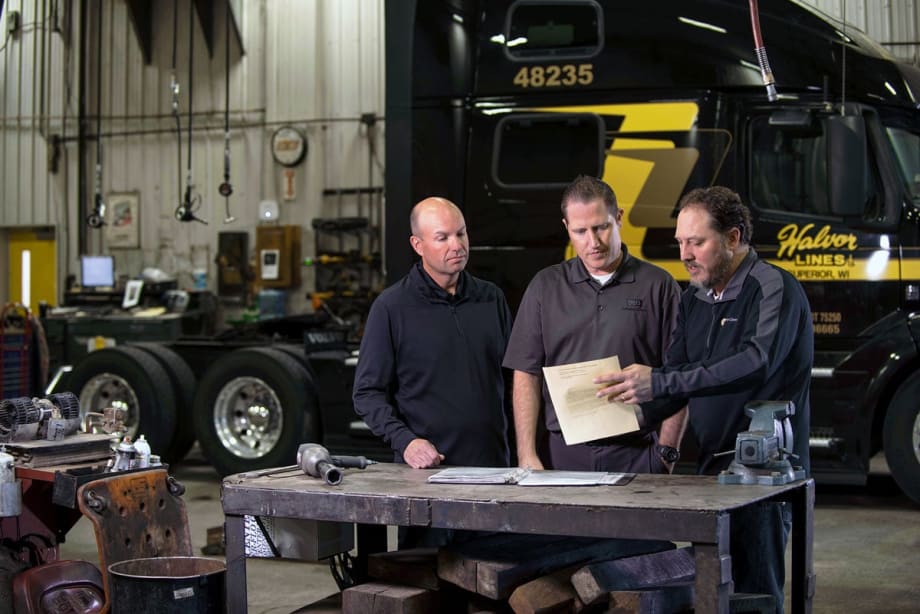
Adam Lang, right, with Halvor CEO Jon Vinje and insurance representative ChadHoppenjan from Cottingham and Butler, posing for a promotional photo for Halvor’sinsurance captive pre-COVID. Lang works with the shop on setting policies, safetytraining, and monthly safety walkthroughs.
Photo: Halvor Lines
6 min to read
Adam Lang originally wanted to pursue a career in medicine. But a change in heart saw him pursuing human resources instead. That eventually led him to the top safety role at Wisconsin-based truckload carrier Halvor Lines – and being named HDT’s 2020 Safety & Compliance award winner.
Lang, Halvor’s chief risk officer, accepted his award as part of the 2020 Fleet Safety Experience, a virtual version of the annual Fleet Safety Conference. He presented information on Halvor’s safety program and how his background in human resources helped him handle the challenges of driver training and safety during the COVID-19 pandemic.
Although his bachelor’s degree was in biology/chemistry, Lang decided he wasn’t interested in a medical career after all and found his way into the world of human resources, eventually getting an HR management certification. He joined Halvor Lines in 2012 as the director of human resources, and by 2014 he had become director of risk management and had earned his certified director of safety (CDS) certification. In 2016 he was promoted to chief risk officer.
“Moving to the trucking industry was quite a big change, but once I came into it, I found that I was a natural fit, and I absolutely love this industry,” he says.
Supporting Truck Drivers
Working with drivers is a key part of his job, Lang says, whether doing one-on-one coaching on the company’s in-cab camera system or answering questions about driver pay or speed limiters.
“After working in the industry for eight years, it’s really hard not to have an extremely high level of respect for what drivers do for our country,” Lang says. “It’s a difficult job and it’s a large sacrifice. I have the utmost respect for what our drivers do.
“Sometimes they just need a voice, someone to talk to them, someone to support them. And again, it’s a very difficult job and it can be a lonely place with your thoughts. So whenever a driver calls, we jump in ready to help whatever the problem is, no matter how big or small.”
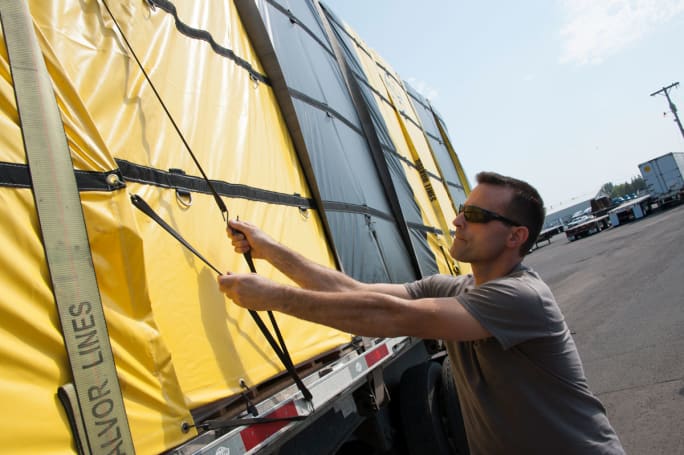
Lang’s human resources background comes into play in his involvement working with
drivers every day. Here a Halvor driver checks a flatbed load’s securement for safe transport.
Photo: Halvor Lines
The COVID-19 pandemic pushed Halvor to change its driver onboarding from a three-day on-site orientation to a one-day onboarding process using pre-recorded presentations from the various departments via CarriersEdge, plus remote training on topics such as driver fatigue, distracted driving, accident reporting, and a Smith System introduction.
Lang is in favor of federal proposals to allow younger drivers to work interstate.
“We have intrastate drivers that are under the age of 21, and had some success with it. I can think of at least seven drivers that have gone through our finishing program and hauled intrastate freight on dedicated routes until they were 21 years of age. Some of them are still with us.
“I think it’s dependent on the individual, because let’s face it, the older you are, the more life experience you’ve gathered. But there’s also younger folks out there that are mature beyond their years and might have had an agricultural background, operating heavy equipment and already have been taught some of the safety basics. Some of them have had military training, and have been put in way more dangerous situations than behind the wheel of a truck. That ought to be considered. So I am a firm believer that for the right individual that meets our hiring criteria, and displays the characteristics that we value, that it can be a worthwhile endeavor.”
Changing Regulations
Lang believes one of the best changes to come the trucking industry’s way recently is the crash preventability determination program. In May 2020, after a decade of trucking companies complaining that the government unfairly counted crashes against their safety record that were not their fault, the Federal Motor Carrier Safety Administration unveiled a permanent program that will not count crashes in which a motor carrier was not at fault when calculating the carrier’s safety measurement profile.

Adam Lang, chief risk officer for Halvor Lines.
Photo: Halvor Lines
While not every single unavoidable crash is covered in the program, he says, incidents such as animal damage or being hit from behind are easy to submit to the crash accountability system. Once the FMCSA deems the crash non-preventable, that improves the carrier’s crash indicator BASIC score in FMCSA’s Compliance, Safety, Accountability program.
“We have successfully removed 10 crashes or had them designated as non-preventable since the program’s inception, and we have a couple that are still pending review. We make liberal use of it,” he says.
The program also has helped in driver hiring. When pulling a PSP (Pre-Employment Screening Program) report, he explains, “You can see their inspection history for the last three years, and their crash history, whatever is considered a DOT recordable crash, for the last five years. Under the new program, if they have one of the crashes that was DOT reportable, but it was entered into the program as not preventable, that note comes up on their PSP also. So an employer can see they were involved in a DOT-reportable crash, but it will say whether or not it could be prevented.”
Another regulatory change that has come about in the past year that Lang supports is the federal Drug and Alcohol Clearinghouse. It requires companies to report any testing violations or refusals, so there’s a national database that employers are required to check when hiring. He is, however, concerned that some companies may not comply with the requirement, and may go undiscovered until they go through a safety compliance review or crash investigation.
“But I am very happy. Drug and alcohol issues are a large problem, and as a society need addressing, but we definitely don’t want folks in our trucks that are under the influence of any type of foreign substance.”
Technology Enhances Safety
When asked how the role of a safety manager has changed, Lang points to technology.
Halvor uses Netradyne in-cab cameras to monitor critical events such as hard braking, rolled stop signs, traffic light violations, following distance violations, and speeding violations. The system evaluates driving habits and assesses risk in real time and assigns drivers a GreenZone score. Drivers are regularly coached on their scores, with lower scores triggering more frequent coaching.
Drivers are assigned a tablet that functions as their electronic logging device, bill-of-lading scanner, and remote training portal. (Lang likens it to a Swiss Army knife.) Currently about 40% of Halvor’s company vehicles have crash mitigation systems, which has significantly reduced rear-end collisions.
And technology has changed a safety director’s day-to-day interactions, he says.
“We’re finding that technology knowledge, knowledge of information technology and different software systems, is imperative. You have to have a very strong background in using multiple different systems, and the ability to use them quickly, to learn quickly, and to adapt.
“Also, in this day and age, we utilize technology to the point that nobody can ever get lost, so to speak. Anyone can find anyone at any given time, whether it’s a big problem or a small problem. So today’s safety director is more on constant alert, because they’ll get phone calls at a moment’s notice. Versus maybe 10 years ago, someone was calling from a phone bank, after the fact of the accident.
“Technology is continuing to evolve. We have drivers enter incidents into their onboard ELD tablets, and take photos with them, and then send them through. When I first started here, there were still pen-and-paper accident reporting kits in the trucks. So we have changed that process pretty dramatically.”
Subscribe to Our Newsletter
More Safety & Compliance

FMCSA Pauses Biennial-Update Enforcement Amid Motus Transition
Carriers whose updates were due on or after June 1 have more time, while FMCSA works to stabilize its new registration system and warns of phishing sites impersonating its new carrier registration system, Motus.
Read More →
ZF Expands Commercial Vehicle Push in North America
ZF is expanding its North American commercial-vehicle presence with new transmission applications, electrification, trailer technology and autonomous-driving systems.
Read More →
Truck Drivers Need More Than Another Alert
Fleets have more visibility into truck health, safety events, and driver activity than ever. The next challenge is turning all that information into useful guidance for the person who has to decide what to do next.
Read More →
Tesla Wants a Self-Driving Semi. Are Cameras Enough?
Could Tesla’s camera-only autonomous driving technology work on an 80,000-pound Semi? In this commentary, HDT's Deborah Lockridge takes a look at Tesla, Cybercab, and how autonomous trucks see the road.
Read More →
What DOT’s Automated Vehicle Strategy Means for Trucking
The U.S. Department of Transportation issued a new automated-vehicle strategy that outlines plans for driverless-truck regulations, cross-state freight corridors, and federal safety standards.
Read More →
NYC Expands Speed, Pedestrian Safety Tech Across Fleet
New York City is expanding intelligent speed assistance and pedestrian-alert systems across its municipal fleet, moving the technologies from pilot programs into vehicle procurement and retrofit requirements.
Read More →
FMCSA Removes 110 Truck Driver Training Schools from Certified ELDT List
Federal regulators also are targeting more than 160 additional training providers and launching a nationwide audit of third-party CDL skills testers as part of a broader crackdown on trucking fraud.
Read More →
Beyond DOT Compliance: What Makes a Trucking Fleet Truly Safe?
A trucking fleet can follow every rule and still make unsafe decisions. The real test comes when safety conflicts with freight, productivity, or cost.
Read More →
Hours of Service Pilot Programs: FMCSA Readies for 2027 Rollout
Two pilot programs could eventually reshape hours-of-service rules, giving truck drivers options to pause their 14-hour clock or use longer split sleeper rest periods.
Read More →
New Guide Offers Pet Safety Tips for Truck Drivers
Hundreds of thousands of pets travel in truck cabs. A new safety guide from Volvo Trucks and the Center for Pet Safety offers practical advice for truck drivers who bring dogs and cats along for the ride.
Read More →