




Global News Roundup: Cummins, Westport Work on Hydrogen Engines
ICYMI: A roundup of global trucking news from Cummins, Westport, Volvo, BYD, Eaton and more.

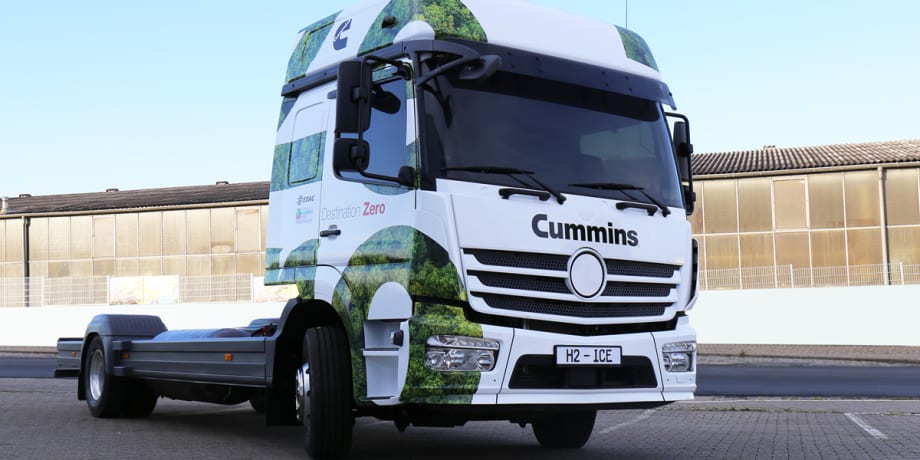
Cummins' medium-duty concept truck powered by the B6.7H hydrogen internal combustion engine.
Photo: Cummins
Both Cummins and Westport are developing internal-combustion engines fueled by hydrogen, with both companies showing off European demonstrations and concept trucks.
In a joint demonstration between Westport and Scania, early engine test results recorded a 51.5% peak in brake thermal efficiency, complemented by 48.7% at road load conditions, all with engine-out nitrogen oxides similar to the base diesel engine. Those numbers are compatible with Euro VII on-highway and EPA 2027 emissions standards.
The test used Westport’s hydrogen HPDI technology applied to a Scania 13L CBE1 engine platform.
“Hydrogen use in an internal combustion engine with our HPDI fuel system is an affordable pathway to employ a zero-carbon fuel using existing engine architecture and existing manufacturing infrastructure,” said Westport Fuel Systems CEO David Johnson in a press release.
Eric Olofsson, senior technical advisor at Scania, said the hydrogen HPDI concept requires limited redesign of the diesel cylinder head, and no redesign of the external gas exchange system, exhaust aftertreatment system or crank case ventilation system.
“This enables a short time to market with an excellent product associated with low investments and could be a complement to battery-electric vehicles, especially for long haulage and locations with limited electrical infrastructure,” Olofsson said.
Cummins showed off a medium-duty concept truck powered by the B6.7H hydrogen internal combustion engine (H2-ICE) at the IAA Transportation exhibition in Hanover, Germany, this fall.
The H2-ICE conversion highlights the opportunity for truck applications across the 10-to-26 ton gross vehicle weight range to operate on zero-carbon hydrogen fuel with a potential operating range of up to 500 kilometers (about 310 miles).
“While Cummins hydrogen fuel cells offer a highly effective solution for specific applications within the truck industry, our hydrogen engines can also help accelerate fleet decarbonization by offering a lower cost basis using more familiar engine technology,” said Alison Trueblood, executive director of Cummins’ on-highway business in Europe.
The Cummins H2-ICE project used a Mercedes-Benz Atego 4x2 truck, which is widely used for multi-drop distribution. Cummins said the hydrogen conversion work does not compromise truck performance, cargo capacity, or payload.
Cummins noted that the seamless substitution of the diesel engine with the 6.7L hydrogen engine and integration with the existing driveline highlights the ability of H2-ICE to offer a zero-carbon solution for fleets based on a lower cost and a more easily deployable technology path.
Proposed Euro 7 Emissions Rules Criticized as Too Severe
The European Commission, the executive body of the European Union, published its proposal for new pollutant emission standards for cars and trucks. Euro 7/VII would go into effect for trucks and buses starting in July 2027.
The proposed measures aim to bring down emissions from the tailpipe as well as from brakes and tires. The EC claims the new rules simplify the Euro 6/VI regulations they will replace. Euro VII will set limits for nitrous oxide emissions from heavy-duty vehicles for the first time. All vehicles, including electric, will need to comply with brake and tire emissions limits.
In 2035, the EC hopes that the new rules will lower total NOx emissions from trucks and buses by 56% compared to current rules. Tailpipe emissions will be reduced by 39% from trucks and buses.
The proposed rules have been greeted with criticism from the ACEA (European Automobile Manufacturers’ Association), which complained that the standards for heavy vehicles in particular are too severe. Martin Lundstedt, CEO of the Volvo Group and chairman of the ACEA’s Commercial Vehicle Board, warned that over-stringent measures would mean more R&D expenditure on diesel engines and therefore less on electric powertrain technologies.
News Briefs from Around the World
Electric trucks for Amazon: Volvo Trucks will deliver 20 fully electric heavy-duty trucks to Amazon in Germany by year end.
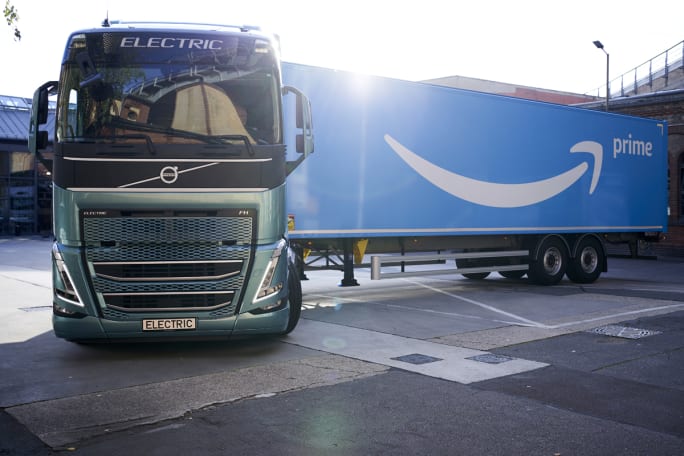
Volvo Trucks will deliver 20 fully electric heavy-duty trucks to Amazon in Germany by year end.
Photo: Volvo
BYD enters European market: BYD Europe BV of Schiedam, Netherlands, the European subsidiary of Shenzhen, China-based BYD Auto Co Ltd, used the IAA Transportation event in Hanover, Germany, to launch two electric trucks, marking its entry into the European e-truck market.
4-Speed Transmission: Eaton debuted an electrified 4-speed transmission for medium- and heavy-duty vehicles for the European market. The gearbox offers flexible gear ratios, improved system efficiency, longer vehicle range and battery life, increased acceleration and grade capability compared with previous generations, according to the company. It’s intended to meet growing demand in several segments, including port drayage, regional and line haul, and vocational applications.
Autonomous trucks in China: Trucks equipped with Inceptio Technology’s Level 3 autonomous “Xuanyuan” system have exceeded 10 million kilometers (about 6.2 million miles) of commercial operation in China.

Trucks equipped with Inceptio Technology’s Level 3 autonomous system have exceeded 10 million kilometers (about 6.2 million miles) of commercial operation in China.
Photo: Inceptio
This news was published in the November/December 2022 issue of Heavy Duty Trucking, produced in partnership with UK-based Truck & Bus Builder. Click here for a free trial subscription to T&BB.
More Fuel Smarts

How Volvo Updated Its D13 for EPA 2027 [Watch]
Volvo’s updated D13 promises lower emissions without sacrificing performance or fuel economy. Take a closer look at what changed inside the engine in this HDT Spotlight video.
Read More →
Diesel Price Spike Shortens Payback for Natural Gas Trucks, Report Says
Energy Vision estimates fleets could recover the higher purchase price of an RNG-fueled Class 8 tractor in 1.3 to 2.8 years under current fuel-price scenarios.
Read More →
Calstart Becomes Catalyst Mobility, Reflecting Broader Focus
Calstart is now Catalyst Mobility, reflecting the nonprofit’s growing national role in clean transportation, including zero-emission trucks, infrastructure and incentive programs.
Read More →

Record Diesel Prices Squeeze Trucking Fleets
Average U.S. diesel prices have climbed to nearly $6 a gallon, surpassing the 2022 record as tight refinery capacity and Middle East disruptions keep fuel costs elevated.
Read More →
How Fuel Delivery Shapes Engine Performance
Fuel delivery depends on more than what happens at the injector. For fleet, maintenance and technical professionals, looking at the full path from pump to injector can provide useful context for understanding engine performance.
Read More →
East Coast Port Launches $45M Electric Truck Push
The Port Authority of New York and New Jersey announced millions in incentives for zero-emission drayage trucks, yard tractors, and new charging hubs near the port.
Read More →
California Bill Could Shed Light on Electric Truck Prices
Why do battery-electric Class 8 trucks remain so expensive? A California bill headed to Gov. Gavin Newsom would give fleets and state agencies more visibility into what manufacturers charge.
Read More →
Detroit Opens Orders for EPA 2027 Engines
Detroit isn’t starting from scratch to meet EPA 2027 diesel emissions standards. Its Gen 6 DD13 and DD15 engines keep much of today’s platform while updating the fuel and aftertreatment systems.
Read More →
Zero-Emission Truck Corridor Planned for West Coast
California, Oregon, Washington, British Columbia and Baja California are coordinating plans for truck charging and hydrogen fueling from Canada to Mexico.
Read More →
A Closer Look at Kenworth’s Electric T880E Vocational Truck [Video]
Learn more about Kenworth's T880E battery-electric vocational truck at the Paccar Technical Center, including its range, applications, upfitting considerations, and PTO options, in this HDT Spotlight video.
Read More →