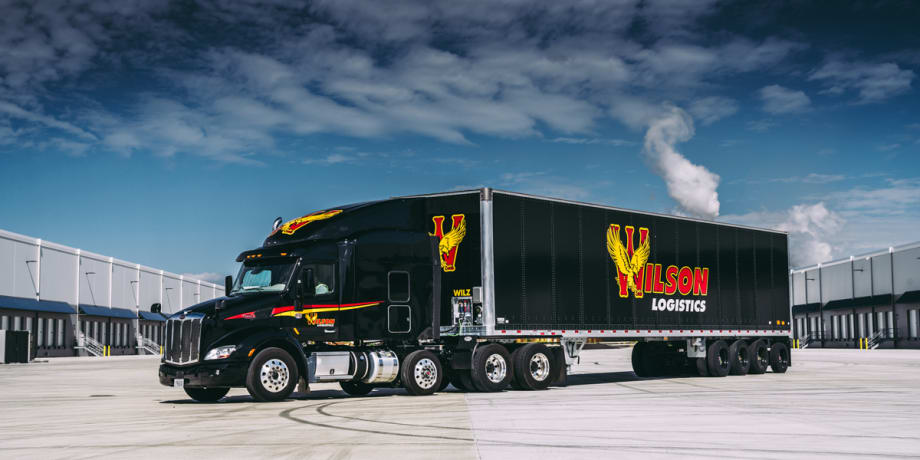
A lot of axles means a lot of tires to manage, and smart tire systems can help.
Photo: Wilson Logistics
8 min to read
Tires have traditionally been exceedingly difficult to manage. That began to change over a decade ago, as the first tire sensors began giving fleets and drivers rudimentary data on tire pressure (and later temperatures). Then active pressure management systems that could transmit real-time alerts when a pressure event occurred were developed.
Ad Loading...
A further extension of this technology was automated tire inflation systems. These didn’t just monitor tire pressure, but also could actively inflate tires in case of a leak.
The use of smart-tire systems in fleets, however, has its own challenges.
Ad Loading...
These systems and the tire sensors that make them possible must work in a confoundingly difficult environment, enduring hellish temperatures inside tires, all sorts of weather on the outside, as well as dirt, grit, grime, vibration and impact damage. They can be damaged or even lost during tire service.
And with up to 18 tires (or more) on a tractor-trailer, it doesn’t take long for the amount of data coming from tire sensors to become overwhelming if it’s not sliced and diced in ways that allow fleets to cull actionable data from general health and status updates.
Still, the insights into tire health and performance these systems provide have been game-changers for many fleets. Learning to manage them, and dealing effectively with the data they send, is critical for getting true value from them.
Understanding the Pain Points
Tires are, of course, the largest pure maintenance expense at fleets, says Gerry Mead, executive vice president of maintenance and equipment at The Hub Group, based in Oak Brook, Illinois.
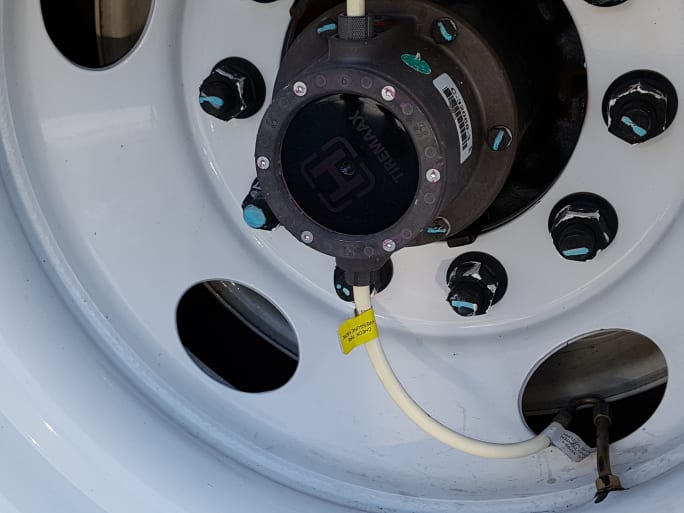
“The biggest pain point I see with collecting data off of tires is ensuring that the correct sensor is assigned to the correct wheel position,” Mead says. “It is the same for internal-mounted or wheel-end-mounted sensors. Getting them in the right place so you receive the right data is vital.”
Ad Loading...
Tire sensors can be a pain when it comes to mounting and dismounting tires, says Bruce Stockton, vice president of fleet services for Wilson Logistics in Springfield, Missouri.
“If the sensors would last as long as a tire, the mounting and dismounting burdens would be worth it,” he says. “The style of sensors that band around the inside of the wheel are particularly cumbersome and often damaged when anyone other than our own guys are mounting and dismounting. Our tires don’t go flat when at our own shops, only on the road. Then when the road service guys don’t know how to address it or don’t have parts, we end up having to break it down again when it gets home.”
Shaun Sadler, senior vice president of equipment for U.S. Xpress, says he faces similar problems when the vehicle is serviced at a dealership or independent repair shop for a tire failure. When this happens, he says, it’s highly unlikely that the sensor will be replaced — or even returned to the fleet.
“The reality is that most dealers and even manufacturers aren’t focusing on this issue enough to help us out much,” he says.
U.S. Xpress uses tire sensors without TPMS or ATIS. Sadler says that although the data from them are invaluable, they do increase the overall cost of service for mounts and dismounts.
Ad Loading...
For some fleets, automatic tire inflation systems offer more peace of mind than data alone.
Photo: Jim Park
Stockton would like to see an OEM-installed system that would simply alert the driver in the cab when there’s a low tire and in which position. “The main point would be a reliable and dependable system — meaning that it is accurate with its readings and pinpoints which wheel position is the issue,” he says.
Reading the tractor tires is one thing, he says. Trailers present other challenges. “While getting better, reading the trailer tires wirelessly is more difficult, especially when multiple trailers are usually stacked in like sardines, making a wireless TPMS read to a different tractor all the time nearly impossible,” he says.
Dealing With Data
What data, and how much, fleets want to get from their smart tire systems is something that is different for each fleet. And that is a big factor in what type of system is right for your operations.
Sadler, for instance, primarily wants to see air pressure, heat, tread performance, and irregular tread wear. That’s why he prefers sensors mounted in the tires over those in valve stems or on the wheel, even though they have drawbacks in terms of maintenance and replacement. Wheel sensors and valve stem sensors, he says, can only provide air pressure and, for wheel-mounted sensors, possibly heat.
Mead says he’s more concerned with proper air pressure, then how many 32nds of tread loss per mile the tires are averaging. Temperature is the least important piece of data to him.
Ad Loading...
“To have this by position is vital, as each position is under unique pressures,” he notes. “Just like any sensor or incoming data stream, you want the ability to filter it down to ‘actionable data’ only.”
One challenge, Mead says, is there can be two separate but related alerts that essentially are only notifications when they occur alone. But when both happen at the same time, they mean something entirely different.
“If the system cannot be customized and controlled, then it is not helpful and will lead to data overload,” he says.
Stockton says one key piece of data he wants to see is final runout mileage, so total cost of ownership can be measured. “But data overload is a major problem with these systems and one that has to be managed. In fact, I recently eliminated a factory-installed TPMS system on our trucks because there was no validated ROI on the system,” he says.
“Really, all you need is the basic tire information, anyway,” Sadler says. “I want to see a simple mounting date, as well as mileage, and then at the end of the tire’s life, a removal mileage number and date to determine which tire performs at specs the best. And we really don’t need a smart wheel or tire to determine that data.”
Ad Loading...
TPMS or ATIS?
Everybody has their own preferences when it comes to tire sensors, says Jarit Cornelius, director of maintenance for Christenson Transportation, a smaller fleet with locations in Missouri and Tennessee.
“I don’t need a portal or a bunch of electronic information coming in telling which tire is low, or hot or flat,” he says. “The truth is we’re just too small — I just don’t have the staff and the capability to manage all of that information effectively. We tried it out. And at the end of the day, we just had some cool technology on our trucks that we really couldn’t do anything with.”
However, Cornelius knew he needed to find a system that would work for his operation. In early 2012 he found the answer.
“When I put in my trailer order that year, I decided to try out [automatic tire inflation systems] on a certain percentage of the units,” he says. “My plan was to track them and benchmark tire cost and wear compared to the units without ATIS on them.”
When the test ended a year later, Cornelius crunched the numbers and found that the tire cost on the ATIS-equipped units was over 90% less than the baseline trailers. “The tread wear was uniform without any irregular wear,” he says. “They only had about 3/32 of tread wear, total — and the casings were all in good shape.”
Ad Loading...
Acting on that data, he retrofitted the remaining trailers in the fleet with ATIS.
One big advantage Cornelius cites with ATIS is peace of mind for drivers. “We get guys call in with a flat tire that went down overnight,” he says. “And the first thing we do is ask them to try and air it back up. We’ll walk them through the process. And in about 10 minutes, nine times out of 10 the tire is aired up to the point they can drive it to a local vendor. We can get that tire repaired and back on the road for under $100, instead of waiting hours for a service call that costs a lot more money.”
Cornelius says ATIS gives a return on investment is around 14 to 16 months, but the units last about 10 years in the field. And, he says, in several instances, the tread on his tires is in such good shape that the casings give out before the tires reach their pull point.
A growing number of fleets are using both TPMS and ATIS, so they can get both that peace of mind and data they can use for insights.
North-Carolina based tanker fleet Eagle Transport, for instance, has both on about 60% of its fleet.
Ad Loading...
“We can identify problems before they become a catastrophic event,” says Joe Phillips, Eagle’s director of maintenance, noting that the systems bring different benefits to the fleet’s tire management program.
“ATIS can help if you’re on the road to get it to back to the shop,” he says. “TPMS is how we track tire life at all times.”
Eagle is now looking to expand its tire management program with additional technology, such as management software integration. “We’re also looking at vibration sensors, because the wheel end has the ability to collect a lot of valuable data,” he says. “And we want to collect as much data on our tires as possible.”
No fleet is the same, of course, which is why suppliers have developed a range of tire management solutions for trucking. But it is important to remember that management is the key word that makes each of these systems successful for fleets.
Smart Tires for Autonomous Trucks
Smart tires will play a role in the ability to deploy driverless trucks. Both Bridgestone and Goodyear have teamed up with autonomous-tech companies to test smart-tire technology.
Smart-tire tech such as tire-mounted sensors and tire pressure monitoring systems will give autonomous-truck companies real-time insights on the performance of the tires on their trucks.
For example, smart tire technologies can collect data and track if weight is evenly distributed among the truck wheels and axles. Weight distribution plays a critical role in vehicle dynamics, controllability and maneuverability, and thus safety and vehicle performance.
Predictive maintenance is also key, helping self-driving trucks to deliver on their promise of near 24/7 operations, and tire data makes that possible. Tire-mounted sensors help avoid a fault before it happens.
The data from the trucks will also help the tire makers to build more accurate predictive maintenance models and optimize future tires for these operations.
For the autonomous-truck companies, feedback from connected tires can be fed into their machine-learning systems to improve fuel economy and overall performance, especially in severe weather and extreme road conditions.
This article first appeared in the May 2022 issue of Heavy Duty Trucking.
Volvo’s updated D13 promises lower emissions without sacrificing performance or fuel economy. Take a closer look at what changed inside the engine in this HDT Spotlight video.
The Michelin X Multi Energy D2 is a regional haul drive tire engineered to help fleets improve fuel efficiency, durability and traction in demanding stop-and-go operations.
ZF is expanding its North American commercial-vehicle presence with new transmission applications, electrification, trailer technology and autonomous-driving systems.
Could Tesla’s camera-only autonomous driving technology work on an 80,000-pound Semi? In this commentary, HDT's Deborah Lockridge takes a look at Tesla, Cybercab, and how autonomous trucks see the road.
The U.S. Department of Transportation issued a new automated-vehicle strategy that outlines plans for driverless-truck regulations, cross-state freight corridors, and federal safety standards.
The Port Authority of New York and New Jersey announced millions in incentives for zero-emission drayage trucks, yard tractors, and new charging hubs near the port.
The National Highway Traffic Safety Administration says it lacks authority to regulate medium- and heavy-duty truck engines separately from complete vehicles, but the existing standards have not yet been eliminated.
Detroit isn’t starting from scratch to meet EPA 2027 diesel emissions standards. Its Gen 6 DD13 and DD15 engines keep much of today’s platform while updating the fuel and aftertreatment systems.