




Listen: HDT Talks Trucking Podcast onTruck Safety's Most Wanted
Fleets: Focus on Drivers for Safety
Hiring the right drivers, supporting them with technology, and keeping them healthy are three winning strategies when it comes to operating a safe fleet. Those were some of the observations from seven panelists participating in two discussions on "What’s Working" at the Federal Motor Carrier Safety Administration’s Truck Safety Summit held Aug. 5.
by James Menzies, Todays Trucking
August 5, 2020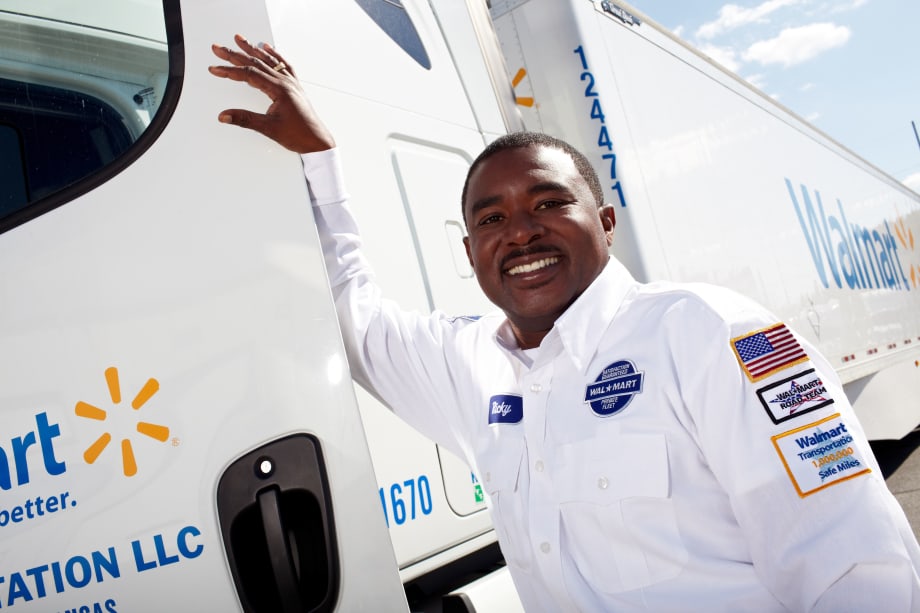
Drivers are key to safety, according to fleets on an FMCSA safety panel.
Photo: Walmart
6 min to read
Hiring the right drivers, supporting them with technology, making sure they're drug-free and keeping them healthy are key winning strategies for operating a safe trucking fleet. Those were some of the observations from seven panelists participating in two discussions on "What’s Working" at the Federal Motor Carrier Safety Administration’s Truck Safety Summit held Aug. 5.
“The number one safety feature in that truck is the guy behind the wheel,” said Steve Fields, a driver with YRC Worldwide. He said his company’s safety journey began with training drivers on the Smith System for Defensive Driving.
Ingrid Brown, an owner-operator running Rollin’ B LLC, agreed that fleets need to focus on driver training and not just technology.
“I am my technology,” she said. “I never want to become lazy or complacent to the point where I hear a bell or whistle go off, because then it’s almost too late.”
When it comes to training, it’s not necessary to reinvent the wheel, according to Dave Edmonson, vice-president of safety and compliance with J&M Tank Lines.
“We tend to plagiarize a lot,” he said of the company’s safety programs, noting it takes what works for other companies and modifies as necessary. One key, he added, is to empower drivers to make decisions. The company adopted an "all-stop" policy that allows drivers to pause any delivery at any time and talk through a situation with dispatch and management before proceeding.
“They’re welcome to do that any time of the day or night,” said Edmonson. “Each driver in orientation gets my cell number, and I tell them I’d rather talk through a situation at 2 a.m. than get a call at 2:15 saying something bad has happened.”
While Knight-Swift Transportation may be the largest carrier in North America, senior vice president of safety and risk management Brett Sant emphasized the need to keep training individualized.
“To think collectively is not useful,” he said. “You have to create individual ownership and accountability. We try to keep things small. We really need people who are connected.”
At J&M, training techniques are always evolving. It began offering online training on fundamentals such as regulations before new hires even begin their in-person orientation, allowing more face-to-face time to be spent hands-on with equipment. That has been crucial to keeping the hiring process moving during the COVID-19 pandemic, noted Edmonson. The company also now has trainers shadow new hires in a separate truck, rather than sharing a cab.
“The trainee gets their hands on multiple loads per day versus only seeing one or two loads per day,” he reasoned.
Technological Support
While driver training is paramount, most fleets taking part in the discussion also agreed technology is an invaluable tool to support those drivers. YRC Worldwide, for instance, has deployed forward-facing in-cab cameras, but Fields said the company took a driver-to-driver approach to coaching to ensure buy-in.
“They seem a little bit more relaxed,” said Fields, when drivers are coached on events by another driver. “You’re not being called out on the carpet by your boss."
Collision mitigation systems, for the panelists whose companies have used them, have effectively driven down collisions and the severity of the crashes that do occur. Thomas DiSalvi, vice president of driver training and compliance with Schneider National, said it implemented collision mitigation systems eight years ago to address rear-end technologies. In the first three years, it reduced its rear-end collision frequency by 68% and the severity of those incidents by 95%.
“If it’s not eliminating the crash, it’s mitigating the impact of it,” he said.
Dean Newell, vice president of safety and training with Maverick, had similar success. His fleet has driven down rear-end collisions to just three incidents in each of 2018 and 2019, and so far this year – zero.
“I think it’s a no-brainer,” he said of the technology.
Werner Enterprises cut its accident frequency in half, and drove the severity down “tremendously,” according to Jaime Maus, vice president of safety and compliance. “It’s there to assist the driver,” she stressed. “Driver behavior is still key.”
Newell said he’d like to see such equipment become standard on new trucks, even if it requires intervention from government to push that.
Testing for Drug Use
Several of the fleets participating in the discussion have transitioned to hair testing for drug use and would like to see the method more widely adopted across the industry.
“It was insane when we saw the difference,” said Werner’s Maus, noting the positive rate was about 10 times greater when using hair testing compared to urinalysis. In addition, the positive results were most frequently for cocaine, amphetamines and opioids when using hair testing. “Marijuana wasn’t even in that top tier,” Maus added.
Maverick’s Newell expressed concern that since beginning pre-employment hair testing in August 2012, his company has seen 324 failed tests while only 18 of those drivers failed a urine test given at the same time.
Schneider National is also a proponent of hair testing, which it has employed since 2008.
“We really believed urine-based testing was underreporting what we felt drug use was in reality,” said DiSalvi. “Through hair testing, we have tested over 100,000 pre-employment applicants.”
Schneider has found a 4-4.5% positive rate using hair testing, a huge increase from its 0.4% positive rate using urinalysis.
“You’re really missing those chronic drug users when relying on urine tests,” he said, noting the company has since expanded hair testing to randomly conducted drug tests.
Committing to hair testing means accepting higher failure rates, added Sant. Swift adopted hair testing in January 2018 after merging with Knight, which was already using the method.
“We did that knowing fully well we were going to have a lot more empty trucks,” Sant admitted. “It takes discipline to do the things we know will lead to safer outcomes, even if it means parking trucks along the fence.”
Addressing Sleep Apnea in Drivers
In addition to addressing drug use, fleets can improve safety by helping drivers get diagnosed and treated for obstructive sleep apnea. Schneider has been a leader in this area, and DiSalvi said it came from eliminating the barriers drivers faced when getting tested.
Some of those barriers keeping drivers from getting tested were downtime, lost earnings, the cost, and concerns about losing their jobs. Schneider partnered with a third-party provider to conduct testing while drivers were on the road, and by covering all costs through their benefits program.
“We partnered with a company that established a network of clinics, such that we could test and treat drivers at risk for sleep apnea while on the road under a load so they didn’t have to wait, or lose income while getting tested,” DiSalvi said.
Schneider saw a reduction in crashes and an increase in driver retention after implementing the program.
Newell drew upon his personal experience with sleep apnea to get Maverick drivers on-board, and offers on-site testing. Driver compliance with treatment is monitored.
Maus agreed there was a time when drivers felt stigmatized when suffering from sleep apnea, but that is changing thanks to increased awareness.
“For a long time within the trucking industry sleep apnea was like a stain on your record – you were worried you were hurting your career going forward,” she said. “But there are programs where within 24 hours someone can be diagnosed and treated, so the driver perception of obstructive sleep apnea has improved because companies are bringing this topic to light.”
“Someone who is treated for sleep apnea is much safer and healthier, and that makes for a much safer fleet,” added DiSalvi.
James Menzies is the editor of Today's Trucking, where this article originally appeared. This content was used with permission from Newcom Media as part of a cooperative editorial agreement.
Subscribe to Our Newsletter
More Safety & Compliance

FMCSA Pauses Biennial-Update Enforcement Amid Motus Transition
Carriers whose updates were due on or after June 1 have more time, while FMCSA works to stabilize its new registration system and warns of phishing sites impersonating its new carrier registration system, Motus.
Read More →
ZF Expands Commercial Vehicle Push in North America
ZF is expanding its North American commercial-vehicle presence with new transmission applications, electrification, trailer technology and autonomous-driving systems.
Read More →
Truck Drivers Need More Than Another Alert
Fleets have more visibility into truck health, safety events, and driver activity than ever. The next challenge is turning all that information into useful guidance for the person who has to decide what to do next.
Read More →
Tesla Wants a Self-Driving Semi. Are Cameras Enough?
Could Tesla’s camera-only autonomous driving technology work on an 80,000-pound Semi? In this commentary, HDT's Deborah Lockridge takes a look at Tesla, Cybercab, and how autonomous trucks see the road.
Read More →
What DOT’s Automated Vehicle Strategy Means for Trucking
The U.S. Department of Transportation issued a new automated-vehicle strategy that outlines plans for driverless-truck regulations, cross-state freight corridors, and federal safety standards.
Read More →
NYC Expands Speed, Pedestrian Safety Tech Across Fleet
New York City is expanding intelligent speed assistance and pedestrian-alert systems across its municipal fleet, moving the technologies from pilot programs into vehicle procurement and retrofit requirements.
Read More →
FMCSA Removes 110 Truck Driver Training Schools from Certified ELDT List
Federal regulators also are targeting more than 160 additional training providers and launching a nationwide audit of third-party CDL skills testers as part of a broader crackdown on trucking fraud.
Read More →
Beyond DOT Compliance: What Makes a Trucking Fleet Truly Safe?
A trucking fleet can follow every rule and still make unsafe decisions. The real test comes when safety conflicts with freight, productivity, or cost.
Read More →
Hours of Service Pilot Programs: FMCSA Readies for 2027 Rollout
Two pilot programs could eventually reshape hours-of-service rules, giving truck drivers options to pause their 14-hour clock or use longer split sleeper rest periods.
Read More →
New Guide Offers Pet Safety Tips for Truck Drivers
Hundreds of thousands of pets travel in truck cabs. A new safety guide from Volvo Trucks and the Center for Pet Safety offers practical advice for truck drivers who bring dogs and cats along for the ride.
Read More →