




EPA 2027 and Beyond: How Will New Low-NOx Rules Affect Fleets?
The transition to zero-emission trucks is going to be messy and difficult, and EPA’s low-NOx rules, coming in 2027, are not making things any easier. In this article, we break down how the trucking industry is facing it all.
March 16, 2023


Regulators have set aggressive reduction targets for NOx, a byproduct of high-temperature combustion of fossil fuels. NOx is responsible for the brown haze often seen over big cities, especially during the summer.
unknown nodePhoto: Jim Park
unknown node12 min to read
The trucking industry is approaching a fork in the road. Within the next 12 to 18 months, fleets looking to place orders for new trucks or fleet renewals will have to decide whether to look at some form of propulsion other than diesel or take a chance on diesel trucks equipped with new emissions-reduction technologies.
New NOx (Nitrogen Oxides) reduction mandates from the Environmental Protection Agency, published late last year, kick in effectively in 2026 with the model-year 2027 heavy-duty trucks. With order boards at truck makers currently close to full and a healthy backlog of unfulfilled orders, lead times are getting close to two years in some cases.
Fleets that plan to order trucks in 2024 could face the prospect of getting a model-year 2027 truck equipped with new NOx-fighting hardware, including cylinder deactivation, close-coupled multi-stream dual aftertreatment systems (two selective catalytic reduction converters), and possibly heated diesel exhaust fluid (DEF) dosers.
We are not dismissing these and other technologies that offer a pathway to reducing NOx emissions by more than 80%. The OEMs believe they are good solutions. The problem is, they are running out of time for adequate durability and reliability testing. These systems are complex, and they must be warranted for periods up to 435,000 miles — nearly four times longer than current EPA-imposed warranty requirements.
That’s a pretty tall order for the OEMs. And it’s asking a lot of fleets that remember only too well the problems we ran into in 2007 when we added diesel particulate filters to engines and cranked up exhaust gas recirculation rates. The short development and testing times for the technology imposed at the time cost the industry billions in repairs and downtime.
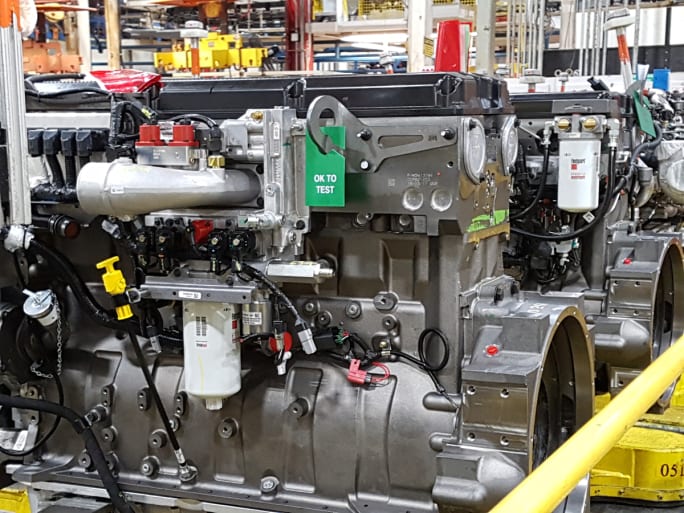
Truck and engine makers have expressed deep concerns about the development timelines for MY 2027-compliant engines.
unknown nodePhoto: Jim Park
unknown node“I think the 2007 and 2010 transitions are instructive,” says Patrick Couch, senior vice president of technical services and partner at clean transportation and energy consultants GNA (Gladstein, Neandross & Associates). “Those first-generation engines with SCR had a lot of problems. It took the engine manufacturers a couple of years to sort them out. That cost the engine OEMs, but it also cost the fleets who couldn’t rely on the new vehicles they were purchasing.”
Maintenance consultant Bruce Stockton of Stockton Solutions remembers that period well, and he doesn’t want to see a repeat performance.
“I have reviewed the new emission regulations, and while not surprised at EPA’s aggressive approach, I think the regulations themselves and the corresponding timeline for implementation are unrealistic,” he says. “I don’t think they provide enough lab and/or field-testing time to prove the new technology.”
Cost and Complexity of Reducing Truck Emissions
There’s very broad agreement that these new rules are going to be costly and difficult to comply with, starting with the hardware required to make the 82.5% step down in NOx emissions from 2 milligrams to .035 mg.
Comments submitted when EPA first proposed this rule last year had references to cost increases from $25,000 to as much as $35,000. Thorough analysis of the final rule, however, has analysts agreeing the upfronts will be somewhat less.
“More recent thinking — because the EPA has pared things back [from the proposed rule] — has everyone settling more in the $20,000 to $25,000 range on the national level,” says Tim Denoyer, vice president and senior analyst at ACT Research.
Denoyer says about $5,000 will be direct equipment costs, such as the additional SCR system and the cylinder deactivation hardware. There are also some re-engineering costs. He warns that the biggest piece of the cost increase will come from the increased useful life and warranty provisions in the regulations.
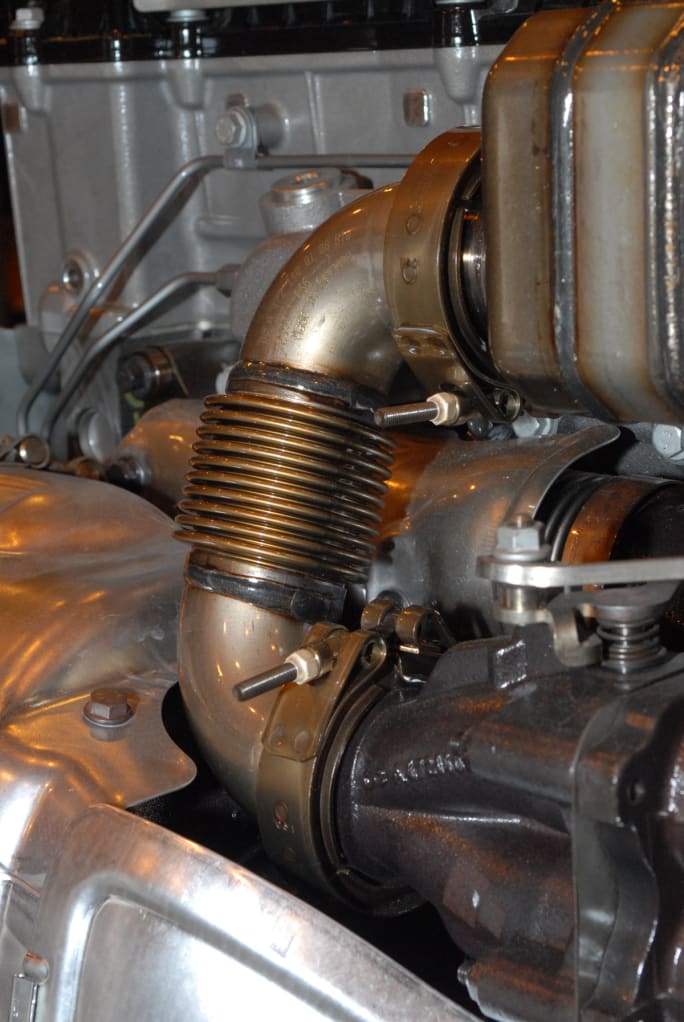
The rush to put compliant engines on the street in 2007 left the industry with a legacy of failed components and downtime from which some fleets never recovered.
unknown nodePhoto: Jim Park
unknown node“Having a long warranty on the emission system will be a benefit for the purchasers, but that's going to go into the upfront price of the truck,” he explains.
Denoyer also believes the dual-dosing SCR function will mean buying more diesel exhaust fluid.
“DEF consumption is going to go up, probably quite a bit, but roughly double,” he says.
How Will the Trucking Industry Realistically Reach EPA NOx Reduction Mandates?
We don’t yet know the exact path forward, as the OEMs haven’t yet opened up about their strategies. But the leading contenders are cylinder deactivation and dual-dosing SCR systems.
Cylinder deactivation is used to help maintain higher temperatures within the aftertreatment system, which improves its NOx conversion efficiency. Dual-dosing SCR systems essentially treat the emissions twice, once on the way into the SCR and again on the way out.
In various comments to last year’s proposed rule, references were made regarding the need to keep the SCR system as close as possible to the engine to minimize thermal losses through the exhaust tube running from the turbocharger to the inlet of the aftertreatment system.
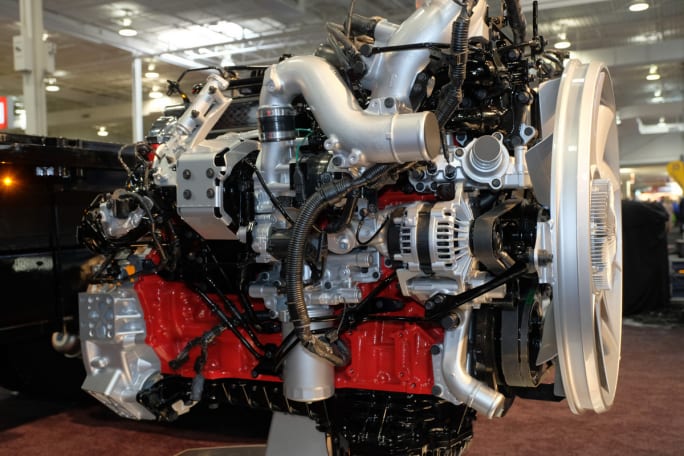
Previous less stringent emissions standards left some manufacturers unable to deliver compliant engines, forcing their withdrawal from the market.
unknown nodePhoto: Jim Park
unknown nodeThis, according to some commenters, could require some re-engineering of the engine bay. It also could be a pinch point for certain chassis configurations where space doesn’t currently exist for such systems.
There were also references in the comments to the challenge of making this work with numerous ratings within an engine family.
EPA, however, did scale the final rule back a bit from its original proposal, which could offer engine makers a little more latitude.
“There were several technical changes to the final rule from the original proposal that make for a very tough standard, but one that — speaking strictly for DTNA — we believe is achievable across various chassis configurations,” says Sean Waters, DTNA's VP of compliance and regulatory affairs. “We have extensive experience meeting previous standards and a greater understanding of the technology that will allow us to meet these tough, enforceable standards for NOx reduction.”
Navistar officials also acknowledged the new rules are complex, but that it’s confident its new S13 Integrated Powertrain will be up to the challenge.
“Any new regulation will challenge the best manufacturer to develop a cost-effective and durable product for their customers,” says Jacqueline Gelb, Navistar’s VP of government relations. “We work cooperatively with all our stakeholders to develop products that not only meet the standard, but also exceed customer expectations for performance, reliability and safety.”
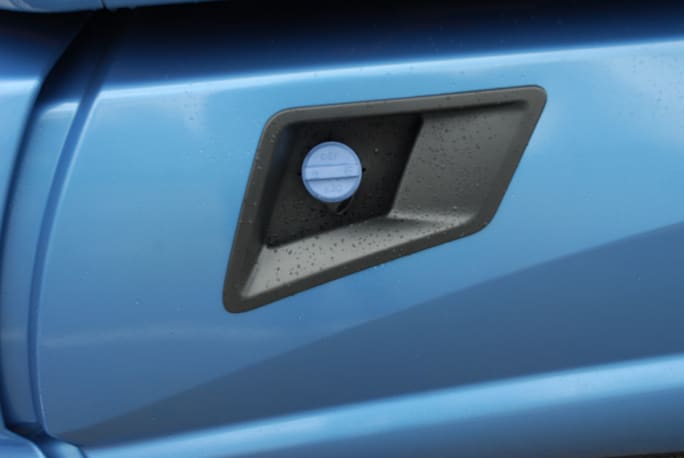
Analysts say measures to double-dose the SCR will double fleets’ DEF consumption.
unknown nodePhoto: Jim Park
unknown nodeIf the OEMs seem confident in their ability to meet the rule, sentiment in the trenches looks a bit different.
Stockton says he has done some analysis on the final rule and has conferred with his suppliers on the issue. He doesn’t sound quite so confident.
“I’m not sure this is achievable without using some kind of a hybrid solution, possibly diesel-electric or diesel-hydrogen,” he says. “The OEMs I've spoken with tell me they don't yet know which technologies or combination of technologies will be required to meet the new regulations. My sources tell me that there’s no way to meet the new regulations using diesel-powered engines alone.”
Hybrid technology is not out of the question at this point, but emissions credits could also provide engine makers with the breathing room they need to achieve the 0.35 mg standard by 2027.
That leaves one wondering if compliance is even possible with divine intervention.
Banking Emissions Credits
GNA’s Couch thinks emissions credits will be key to compliance.
“I think you’re correct that most of the engine manufacturers don’t believe that diesel engines can meet what we call the direct standard in 2027,” he says. “The direct standard is the 35 mg standard you would have to comply with without credits. But EPA has built into this rule the ability to generate credits for NOx, which can be used to certify engines above the direct standard from 2027 through 2034.”
In the near term, he expects a number of diesel engine manufacturers will begin certifying their engines below the current 200 mg standard but not as clean as the 0.035 mg direct standard by 2027. That, he says, will enable them to bank a certain number of credits over the next few years.
“They may also employ a few other mechanisms to generate credits,” he says. “That will allow them to not suddenly have to stop selling diesel engines in 2027, but also be able to extend the sales life of those engines and hopefully provide enough time for the market to get to the point where we are actually able to bridge the gap and transition to zero-emission or some other substantially cleaner combustion solutions.”
Diesel Alternatives Are Scarce
Substantially cleaner solutions, at this point, are few and far between.
EPA’s low-NOx regulation is intended to push diesel fleets toward electrification, but at this early stage of that push, electrification isn’t a viable option for most fleets. Range remains an issue, but the biggest stumbling block, presently, is the charging infrastructure.
“Overwhelmingly, infrastructure is slowing us down in terms of EV deployment,” DTNA President and CEO John O’Leary said. “Site prep, permitting, and construction delays all contribute to deployment times being measured in years, not weeks or months.”
Speaking to a group of trucking journalists in Las Vegas ahead of the unveiling of the company’s SuperTruck II project, O’Leary said customers are having to shelve expansion plans for their BEV fleets because of the lack of charging infrastructure.
“There’s a lot of will in the regulatory and political arenas to make that happen, but when you start talking about moving large megawatt lines of electricity around and building new substations, it just takes time,” he said.
So, if electrification isn’t a realistic option right now, what is? Hydrogen faces at least as long an uptake period as battery-electric, likely longer.
Which leaves natural gas.
“I think natural gas right now is sort of the incumbent alternative,” says GNA's Couch, noting that engines for Class 7 and 8 in long-haul, vocational and transit applications are already certified at or below the 2027 standard.
“They seem to be the natural go-to engine, and we may actually see engine manufacturers promoting the sale of the low-NOx natural gas engines in the near term as a way to not only prepare fleets for pending transition, but also to build a credit bank so that they have options post-2027," he says."
Couch is also watching Hyliion’s Hypertruck ERX natural gas-powered range-extender electric truck.
“That’s an interesting platform and, depending on how it gets certified the under the rule, it could also generate substantial additional credits [for the OEM]," he says.
Natural gas may not be a popular alternative at the moment, but impressions could change when Cummins brings its X15N 15-liter natural gas engine to market in 2024.
Puneet Jhawar, the general manager of Cummins’ global natural gas business, told HDT last summer that interest in the new 15L engine from existing customers — as well as those who had never considered natural gas — surged following the announcement of the new engine.
Is a Truck PreBuy on the Horizon?
The 800-pound gorilla in this discussion, of course, is fleets’ fear of the unknown, coupled with the memory of what happened in 2006-2007. Stockton believes that means a major pre-buy.
“In addition to a pre-buy over the next 36 months, it’s also inevitable that we’ll see a ‘no-buy’ starting in January 2026,” he asserts. “The upside to that is spare parts will no longer be in short supply. The OEMs and parts providers will be in over-supply mode with truck production down significantly.”
Indeed, the obstacles to a smooth transition are piling up. EPA’s 2027 low-NOx mandate will be challenging enough, but the California Air Resources Board could add an additional NOx reduction requirement in 2024.
“The national pre-buy that we're expecting is really likely to pick up mid-year 2025 and go through 2026, ahead of the 2027 standards,” says ACT’s Denoyer. “On top of that, California is planning on going ahead with its low-NOX regulations for 2024. There are still some question marks in the industry about if and how that's going to happen. If it does, I think there could be some pre-buying in California this year.”
According to GNA’s Couch, the CARB rule is more stringent than the EPA rule. It has a 0.02 gram (2 mg) standard in 2027, whereas the EPA rule is 0.035 mg.
“CARB also has an interim milestone, and they have some additional useful life requirements in the heavy-duty engine group,” he says. “So, yes, there are some significant differences between the two rules."
Couch adds: "The CARB rule would allow for manufacturers to achieve a 50-state compliant engine by certifying their entire national diesel engine fleet to a higher standard than what’s called for in the ’24 to ’26 model-year period under the current rule."
A significant pre-buy is the last thing the truck and engine makers want. Both Daimler and Navistar told HDT they expect minimal disruption.
“The Clean Truck Plan was drafted in a manner that should significantly reduce the magnitude of any regulatory pre-buy,” DTNA's Waters says. “However, it is hard to have a definitive idea of the full impacts until EPA proposes and then finalizes GHG Phase 3.”
Navistar’s Gelb says the company is collaborating with dealers, customers and suppliers early in the regulatory process to ensure technology solutions that are being developed for the market align with customers’ business needs.
“Through this partnership, Navistar believes that any technology introduced will be market-accepted and minimize any pre-buy/no-buy in 2026,” she says.
We have barely mentioned GHG Phase 3, which would apply to model-year 2027 and later trucks. It would require truck and engine makers to lower GHG emissions by essentially improving fuel efficiency. GHG reductions can be good for fleets in that they bring down fuel consumption, but they may worry that the cost of achieving those improvements will outweigh the fuel savings.
Advance Planning: Trade Cycles and Acquisition Plans
There are a few upsides to a nationwide pre-buy. It creates temporary over-capacity, which has a destabilizing effect on capacity and rates. It forces manufacturers to double up on production, which can lead to declines in the quality of the finished product. Post-prebuy, manufacturers are often forced to lay off workers, and that has a ripple effect all the way along the supply chain.
“The biggest concern I have for the trucking industry is adding a lot of capacity in a pre-buy is just inherently bad for rates and hurts truckers’ profitability,” ACT’s Denoyer says. “But over the longer term, from a five- or 10-year perspective, I think the higher cost base for the industry, and the increased complexity, is going to actually help pricing power for fleets and help them to raise rates. And ultimately, I think it’s going to be a positive.”
He says now is the time to start thinking about trade cycles and future acquisition plans. We know from experience how costly extended trade cycles can be. Do you deal equipment now that’s due for trade in 2025-2026, or hang on to it and ride out the storm? Smaller fleets that rely primarily on used trucks may be the least affected by a pre-buy, but that will certainly drive up the cost of secondhand equipment.
“We're in a truly generational transition time,” GNA's Couch says. “The transition to zero-emission is going to happen. It is going to be difficult and messy. And it's not going to happen on the timelines that people would like or project.
“My message for fleets is to really pay attention to what's going on here. Try to dig into how your fleet would look under a zero-emission operation and start using this time to get ready for when you have to do what you have to do. Don't wait ‘til the last minute to try to comply.”
This article appeared as the cover story of the March 2023 issue of Heavy Duty Trucking magazine.
Subscribe to Our Newsletter
More Fuel Smarts

How Volvo Updated Its D13 for EPA 2027 [Watch]
Volvo’s updated D13 promises lower emissions without sacrificing performance or fuel economy. Take a closer look at what changed inside the engine in this HDT Spotlight video.
Read More →
Diesel Price Spike Shortens Payback for Natural Gas Trucks, Report Says
Energy Vision estimates fleets could recover the higher purchase price of an RNG-fueled Class 8 tractor in 1.3 to 2.8 years under current fuel-price scenarios.
Read More →
Calstart Becomes Catalyst Mobility, Reflecting Broader Focus
Calstart is now Catalyst Mobility, reflecting the nonprofit’s growing national role in clean transportation, including zero-emission trucks, infrastructure and incentive programs.
Read More →

Record Diesel Prices Squeeze Trucking Fleets
Average U.S. diesel prices have climbed to nearly $6 a gallon, surpassing the 2022 record as tight refinery capacity and Middle East disruptions keep fuel costs elevated.
Read More →
Sponsored•September 9, 2026
How Fuel Delivery Shapes Engine Performance
Fuel delivery depends on more than what happens at the injector. For fleet, maintenance and technical professionals, looking at the full path from pump to injector can provide useful context for understanding engine performance.
Read More →
East Coast Port Launches $45M Electric Truck Push
The Port Authority of New York and New Jersey announced millions in incentives for zero-emission drayage trucks, yard tractors, and new charging hubs near the port.
Read More →
California Bill Could Shed Light on Electric Truck Prices
Why do battery-electric Class 8 trucks remain so expensive? A California bill headed to Gov. Gavin Newsom would give fleets and state agencies more visibility into what manufacturers charge.
Read More →
Detroit Opens Orders for EPA 2027 Engines
Detroit isn’t starting from scratch to meet EPA 2027 diesel emissions standards. Its Gen 6 DD13 and DD15 engines keep much of today’s platform while updating the fuel and aftertreatment systems.
Read More →
Zero-Emission Truck Corridor Planned for West Coast
California, Oregon, Washington, British Columbia and Baja California are coordinating plans for truck charging and hydrogen fueling from Canada to Mexico.
Read More →
A Closer Look at Kenworth’s Electric T880E Vocational Truck [Video]
Learn more about Kenworth's T880E battery-electric vocational truck at the Paccar Technical Center, including its range, applications, upfitting considerations, and PTO options, in this HDT Spotlight video.
Read More →