




Engine Smarts: New directions in aftertreatment
You may not know that Navistar owns a subsidiary company called PurePower Technologies, formed last year, which has just announced the purchase of the Eaton Corporation's aftertreatment business. And it says the solid-ammonia dosing technology developed by a small Danish compan
You may not know that Navistar owns a subsidiary company called
PurePower Technologies, formed last year, which has just announced the purchase of the Eaton Corporation's aftertreatment business. And it says the solid-ammonia dosing technology developed by a small Danish company
-- in which Navistar invested two years back -- is the aftertreatment answer for the future.
If I have the somewhat complicated history right, PurePower results from a series of partnerships and joint ventures that go way back to 1999 when Navistar and Siemens got together to make fuel injectors. A few years later Navistar and Holley, better known for carburetor manufacturing, collaborated to develop intake throttle valves and actuators.
In 2009 Navistar bought Continental AG's American injector business (you thought they only made tires?) and invested in Amminex, the Danish start-up firm with an interesting product called AdAmmine. That's the ammonia storage system that uses a solid "brick" of ammonia to reduce NOx emissions in an engine's exhaust stream. Call it selective catalytic reduction, or SCR, without the liquid urea. A small brick of AdAmmine contains the equivalent of 75 liters (16 U.S. gallons) of ammonia gas. Interesting stuff.
Anyway, last year Navistar bought Holley's actuator and valve business, along with a foundry, and PurePower was formed. It is firmly in the diesel aftertreatment business, addressing hydrocarbon and soot reduction by way of diesel oxidation catalysts and diesel particulate filters. Additional products include a variation on the Danish NOx-reduction catalyst.
And now the company has acquired Eaton's aftertreatment technology along with a development lab and testing facility.
"Like fuel and air systems, diesel aftertreatment is a core technology necessary for the future success and profitability of the world's businesses that rely on diesel-powered commercial vehicles," says PurePower President Houman Kashanipour. "Further, the catalyst development capability gained through the Eaton aftertreatment technology acquisition will uniquely position PurePower in meeting customer aftertreatment needs."
The company will apparently bring the Danish technology to market. That NOx gas reduction system stores ammonia in a stable, rechargeable cartridge that has unlimited shelf life, will not deposit solids in the system, is tamper-resistant, and won't freeze. Taking a sizeable but quiet shot at the competition, Kashanipour says their aftertreatment answer requires less maintenance and packaging space than aqueous-urea SCR systems. Packaging is also said to be much more compact.
The technology minimizes NOx emissions and particulate matter in compliance with all current global diesel emissions standards, the company claims, including EPA 2010 and Euro emissions standards for on-highway vehicles and through Tier IV, final stage for off-road equipment.
Based in Columbia, S.C., PurePower operates a research and development center there, a manufacturing plant nearby, and metal-casting foundries in Wisconsin and Indiana. With the Eaton deal, it now also operates a research and development facility in California.
You will have as many questions as I do here, like when will this solid-ammonia technology hit the ground? Does this constitute the foundation of Navistar's future emissions strategy?
I have no answers yet but will pursue those questions and more.
More Equipment

ZF Expands Commercial Vehicle Push in North America
ZF is expanding its North American commercial-vehicle presence with new transmission applications, electrification, trailer technology and autonomous-driving systems.
Read More →
Tesla Wants a Self-Driving Semi. Are Cameras Enough?
Could Tesla’s camera-only autonomous driving technology work on an 80,000-pound Semi? In this commentary, HDT's Deborah Lockridge takes a look at Tesla, Cybercab, and how autonomous trucks see the road.
Read More →
Kodiak: Driverless Long-Haul Truck Launch on Track for 2026
Kodiak AI says its driverless long-haul safety case is 93% complete and it remains on track to begin commercial operations by year-end 2026.
Read More →
What DOT’s Automated Vehicle Strategy Means for Trucking
The U.S. Department of Transportation issued a new automated-vehicle strategy that outlines plans for driverless-truck regulations, cross-state freight corridors, and federal safety standards.
Read More →
East Coast Port Launches $45M Electric Truck Push
The Port Authority of New York and New Jersey announced millions in incentives for zero-emission drayage trucks, yard tractors, and new charging hubs near the port.
Read More →
PlusAI Going Public to Fund Autonomous Truck Launch
A SPAC deal could provide PlusAI with up to $300 million as it works toward a 2027 commercial launch of factory-built autonomous trucks.
Read More →
NHTSA Moves to Rewrite Truck Fuel-Economy Rules
The National Highway Traffic Safety Administration says it lacks authority to regulate medium- and heavy-duty truck engines separately from complete vehicles, but the existing standards have not yet been eliminated.
Read More →
Detroit Opens Orders for EPA 2027 Engines
Detroit isn’t starting from scratch to meet EPA 2027 diesel emissions standards. Its Gen 6 DD13 and DD15 engines keep much of today’s platform while updating the fuel and aftertreatment systems.
Read More →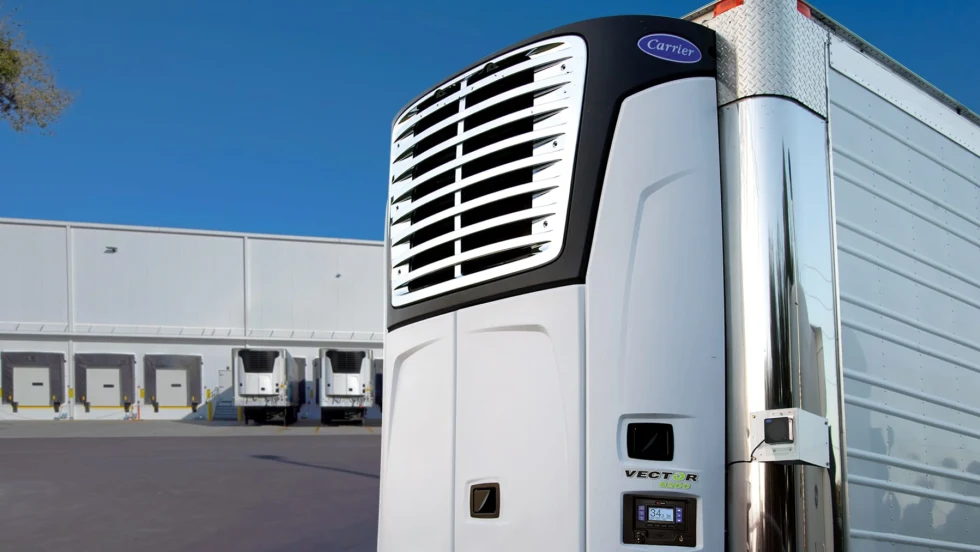
Carrier Transicold Adds All-Electric TRU for Stationary Cold Storage
Carrier Transicold’s new Vector 8200 all-electric transport refrigeration unit gives fleets a diesel-free option for temporary refrigerated and frozen trailer storage.
Read More →
A Closer Look at Kenworth’s Electric T880E Vocational Truck [Video]
Learn more about Kenworth's T880E battery-electric vocational truck at the Paccar Technical Center, including its range, applications, upfitting considerations, and PTO options, in this HDT Spotlight video.
Read More →