




Engine Smarts: A Game-Changer Engine?
You'll be hearing a lot about the 'OPOC' engine in the next little while, and maybe for a long time to come.
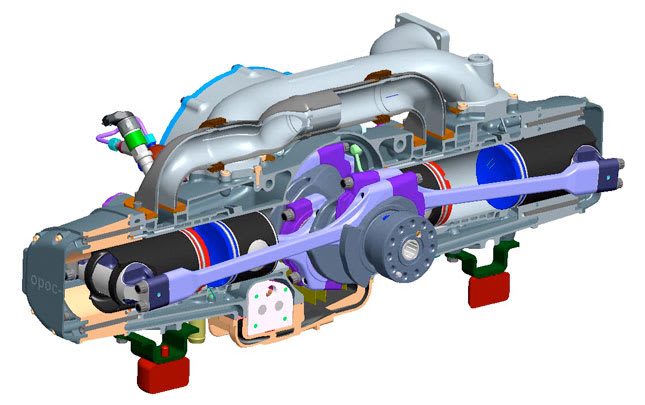
You'll be hearing a lot about the 'OPOC' engine in the next little while, and maybe for a long time to come.
Not least because Navistar International announced, during an online press conference this week, a development agreement with Michigan-based EcoMotors International to help bring the latter company's Opposed-Piston/Opposed-Cylinder engine to market. The first product targeted for commercial applications is a turbo-diesel version, but it can actually run on pretty much any fuel except charcoal briquettes by the sound of it. Including gasoline, natural gas, ethanol, even hydrogen.
Wiping exaggerations aside, it really does sound like it could potentially be the game-changer it's made out to be. Mighty promising at the very least. Promising enough to have Bill Gates of Microsoft fame as one of two key investors, the other being Khosla Ventures' Vinod Khosla, EcoMotors' primary backer.
So what's this wonder engine all about?
Well, before we go to the technical specifics, let's look at what it's claimed to offer. Like two to three times the power density of conventional engines with 50 percent fewer parts and at least 15 percent better fuel efficiency -- rising as power rises to as high as 55 percent! -- with attendant gains in emission levels. Its mechanical simplicity means it should cost 20 percent less to manufacture, I'm told. And its small stature would mean significant packaging gains and thus truck designs that could better optimize aerodynamic efficiency.
And how about this? An existing prototype, model EM100, produces 325 horsepower and 664 pounds-feet of torque, yet weighs only 296 pounds. That's an astounding power-to-weight ratio of 1.1 horsepower per pound.
OK, now for the technical bits. Start by thinking about the flat, boxer engines in old Volkswagen Beetles, present-day Subarus, and, if you're old enough, the Corvairs of the 1960s. The OPOC isn't just another boxer, however. Its inventor, Peter Hofbauer, actually calls it a cross between the little VW motor and the various Junkers aircraft engines that propelled an awful lot of German planes starting back in 1929. In a two-stroke design, a typical variant might have six cylinders and 12 pistons in an opposed-piston configuration with two crankshafts, one at the bottom of the cylinder block and the other at the top, geared together. The pistons moved towards each other during the operating cycle. The OPOC is a variation on the theme.
It may be no coincidence that Hofbauer, chairman and chief technical officer at EcoMotors, conceived the OPOC engine in 1997 while working as head of powertrain development at VW, though long after its flat-four days (he designed the original VW diesel engine that became the foundation for the Jetta 'Clean Diesel' of today). Six years later a working OPOC motor existed.
Its opposed-piston/opposed-cylinder, direct-gas-exchange operation -- making it a two-stroke motor, technically -- comprises two opposing cylinders per module, with a crankshaft between them, and each cylinder has two pistons moving in opposite directions. This eliminates the cylinder head and valve train, meaning there's also no camshaft or timing chain. It may be a two-stroker, but not like others we've known, as it's said to have the emissions benefits of a four-cycle design.
Those pistons also move a lot faster than conventional diesels. That EM100 motor mentioned above produces peak power at 3500 rpm, for example. How come? Because the pistons have to travel only half the distance, so the engine can be run at double the speed.
One of the key features of the OPOC design is that the basic single engine is really a module that can be 'stacked'. A complete engine might be two or even three modules, conjoined by an electrically controlled clutch assembly housed between them. It's engaged when power demand requires both modules but when that demand drops, the clutch is disengaged and the second engine module stops completely. This will obviously improve fuel economy dramatically by reducing parasitic losses, but will also improve the efficiency of the primary module.
Another key is the electrically controlled turbocharger that puts an electric motor in the turbo assembly to regulate boost pressure. The claimed advantages include improved combustion efficiency to meet emissions mandates; precisely controlled and thus variable compression ratio; the absence of turbo lag; and enhanced driveability due to improved low-end torque.
How much more torque? At least 10 percent more at the low end on the tach, but it can be 'trimmed' any which way, I'm told, and can even improve on that 10 percent at higher rpm.
In this week's press conference, Hofbauer said that development work at this stage is concentrated on combustion and fuel management in general, which are Navistar specialties.
Navistar Engine Group president Eric Tech added that the engine "has good potential" not to require SCR to meet the Environmental Protection Agency emissions mandate when it hits the street.
And when will that be?
"In two to three years we want some in the marketplace," said Dan Ustian, Navistar chairman, president and chief executive officer. Test engines will be installed in a truck and a genset later this year.
We were told in a separate interview with Don Runkle, CEO at EcoMotors and a General Motors veteran, that the OPOC engine now being dyno-tested is a 2.5-liter version producing 250-300 hp. But the matter of displacement needs clarification because the figure doesn't relate directly to our normal idea of size -- the OPOC equivalent to the 15-liter diesel of today might only be 7 liters, as we understand things.
The engine's potential is hypothetically huge. According to Runkle, there are 100 million or so engines built every year, and the OPOC could theoretically fill every one of those demands from light to heavy and on to stationary and marine applications and whatever else there might be.
It's worth noting that the EcoMotors agreement with Navistar is non-exclusive. Runkle says the company will announce a similar development agreement with another vehicle and equipment builder next month. I'll hazard a wild guess and suggest that there could well be yellow OPOC motors in years to come.
In spite of all the promise, of course, the only thing we can be sure of is that a bunch of us will be watching this one closely in the next few years.
For two interesting short videos explaining the OPOC engine, go to:
www.ecomotors.com/videos/introduction-ecomotors-prof-peter-hofbauer
www.ecomotors.com/videos/introduction-opoc-powertrain
More Equipment

ZF Expands Commercial Vehicle Push in North America
ZF is expanding its North American commercial-vehicle presence with new transmission applications, electrification, trailer technology and autonomous-driving systems.
Read More →
Tesla Wants a Self-Driving Semi. Are Cameras Enough?
Could Tesla’s camera-only autonomous driving technology work on an 80,000-pound Semi? In this commentary, HDT's Deborah Lockridge takes a look at Tesla, Cybercab, and how autonomous trucks see the road.
Read More →
Kodiak: Driverless Long-Haul Truck Launch on Track for 2026
Kodiak AI says its driverless long-haul safety case is 93% complete and it remains on track to begin commercial operations by year-end 2026.
Read More →
What DOT’s Automated Vehicle Strategy Means for Trucking
The U.S. Department of Transportation issued a new automated-vehicle strategy that outlines plans for driverless-truck regulations, cross-state freight corridors, and federal safety standards.
Read More →
East Coast Port Launches $45M Electric Truck Push
The Port Authority of New York and New Jersey announced millions in incentives for zero-emission drayage trucks, yard tractors, and new charging hubs near the port.
Read More →
PlusAI Going Public to Fund Autonomous Truck Launch
A SPAC deal could provide PlusAI with up to $300 million as it works toward a 2027 commercial launch of factory-built autonomous trucks.
Read More →
NHTSA Moves to Rewrite Truck Fuel-Economy Rules
The National Highway Traffic Safety Administration says it lacks authority to regulate medium- and heavy-duty truck engines separately from complete vehicles, but the existing standards have not yet been eliminated.
Read More →
Detroit Opens Orders for EPA 2027 Engines
Detroit isn’t starting from scratch to meet EPA 2027 diesel emissions standards. Its Gen 6 DD13 and DD15 engines keep much of today’s platform while updating the fuel and aftertreatment systems.
Read More →
Carrier Transicold Adds All-Electric TRU for Stationary Cold Storage
Carrier Transicold’s new Vector 8200 all-electric transport refrigeration unit gives fleets a diesel-free option for temporary refrigerated and frozen trailer storage.
Read More →
A Closer Look at Kenworth’s Electric T880E Vocational Truck [Video]
Learn more about Kenworth's T880E battery-electric vocational truck at the Paccar Technical Center, including its range, applications, upfitting considerations, and PTO options, in this HDT Spotlight video.
Read More →