




Electric Vehicles Zoom in Indy
Is electricity a fuel? Sure, even if we call it “power.” Electricity itself is far cheaper than any petroleum or gaseous fuel, and the motors it powers have many advantages for propulsion – high efficiency, tremendous torque, quietness and cleanliness, at least in the vehicle itself.

Is electricity a fuel? Sure, even if we call it “power.” Electricity itself is far cheaper than any petroleum or gaseous fuel, and the motors it powers have many advantages for propulsion – high efficiency, tremendous torque, quietness and cleanliness, at least in the vehicle itself.
The big limitation with electric cars and trucks is range, which is restricted by battery capacity. Various types of lithium-ion batteries, so far the best kind for these applications, deliver 75 to 100 miles of operation, which is enough for many city routes. However, batteries remain expensive, driving up the vehicles’ cost. Prices for commercial electric trucks can be twice that of conventionally driven versions, but very low maintenance requirements and negligible downtime for electric vehicles, or EVs, can pay for them in time.
Not many battery electric trucks have been sold in the U.S., but low-volume manufacturers have been hanging on. Among them is Smith Electric, maker of the Newton and Edison trucks, which recently shut down its plant in Kansas City, Mo. Its CEO, Bryan Hansel, called it a “pause,” and said he will soon announce new financial backing and resumption of production.
Assembly will be more efficient and a Generation III design will improve the trucks. Plans for other plants that will support municipally backed acquisitions in Chicago and New York City are likewise on hold, but will eventually open, he said.
Yet fleets that are using EVs are usually enthusiastic about them, for several reasons: low operating costs, ability to run into closed loading/unloading areas, and the “green” image, which resonates with many customers.
EVs are ideal for city deliveries, managers say, and their batteries are easily recharged while the trucks are parked overnight. Bosses also relate that drivers love them because they’re quiet and relaxing to drive and they’re fast. Fast is what I’ve found with almost every electric truck I’ve driven. Here are two more, sampled during the National Truck Equipment Association’s Work Truck Show in March.
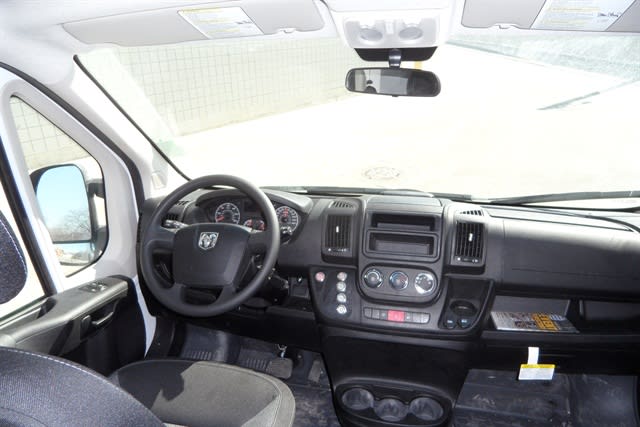
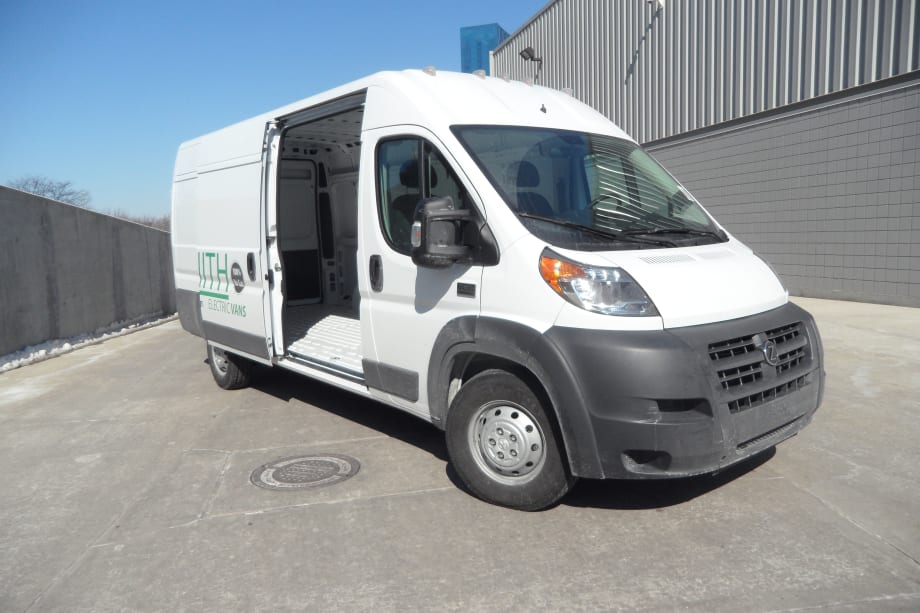
The Zenith van is a Ram Promaster with the gasoline powertrain replaced with a battery electric drive system. The interior is as Chrysler made it, except push buttons replace a shifter lever and an ammeter is where the tachometer was.
Zenith Electric Cargo Van
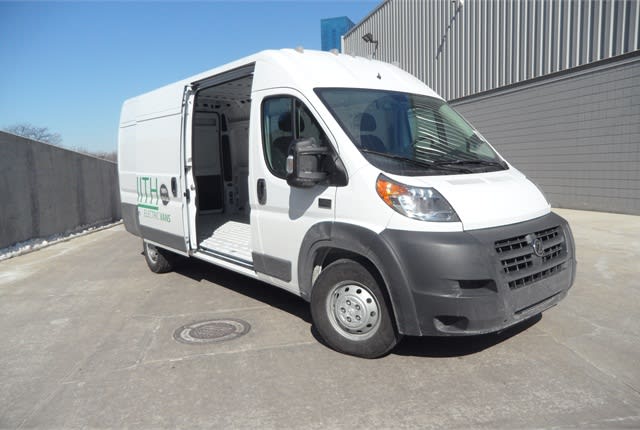
Think the Zenith looks like a new Fiat-based Ram Promaster cargo van? That’s because it is a Promaster, converted to electric drive. Zenith Motors, located in northern Kentucky across the river from Cincinnati, acquires the trucks from Chrysler, pulls out their gasoline powertrains and installs its own electric drivetrain. A Zenith remains front-wheel drive and retains the low floor and wide doors that make the Promaster easy to load and unload.
The van displayed at the NTEA show was a 250 model with a 2,500-pound payload capacity (a 350 model with a 3,000-pound capacity is also available, as is a passenger version). Most interior appointments and controls are as Ram designed and made them, except Zenith yanked out a stubby shift lever from the dashboard and replaced it with a panel of pushbuttons labeled P, R, N and D.
Push D for Drive and hang on, because the 180-horsepower, 250-pound-foot motor sets the truck into motion right away. There was a soft whirring as we accelerated and a quieter hum when I backed my foot from the go-pedal and regeneration began. This of course turns the motor into a generator, sending juice to the batteries and extending the range. That range is 100 miles or more, according to the company.
Several hotels are now using the Zenith passenger vans, and drivers plug them in between runs so that advertised range hasn’t really been tested, said Christine Smith, Zenith’s vice president of sales and marketing. She was along for the ride in downtown Indianapolis. The cargo compartment was empty, but I imagine the electric drivetrain would authoritatively move a load.
Smith pointed out that what looks like a tachometer, next to the speedometer, was actually an ammeter that showed how many amperes were being drawn by the motor. The needle went to 270 amps, and I managed to peg it once or twice during fast getaways from traffic lights.
Other trucks and cars quickly receded in our mirrors, their drivers maybe not believing that a cargo van could blow their doors off (or maybe not caring). A wise Zenith driver will try to keep the ammeter’s needle from swinging too far, because the fewer amps he uses, the farther the truck will go.
The prescribed route for the NTEA’s Green Truck ride-and-drive was like going around a long block – about a mile and a half. It was sufficient to show that the Zenith makes serious power, has fairly serious cargo-carrying abilities and is a well-finished and pleasant van to drive.
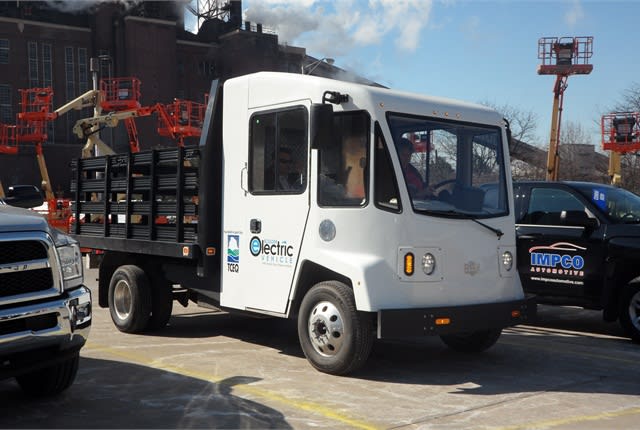
The Boulder EV’s bulbous cab contrasts with more conventional-looking trucks at NTEA event. The cab is made of lightweight composite materials and is roomy inside. The driver sits close to the windshield and slightly ahead of the side doors. On the dash is a rotary switch marked R-N-D, and a handbrake is used for parking.
Boulder Electric Vehicle
Odd yet purposeful in appearance, the Boulder is a walk-in delivery van (designated DV) that also comes as cab-and-chassis versions with a flatbed (designated FB) or service body (SB). Or customers can buy a bare chassis and mount other bodies. The one at the NTEA show was an FB-500 with a stake-side flatbed behind its long cab with a 4,000-pound payload. A longer-wheelbase 1000 series can carry up to 6,500 pounds. Lightweight composite panels are used throughout, including for the alternating-current motor.
The bulbous cab, designed and made by Boulder in its Colorado plant, is smoothly rounded for easy air flow, the company says. The driver sits relatively close to the big windshield for good outward visibility that’s aided by huge side glass. But he’s slightly ahead of the sliding side doors, so to exit the truck he has to pivot to the right- or left-rear. I found it a little awkward, but a tall ceiling made it easier, and most guys would get accustomed to it pretty quickly. In the cab’s rear there’s room for at least two passengers.
Bryan Bliss, vice president of sales, showed me how to operate the truck. A rotary switch on the dash lets the driver choose R, N or D; there’s no P, so a handbrake is used for parking. When in Drive, the Boulder was no rock. It scooted more quickly than its bulky cab would suggest, enough to easily beat out other traffic from a standstill (there I go again). There was no load aboard, but I’m guessing the motor would labor less hard than a gasoline or diesel engine if the flatbed were loaded to the gills.
That motor is supplied by Borg Warner and makes 134 continuous horsepower and 188 peak horsepower. Maximum torque is claimed to be 664 pounds-feet. The lithium iron phosphate batteries are “the safest and most reliable of all the different lithium technologies, with a life span of 3,000 cycles or more and only one-third of the weight compared to lead-acid batteries,” the company’s website says. They are carried below the floor and protected by a composite enclosure.
More Fuel Smarts

How Volvo Updated Its D13 for EPA 2027 [Watch]
Volvo’s updated D13 promises lower emissions without sacrificing performance or fuel economy. Take a closer look at what changed inside the engine in this HDT Spotlight video.
Read More →
Diesel Price Spike Shortens Payback for Natural Gas Trucks, Report Says
Energy Vision estimates fleets could recover the higher purchase price of an RNG-fueled Class 8 tractor in 1.3 to 2.8 years under current fuel-price scenarios.
Read More →
Calstart Becomes Catalyst Mobility, Reflecting Broader Focus
Calstart is now Catalyst Mobility, reflecting the nonprofit’s growing national role in clean transportation, including zero-emission trucks, infrastructure and incentive programs.
Read More →

Record Diesel Prices Squeeze Trucking Fleets
Average U.S. diesel prices have climbed to nearly $6 a gallon, surpassing the 2022 record as tight refinery capacity and Middle East disruptions keep fuel costs elevated.
Read More →
How Fuel Delivery Shapes Engine Performance
Fuel delivery depends on more than what happens at the injector. For fleet, maintenance and technical professionals, looking at the full path from pump to injector can provide useful context for understanding engine performance.
Read More →
East Coast Port Launches $45M Electric Truck Push
The Port Authority of New York and New Jersey announced millions in incentives for zero-emission drayage trucks, yard tractors, and new charging hubs near the port.
Read More →
California Bill Could Shed Light on Electric Truck Prices
Why do battery-electric Class 8 trucks remain so expensive? A California bill headed to Gov. Gavin Newsom would give fleets and state agencies more visibility into what manufacturers charge.
Read More →
Detroit Opens Orders for EPA 2027 Engines
Detroit isn’t starting from scratch to meet EPA 2027 diesel emissions standards. Its Gen 6 DD13 and DD15 engines keep much of today’s platform while updating the fuel and aftertreatment systems.
Read More →
Zero-Emission Truck Corridor Planned for West Coast
California, Oregon, Washington, British Columbia and Baja California are coordinating plans for truck charging and hydrogen fueling from Canada to Mexico.
Read More →
A Closer Look at Kenworth’s Electric T880E Vocational Truck [Video]
Learn more about Kenworth's T880E battery-electric vocational truck at the Paccar Technical Center, including its range, applications, upfitting considerations, and PTO options, in this HDT Spotlight video.
Read More →