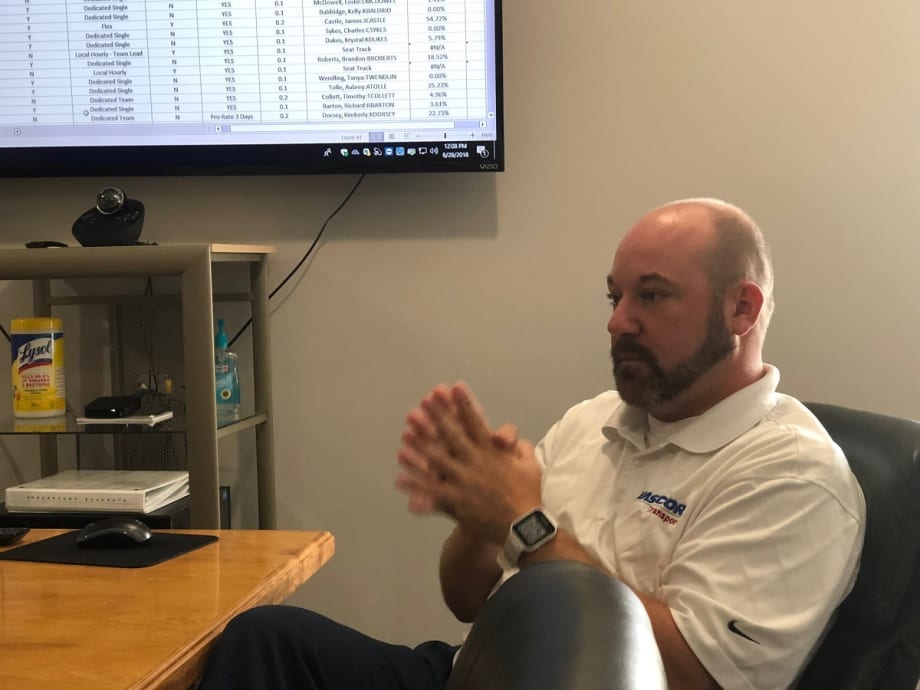
Chris DeRose, vice president of operations for Vascor Transport, says his fleet was looking for a good way to incentivize drivers, but wanted to get something in return for that investment.
Photos: Jack Roberts
3 min to read
In 2005, Jon Flynn got a call that one of his drivers was dead in an accident. It’s an experience that has driven a focus on safety ever since. Today, as chief operating officer for Vascor Transport, he also uses safety as a way of boosting driver pay.
Ad Loading...
A regional fleet based right in Georgetown, Kentucky, Vascor’s core customer base is automotive parts suppliers in the region. The need for just-in-time delivery puts tremendous pressure on the fleet’s 155 drivers to make their runs on time, safely, every time.
“If Toyota decides they’re going to make 800 red Camrys tomorrow, they’re going to build 800 red Camrys tomorrow,” says Chris DeRose, vice president of operations. “And if they don’t make those 800 red Camrys and you’re the reason they didn’t, you’re going to pay.”
Ad Loading...
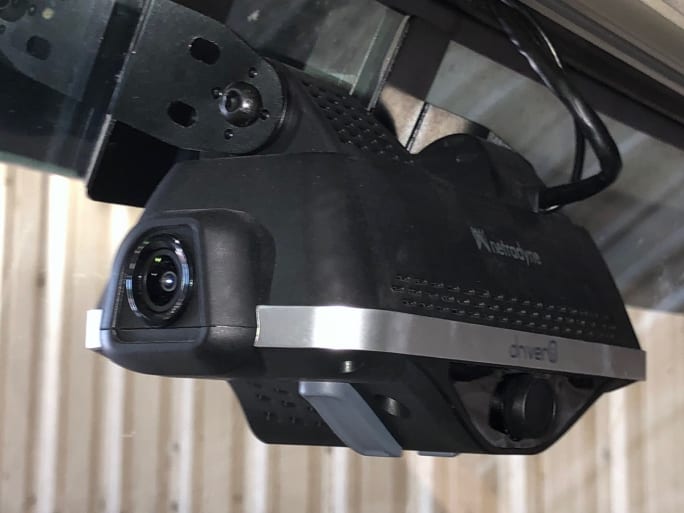
Enter Netradyne, which offered Vascor the opportunity to field test the latest version of its Driveri camera-based, artificial-intelligence-driven safety system. With Flynn’s determination to never repeat the experience of having to tell someone their loved one had died in one of his trucks, he and DeRose jumped at the chance.
“As terrible as that accident was, one of the biggest frustrations Jon had was the lack of information early on,” DeRose says. “You had no idea what the road condition was, or the weather — or if the driver was on their phone. And those were information gaps we wanted to fill in.”
In August of 2017, Vascor began a six-month trial run with Driveri. DeRose says he immediately was blown away by the quality of the video sent into the office. And he wasn’t being overwhelmed with data he had to sift through.
Vascor Transport is now installing the Driveri system on every new truck it buys, and anticipates saving around $500,000 in accident-associated costs in its first year of use.
“Driveri is set up with scoring parameters we set ourselves, and access is quick and easy through the web,” DeRose explains. “We initially set up 10 actions that we wanted to monitor and coach drivers on — things like speeding, rolling through stop signs, and tailgating. As time went on, we were able to get a much clearer picture of what our drivers’ strengths and weaknesses are, and tailor the system to better reflect that reality.”
Today, DeRose has his Driveri scores set up in Green, Yellow and Red zones for the drivers. Each driver has to log 2,200 minutes behind the wheel each week and score 900 or above to be in the Green Zone and eligible for a safety bonus. Some drivers contact their driver managers at the end of each day to find out how they did. Netradyne is also working on a smartphone app that will allow drivers to check their scores any time they wish.
Ad Loading...
“We wanted to increase driver pay, but we also wanted to get something in return for that commitment,” DeRose says. “Driveri gives us the tools to do this. As a result, we’re a safer fleet, and we can offer our drivers up to $3,900 a year in bonus pay.”
Using Driveri, Vascor has been able to better manage operating costs while getting a handle on safety issues. And DeRose feels word is starting to get out about the easy money his drivers make just by playing it safe.
Fleet Snapshot
Who: Vascor Transport
Where: Georgetown, KY
Fleet: 130 trucks and 165 drivers
Operations: Automotive, refridgerated, general freight
Fun Fact: Vascor purchased Commonwealth Express in 2015 to create Vascor Transport
Challenge: Staying in front of safety and driver turnover
English language proficiency rules for commercial drivers aren’t new, but renewed out-of-service enforcement has raised the stakes. Here’s what carriers need to know before a driver reaches a roadside inspection.
After three decades in trucking, Harold Perry shares what he's learned about driver safety, mentorship, and helping the next generation build confidence behind the wheel.
Fleets have more visibility into truck health, safety events, and driver activity than ever. The next challenge is turning all that information into useful guidance for the person who has to decide what to do next.
Federal regulators also are targeting more than 160 additional training providers and launching a nationwide audit of third-party CDL skills testers as part of a broader crackdown on trucking fraud.
Two pilot programs could eventually reshape hours-of-service rules, giving truck drivers options to pause their 14-hour clock or use longer split sleeper rest periods.