




Driver Safety Behavior Insights Gleaned from Lytx Data
Could drivers be more drowsy on Tuesday mornings because of Monday Night Football? And what does wearing a seat belt have to do with the likelihood of having a crash? Those are among the insights Lytx shared at the American Trucking Associations’ Management Conference and Exhibition.

Could drivers be more drowsy on Tuesdays because of Monday Night Football? And what does wearing a seatbelt have to do with the likelihood of having a crash? Those are among the insights Lytx shared with reporters during a briefing at the American Trucking Associations’ Management Conference and Exhibition in Austin, Texas, in late October.
In its State of the Data presentation, Lytx offered insights based on 100 billion miles of driving data, focusing on over-the-road truck-driving safety, risk factors and behaviors. Lytx is a provider of video telematics, analytics and safety solutions; you might know them better by the DriveCam name of their in-cab camera safety and coaching offering.
The insights come from analyzing the data in Lytx's trucking-industry client database. The data is anonymized, normalized and generalizable to the trucking industry as a whole. (For ATA, this focused on over-the-road fleets, not vocational fleets, delivery fleets, etc.)
Riskiest Days and Times
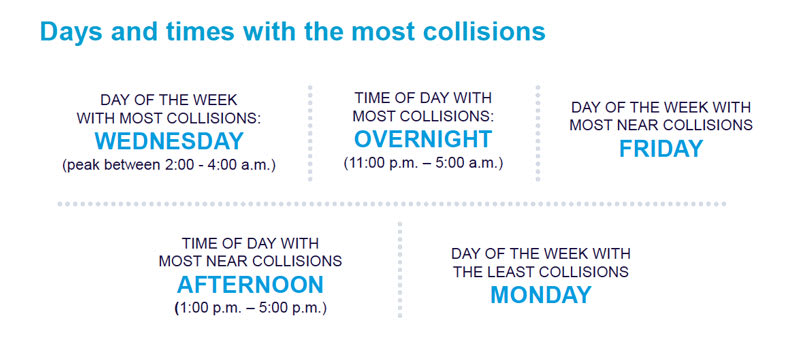
Lytx trucking-industry data shows the top riskiest days of the week and times of day for North American truck drivers between January and September 2018 were:
Day of the week with most collisions: Wednesday (peak between 2:00 – 4:00 a.m.)
Time of day with most collisions: Overnight (11:00 p.m. – 5:00 a.m.)
Day of week with most near collisions: Friday
Time of day with most near collisions: Afternoon (1:00 p.m. –5:00 p.m.)
Day of week with least collisions: Monday
Generally speaking, the risk tends to rise steadily as the work week progresses, said Ryan Brandos, a Lytx data analyst, who presented the findings at ATA MC&E.
“There is a distinct difference between collision and near-collision trends," he explained. “Collisions occur more frequently at night. We see those same drivers avoid contact during the afternoon hours, resulting in more near collisions during the day.”
Common Risky Behaviors
Looking at 358,359 fewer instances of risky driving between June-August 2018 compared to the same period in 2017, Lytx reported the top 10 observed driving behaviors by frequency, along with their relative, correlative collision risk.
Correlative Collision Risk refers to the relationship or connection between the observed driving behavior and a collision. For instance, we see that “driver not wearing seatbelt,” the most observed behavior, with a correlative collision rank of 4, is more closely related to a collision than smoking, which while the fourth most common observed behavior, had a rank of 35.
Brandos said it might seem odd that not wearing a seatbelt is so correlative. However, he said, “If the driver was willing to take a chance on their personal safety, they’re probably more likely to take a chance with their vehicle safety.”
The second most commonly observed driving behavior was “late response,” which is ranked fifth.
Most of these behaviors were declining in frequency from 2017 to 2018, with the exceptions being following distance of 1 to 2 seconds, posted speed violations, and “other” violations such as traveling over the centerline, blocking traffic in an intersection or driving on the shoulder.
"The driving behavioral improvements we're seeing are largely the result of our clients' strong focus on driver coaching and training," said Del Lisk, vice president of safety services at Lytx, in a release.

Most Dangerous Behaviors
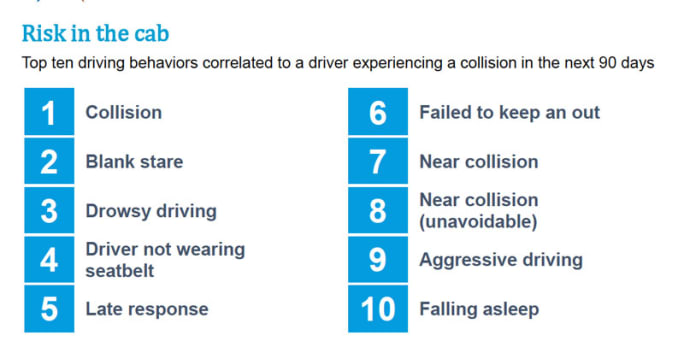
Using human-reviewed data, Lytx said, it is able to identify correlations between specific risky driving behaviors and the likelihood of those behaviors resulting in a collision. The top 10 driving behaviors it found were correlated to a driver experiencing a collision in the next 90 days were:
Collision (if a driver has a crash, he or she is more likely to have another in the near future.)
Blank stare
Drowsy driving
Driver not wearing seatbelt
Late response
Failed to keep an out (the driver didn’t leave enough space to react to other drivers’ behavior)
Near collision
Near collision (unavoidable)
Aggressive driving
Falling asleep
Now About That Monday Night Football…
Brandos initially discovered an odd statistic while doing research into seasonality trends in a subsection of the solid waste segment – nearly a triple increase in captured drowsy driving events during a four-month time frame every year for several years in a row, from late August to mid-December – and the bulk of this spike was on Mondays and Tuesdays, in the early mornings.
“This led me to believe there was something that was very widespread and occurring on Sunday/Monday evening” that was affecting the data, Brandos explained to HDT, and the effect was more concentrated in the Eastern and Central time zones. His theory? Sunday and Monday Night NFL football games that can run as late as 1 a.m. eastern time.
He later looked at all Lytx customer vehicles and found a less-pronounced, but similar, increase in captured drowsy driving events.
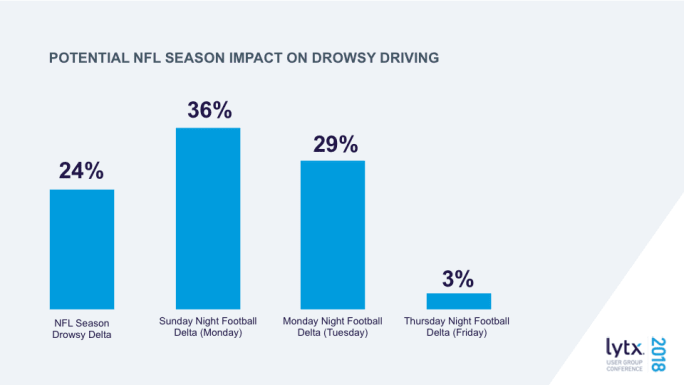
Turns out, on Mondays following an NFL season game, there's a 36% spike in drowsy driving events compared to Mondays when there are no games the previous night. On Tuesdays after a game, the increase in drowsy driving is 29%. But on Fridays, when NFL games are only broadcast to a much smaller audience in a special paid channel, there's a much smaller increase. Overall, there's a 24% increase in drowsy driving associated with NFL season games.
More Safety & Compliance

FMCSA Pauses Biennial-Update Enforcement Amid Motus Transition
Carriers whose updates were due on or after June 1 have more time, while FMCSA works to stabilize its new registration system and warns of phishing sites impersonating its new carrier registration system, Motus.
Read More →
ZF Expands Commercial Vehicle Push in North America
ZF is expanding its North American commercial-vehicle presence with new transmission applications, electrification, trailer technology and autonomous-driving systems.
Read More →
Truck Drivers Need More Than Another Alert
Fleets have more visibility into truck health, safety events, and driver activity than ever. The next challenge is turning all that information into useful guidance for the person who has to decide what to do next.
Read More →
Tesla Wants a Self-Driving Semi. Are Cameras Enough?
Could Tesla’s camera-only autonomous driving technology work on an 80,000-pound Semi? In this commentary, HDT's Deborah Lockridge takes a look at Tesla, Cybercab, and how autonomous trucks see the road.
Read More →
What DOT’s Automated Vehicle Strategy Means for Trucking
The U.S. Department of Transportation issued a new automated-vehicle strategy that outlines plans for driverless-truck regulations, cross-state freight corridors, and federal safety standards.
Read More →
NYC Expands Speed, Pedestrian Safety Tech Across Fleet
New York City is expanding intelligent speed assistance and pedestrian-alert systems across its municipal fleet, moving the technologies from pilot programs into vehicle procurement and retrofit requirements.
Read More →
FMCSA Removes 110 Truck Driver Training Schools from Certified ELDT List
Federal regulators also are targeting more than 160 additional training providers and launching a nationwide audit of third-party CDL skills testers as part of a broader crackdown on trucking fraud.
Read More →
Beyond DOT Compliance: What Makes a Trucking Fleet Truly Safe?
A trucking fleet can follow every rule and still make unsafe decisions. The real test comes when safety conflicts with freight, productivity, or cost.
Read More →
Hours of Service Pilot Programs: FMCSA Readies for 2027 Rollout
Two pilot programs could eventually reshape hours-of-service rules, giving truck drivers options to pause their 14-hour clock or use longer split sleeper rest periods.
Read More →
New Guide Offers Pet Safety Tips for Truck Drivers
Hundreds of thousands of pets travel in truck cabs. A new safety guide from Volvo Trucks and the Center for Pet Safety offers practical advice for truck drivers who bring dogs and cats along for the ride.
Read More →