




Don't Scrub Away Tire Savings
When your truck's alignment is out of whack, with all those wheels heading in different directions, it's unlikely you're getting the best fuel economy — or tire life.


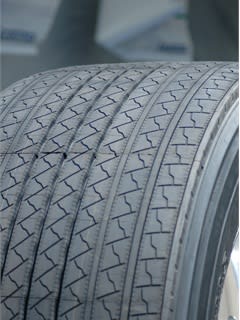
You've heard the expression, "It's like herding cats"? It's like that with tires when your alignment is out of whack. With all those wheels heading in different directions, it's unlikely you're getting the best fuel economy – or tire life.
The effects of misalignment are subtle, but the impact is rather startling. Bridgestone's Guy Walenga tells when a wheel is misaligned it's like dragging it sideways across the pavement.
"We have said in the past that if you have a 2-inch misalignment between steer and drive tires on tractor with a 181-inch wheelbase it would be like scrubbing the tires across the pavement for about 60 feet for every mile you drove," he says.
"Increasing the scale for dramatic effect, over a year, that would amount to dragging the tires sideways for about 1,100 miles. Not only is that going to produce tire wear, it saps fuel economy too. It takes a lot of energy to drag a tire sideways, and the energy comes right from your fuel tank."
Alignment is a fuel savings opportunity many fleets overlook, but Bill Bliem, senior vice president of Fleet Services at Vineland, N.J.-based NFI, takes full advantage of the savings it provides.
"When I joined the company, I did a lot of yard surveys with my maintenance directors, and I noticed most of the drive tires had [alignment-related] feather wear," he says. "I discovered the company never did vehicle alignments except where there was an obvious need. Since we started doing regular alignments of the front axles as well as the drives and trailers, we found that many of the drive axles were a good bit out. The trailers are another story."
NFI aligns each of its tractors and trailer once a year during the annual inspection at a cost of $100 or less, plus any adjustments that need to be made, or as the need arises. Bliem says he does alignments to reduce tire wear and to improve fuel economy.
"I haven't documented fuel savings directly related to alignment because I don't have a baseline, unaligned truck to compare," says Bliem. "I know intuitively that the truck is a lot more efficient when all the wheels are moving in the same direction. As for tire costs, with as much as tire prices have risen over the past five years, our tire-cost per-mile has stayed the same since we started doing regular alignments."
Alignment and Fuel Economy
Many fleets still see alignment as a solution to a tire problem, rather than a way of improving fuel economy, but that may be changing. Justin Gonzalez, heavy duty marketing manager at Hunter Engineering, say his company is starting to get enquiries from fleets that are already doing everything else to reduce fuel costs.
"I'm not aware of any definitive research that proves the effect of proper alignment on fuel efficiency," he says. "We do know that if it's preventing tire wear, it's saving fuel. Any forces that are scrubbing rubber off of tires are also increasing resistance to forward movement. That hurts fuel economy."
Checking trailer and drive axle alignment can be as simple as using a measuring tape, while steering geometry can be more complicated. The machines from Hunter, Bee Line and others are one solution. Portable laser devices from MD Alignment, E-Z Line and others offer a do-it-yourself solution.
Each fleets knows the extent of its irregular wear problems. Now imagine how much diesel-powered energy is required to make that happen. In effect, fleets that don't align their trucks are paying a lot of extra money to wreck their own tires.
Watch for more fuel-saving ideas in HDT's special June fuel issue.
More Fuel Smarts

How Volvo Updated Its D13 for EPA 2027 [Watch]
Volvo’s updated D13 promises lower emissions without sacrificing performance or fuel economy. Take a closer look at what changed inside the engine in this HDT Spotlight video.
Read More →
Diesel Price Spike Shortens Payback for Natural Gas Trucks, Report Says
Energy Vision estimates fleets could recover the higher purchase price of an RNG-fueled Class 8 tractor in 1.3 to 2.8 years under current fuel-price scenarios.
Read More →
Calstart Becomes Catalyst Mobility, Reflecting Broader Focus
Calstart is now Catalyst Mobility, reflecting the nonprofit’s growing national role in clean transportation, including zero-emission trucks, infrastructure and incentive programs.
Read More →

Record Diesel Prices Squeeze Trucking Fleets
Average U.S. diesel prices have climbed to nearly $6 a gallon, surpassing the 2022 record as tight refinery capacity and Middle East disruptions keep fuel costs elevated.
Read More →
How Fuel Delivery Shapes Engine Performance
Fuel delivery depends on more than what happens at the injector. For fleet, maintenance and technical professionals, looking at the full path from pump to injector can provide useful context for understanding engine performance.
Read More →
East Coast Port Launches $45M Electric Truck Push
The Port Authority of New York and New Jersey announced millions in incentives for zero-emission drayage trucks, yard tractors, and new charging hubs near the port.
Read More →
California Bill Could Shed Light on Electric Truck Prices
Why do battery-electric Class 8 trucks remain so expensive? A California bill headed to Gov. Gavin Newsom would give fleets and state agencies more visibility into what manufacturers charge.
Read More →
Detroit Opens Orders for EPA 2027 Engines
Detroit isn’t starting from scratch to meet EPA 2027 diesel emissions standards. Its Gen 6 DD13 and DD15 engines keep much of today’s platform while updating the fuel and aftertreatment systems.
Read More →
Zero-Emission Truck Corridor Planned for West Coast
California, Oregon, Washington, British Columbia and Baja California are coordinating plans for truck charging and hydrogen fueling from Canada to Mexico.
Read More →
A Closer Look at Kenworth’s Electric T880E Vocational Truck [Video]
Learn more about Kenworth's T880E battery-electric vocational truck at the Paccar Technical Center, including its range, applications, upfitting considerations, and PTO options, in this HDT Spotlight video.
Read More →