




Don't Ignore Your Brakes
There's nothing like a smack up side the head with a two-by-four to get your attention. That's what the Federal Motor Carrier Administration is doing to fleet maintenance with its Compliance, Safety, Accountability program

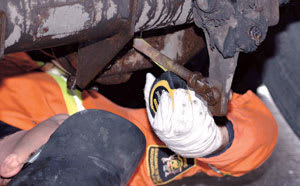
There's nothing like a smack up side the head with a two-by-four to get your attention. That's what the Federal Motor Carrier Administration is doing to fleet maintenance with its Compliance, Safety, Accountability program.
Fleets are starting to dig into their CSA scores to see where the weaknesses lie, says Bruce Stockton, president of Stockton Solutions, a contract maintenance consultant based in Joplin, Mo.
"Maintenance departments are hearing from compliance departments," Stockton says. "They are saying just fix it; just make sure it's right.
"Frankly, that's making it easier to get budget for maintenance, but there's still a lot that needs to change before certain fleets see improvements in their CSA scores."
Brakes are central to both the maintenance operation and the outcome of those efforts as recorded by CSA. Last year, Commercial Vehicle Safety Alliance inspectors to both the maintenance operation and the outcome of those efforts as recorded by CSA. Last year, Commercial Vehicle Safety Alliance inspectors recorded close to 700,000 vehicle defect violations related directly to braking systems.
The defects found at roadside, according to William Schaefer, director of vehicle programs at CVSA, aren't always dramatic. It's mostly small stuff that goes un-noticed in a cursory pre-trip inspection, or things that occur over time if the equipment isn't serviced regularly.
"In no particular order, we see a lot of air leaks in brake hoses, non-matching or mis-sized brake chambers on an axle, insufficient brake lining thickness, and, of course, brakes out of adjustment," he says.
"Certain things are hard for a driver to spot, such as cracked or separated brake linings, and if a driver is alone, it's very difficult to check brake stroke."
PM is not just a pair of letters that roll easily off the tongue. The purpose of a preventive maintenance inspection is to prevent unscheduled downtime, and in this context, guard against citations, fines and CSA points.
"Fleets need to place more emphasis on the basics of good maintenance to prevent any possible CSA questions or even violations," says John Hinesley, a regional director with Meritor DriveForce field operations. "The larger fleets are paying more attention to maintenance of key systems like brakes, and virtually all motor carriers understand fully the potential risk involved of losing shippers over poor CSA scores."
However, regular PMs are hard to do when trailers are in the field for months at a time.
"I see brake violations and defects predominantly on trailers," Stockton says. "Trailers are neglected because a driver typically only has a trailer for two or three days, and the thing never gets to a shop. These days, the 12-month annual inspection just isn't enough. Heck, three months is barely enough on a five-year-old trailer."
Stockton says mobile maintenance is the answer for fleets that can't get their trailers in at least every 45 days.
"Look at the less-than-truckload model, where the equipment comes back to the terminal every day or so," he says. "They can more economically inspect that equipment more often. You have to replicate that in the long-haul world by using mobile maintenance and a network of shops. And no, it won't be cheap, but that's the new reality."
Scott Corbett, director of technical service and warranty at Haldex, suggests structuring a PM program based on the same inspection criteria CVSA uses at roadside. "That's the ultimate barometer, isn't it?" he says. "If you are not at least that thorough, something is going to get past."
Fleets can get a copy of the North American Standard Out-of-Service Criteria from CVSA to identify what inspectors look for. Your inspections need to be at least at that level. And frankly, your driver's pre-trip inspections also need to be that thorough.
That will be a tough one to crack, but Stockton says fleets can no longer make assumptions about what drivers know.
"There seems to be an assumption that because a driver has a CDL he or she can do a vehicle inspection," Stockton indicates. "Most people, particularly new employees, don't want to tell their boss that they don't know how to inspect brakes or other safety items."
Part of the problem, he says, is the length of time spent in orientation. Keep them there too long, and the new driver might not stay. Too short and you won't get the training in.
"Proper vehicle inspections have got to become part of orientation if you hope to get accurate reports from drivers," Stockton says.
Finding out something's wrong is only part of the equation. The brakes still need to be fixed properly.
Gary Ganaway, director of marketing and global customer solutions at Bendix Spicer Foundation Brake, says top-quality replacement parts are no longer a luxury, but a necessity.
"It's becoming a question of which is more affordable, cheap parts or breakdowns and violations," he suggests. "Our Fleet Council tells us that fleets are putting a tremendous amount of effort into improving their PM routines, training drivers and technicians. It seems risky to leave all that to chance by using less than top-quality parts because they cost less up front."
The fact is, brakes are consumable components, they have moving mechanical parts, and they will wear out or fail at some point in time. The real question is whether your staff or a CVSA inspector finds the problem first.
For 2011, the Commercial Vehicle Safety Alliance reported five brake system violations in the top 20 vehicle out-of service conditions -each worth 4 points against your CSA score.
With one exception, the brake violations noted would all be fairly easy to detect on a thorough PM. Many would be obvious to drivers during pre-trip inspections - if they knew what to look for.
5: Fail to secure brake hose/tubing against mechanical damage: 218,191 violations
7: Clamp/roto-chamber type brake(s) out of adjustment: 195,226 violations
13: Automatic brake adjuster [not present] on CMV made on or after 10/20/1994: 94,516
17: Brake tubing and hose adequacy: 68,704
19: Brake connections with leaks/constrictions: 59,971
More Safety & Compliance

FMCSA Moves to Codify English Language Requirements for Commercial Drivers
By changing regulations on English-language proficiency requirements for commercial drivers, rather than relying on a guidance memo, the FMCSA said future administrations won't be able to walk back the Trump administration's stricter enforcement with just a memo.
Read More →
Trump Administration Expands Homeland Security's Role in Trucking Enforcement
The administration's latest trucking crackdown goes beyond roadside inspections, expanding Homeland Security's role in commercial vehicle enforcement and investigations involving CDL training schools.
Read More →
Paccar Recalls 2027 Trucks Built This Summer for Possible Electrical Problem
The nearly 6,000 Kenworth and Peterbilt trucks in the recall could potentially lose engine power, among other things.
Read More →
Brake Safety Week to Focus on Drums and Rotors
Commercial vehicle inspectors will be focusing on brakes during CVSA's Brake Safety Week, August 23-29.
Read More →
Trump Administration Looks to Put More Veterans Behind the Wheel
The Freedom Haulers program pulls together existing and expanded programs at several federal agencies to recruit veterans to drive commercial heavy-duty trucks and cut the red tape for them to get a CDL, training, and employment.
Read More →
$604 Million Verdict Tests Broker Liability After Supreme Court Ruling
C.H. Robinson plans to appeal after a Texas jury found it bore the largest share of responsibility for a fatal 2021 crash, in a case that follows the Supreme Court's Montgomery decision allowing negligent hiring claims against freight brokers.
Read More →
How Fraley & Schilling Improved Logbook Compliance by Over 50%
Fraley & Schilling needed a way to close a compliance workflow gap in its ELD system without adding more work from driver training, reminders, and back-office follow-ups. It found the answer in a custom driver app.
Read More →
Farewell, CDL: Why I'm Giving Up My Commercial Driver's License
After more than 20 years as a CDL holder, HDT Executive Editor Jack Roberts is letting his commercial license expire. Not because he wants to — but because trucking's nuclear verdict crisis has made the risks of public-road test drives too great for editors, manufacturers, and everyone involved.
Read More →
Enhance Fleet Performance with High-Efficiency Auxiliary Power Units
Drive sustainable cost savings while increasing driver comfort during short- and long-haul logistics operations.
Read More →
Wabash Trailers Recalled for Improperly Installed Underride Guards
More than 900 Wabash dry van trailers may not comply with the Federal Motor Vehicle Safety Standard for rear impact guards.
Read More →