




Do You Need Smart Trailers?
Today, technologies can monitor and report on a variety of things such as tire pressure, box temperature, reefer condition, and battery levels, that can be reported directly to fleet managers in real time. So how do you know if these technologies are right for your fleet?

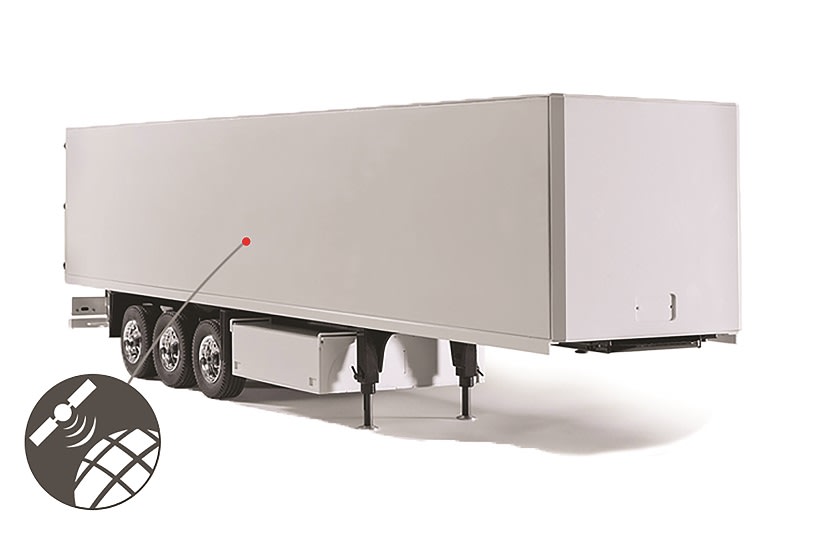
A smart trailer delivers more information than just location.
Photo: GPS Insight
Fleets have known about the benefits of trailer tracking technologies for some time, as it allows them to know where their trailers are. Today, technologies have evolved that can monitor and report on a variety of things beyond location, such as tire pressure, box temperature, reefer condition, and battery levels, that can be reported directly to fleet managers in real time. For instance, XTRA Lease has offered trailer tracking for years and now has SkyBitz’s solar-powered devices on more than 50,000 of its over-the-road dry vans and reefers. This year, the firm added cargo sensors on more than 9,000 new dry vans.
How do you know if these technologies are right for your fleet? A “yes” to any of the following questions may mean your fleet can benefit:
Do you sometimes not know where all of your trailers are?
“With tightening capacity, if you don’t know where all of your trailers are, you can’t leverage your fleet to its maximum potential,” says Ben Wiesen, vice president, products and services, for Carrier Logistics Inc., which provides trucking software for transportation companies.
“Knowing where a trailer is located is key,” says Roni Taylor, vice president of strategy and business development for tracking and fleet management provider Spireon. That information allows fleets to determine if they have the right number of trailers for their needs. For instance, after analyzing a customer’s trailer location data, Spireon was able to determine that 11% of its trailers never moved “That got them thinking about whether they needed those trailers that didn’t move,” she explains. After more evaluation, the customer found it could improve turns by moving those particular trailers to another location where they would be used.
Can your drivers easily find the right trailer when they need it – and is that trailer always ready to roll?
Truck driving often puts a unique set of frustrations and stresses on drivers. Having to look all over a yard for the trailer they are supposed to pick up, then finding that trailer has a flat tire, are preventable stresses. Plus, it’s inefficient.
“Local delivery operations may have drivers checking trailers to see if they are ready because the trailers can’t tell them,” Wiesen says. “That prevents them from doing something more productive with their time.”
Trailer tracking technologies can also tell you if the trailer is ready to roll, or not. “Anytime you can keep wheels moving and mitigate driver frustrations, you win,” says Gerry Mead, executive director of innovation for Phillips Connect Technologies, which is working to consolidate the information generated by multiple intelligent trailer systems through its TrailerNet platform. “Fleets can make sure that when a driver picks up a trailer, there are no problems – no flat tires, for instance.”
But it goes beyond tires. Dead batteries on other trailer devices or equipment such as liftgates are another possible source of driver frustration. Smart trailers can tell you how much charge a liftgate battery has left before the driver picks it up, Taylor notes.
Power management is key for trailers, she adds. Some fleets have several different sensors on their trailers. Many of these are wireless and may have their own batteries. Unless a carrier has dedicated personnel visiting each and every trailer parked in a yard (or yards) on a regular basis, the only way they can know for certain the condition of the trailer is to use a trailer tracking solution that can monitor these device batteries – including those on the tracking device itself.
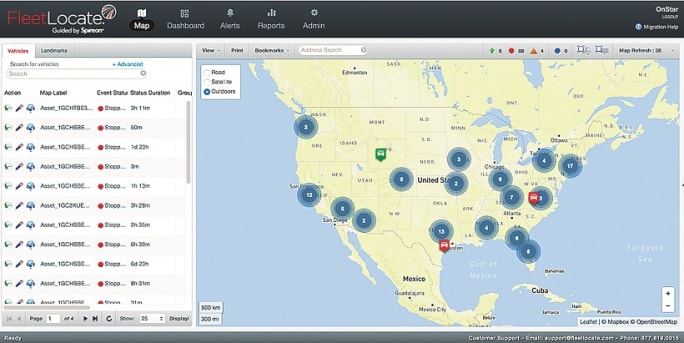
The number one benefit from using trailer tracking technology is being able to know where all your assets are located.
Photo: Spireon
Do you know the temperature inside your refrigerated vans?
Spoiled loads due to improper temperature control can hurt the bottom line. Plus, recently enacted rules regarding food transport authorized by the Food Safety Modernization Act require carriers to be able to document the condition of all food products under their control from pickup to delivery, which includes the product and reefer temperature. While monitoring the temperature inside a refrigerated trailer has always been a major consideration, the new rules add regulatory teeth.
Reefer unit manufacturers offer services to monitor the reefer’s performance and sensors inside the trailer monitor the box, as well as how many times (and for how long) doors have been opened. When asked, a carrier must provide a record that “perishable goods were transported at the correct temperatures,” says Ryan Driscoll, director of marketing for GPS Insight, “or if a door remains opens too long.”
Are you having trouble tracking trailer maintenance?
Mead says the maintenance benefits of smart trailers are huge. And he should know, as the previous executive vice president of maintenance at U.S. Xpress. “The ROIs speak for themselves.”
Many truckload carriers set maintenance schedules using a pre-determined time-based system that may not deliver the best results. Instead, using a mileage-based scheduling with data supplied by trailer tracking devices, fleets can be sure they are bringing their trailers in at the right time. “For things like brake lights and tires, if you can cut those costs by a few percent, that’s huge,” Mead adds. “Breakdowns are costly. If I can cut those costs by 25% by being more predictive with maintenance, that’s a huge maintenance upside that improves the bottom line.”
Truck-Lite recently reported on a customer’s experience using its Road Ready trailer telematics system and its SmartBridge Integrator, which ties in to the trailer’s existing devices such as tire pressure inflation and door monitoring systems. As the Stemco tire inflation system kicked in, the customer received an alert on his cell phone. Not only did he know that one of his axles was receiving pressure, he knew exactly which one.
Does your trailer tracking system integrate with your back office software?
The data that a trailer tracking device and other systems gather becomes even more useful if it easily integrates with the dispatch and truck management system in the back office. Knowing a trailer has a flat tire is one thing. Knowing when that trailer is scheduled to be picked up is much better.
The same is true for other sensor information, according to CLI’s Weisen. “Integrating the data into the ERP (enterprise resource planning) application means the TMS (transportation management system) software can connects the dots,” he explains. “The TMS knows the context – which driver, which facility, for instance.”
While the trailer device knows where the trailer is, the TMS is able to use that data and other trailer sensor data to perform automated functions. Knowing the temperature of a refrigerated trailer is important. If you also know that trailer is hauling ice cream that needs to stay below zero, that is another layer of information that only the TMS knows, he says.
Driscoll says that “In today’s world, it is always preferred to have related apps integrate so that the data is more meaningful and found in one place.” But he notes that not all fleets feel it is necessary to have such integration. “Some organizations are not integrating their trailer tracking with other platforms and use it as a standalone, while some cannot function without” pushing data to other systems.
The vast majority of providers offer such integration with most major TMS program, and most of that integration is seamless. “I’ve seen a little more consistency between the features that can be integrated over the last five years,” Wiesen says. Third-party providers are creating products that may have distinguishing features, but fleets expect those products to communicate with their TMS. “At home, you may not have the same brand TV or DVD player, but the expectation is that they will work together. The same applies to these types of systems.”
The five questions above are by no means an exhaustive list. There are many other areas that smart trailer technology can help fleets improve their bottom line. And that is what it’s all about.
More Equipment

How Volvo Updated Its D13 for EPA 2027 [Watch]
Volvo’s updated D13 promises lower emissions without sacrificing performance or fuel economy. Take a closer look at what changed inside the engine in this HDT Spotlight video.
Read More →
Michelin Tire Improves Efficiency and Durability for Regional Fleets
The Michelin X Multi Energy D2 is a regional haul drive tire engineered to help fleets improve fuel efficiency, durability and traction in demanding stop-and-go operations.
Read More →
ZF Expands Commercial Vehicle Push in North America
ZF is expanding its North American commercial-vehicle presence with new transmission applications, electrification, trailer technology and autonomous-driving systems.
Read More →
Tesla Wants a Self-Driving Semi. Are Cameras Enough?
Could Tesla’s camera-only autonomous driving technology work on an 80,000-pound Semi? In this commentary, HDT's Deborah Lockridge takes a look at Tesla, Cybercab, and how autonomous trucks see the road.
Read More →
Kodiak: Driverless Long-Haul Truck Launch on Track for 2026
Kodiak AI says its driverless long-haul safety case is 93% complete and it remains on track to begin commercial operations by year-end 2026.
Read More →
What DOT’s Automated Vehicle Strategy Means for Trucking
The U.S. Department of Transportation issued a new automated-vehicle strategy that outlines plans for driverless-truck regulations, cross-state freight corridors, and federal safety standards.
Read More →
East Coast Port Launches $45M Electric Truck Push
The Port Authority of New York and New Jersey announced millions in incentives for zero-emission drayage trucks, yard tractors, and new charging hubs near the port.
Read More →
PlusAI Going Public to Fund Autonomous Truck Launch
A SPAC deal could provide PlusAI with up to $300 million as it works toward a 2027 commercial launch of factory-built autonomous trucks.
Read More →
NHTSA Moves to Rewrite Truck Fuel-Economy Rules
The National Highway Traffic Safety Administration says it lacks authority to regulate medium- and heavy-duty truck engines separately from complete vehicles, but the existing standards have not yet been eliminated.
Read More →
Detroit Opens Orders for EPA 2027 Engines
Detroit isn’t starting from scratch to meet EPA 2027 diesel emissions standards. Its Gen 6 DD13 and DD15 engines keep much of today’s platform while updating the fuel and aftertreatment systems.
Read More →