




Digging Deeper into Navistar's New eStar
In a Portland "market" launch of its plug-in electric commercial van, Navistar expanded on the technical side of the eStar, which it's offering in cooperation with Modec of the United Kingdom. The Class 2C-3 van is all-electric. With a range of 100 miles on an eight-hour charge, the revolutionary-looking vehicle is targeted at operations that currently use gasoline or diesel step vans in city applications.
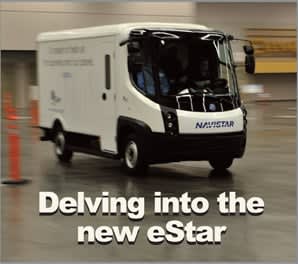
In a Portland "market" launch of its plug-in electric commercial van, Navistar expanded on the technical side of the eStar, which it's offering in cooperation with Modec of the United Kingdom.
The Class 2C-3 van is all-electric. With a range of 100 miles on an eight-hour charge, the revolutionary-looking vehicle is targeted at operations that currently use gasoline or diesel step vans in city applications.
Not surprisingly, FedEx and UPS are development partners. Because of its environmental and sustainable public green policies, Portland was been chosen as the first market and the stage for the announcement last week.
Transforming the UK model
The eStar is broadly based on the UK Modec. The broad layout of the chassis, electric storage and powertrain are the same for the International as the Modec van, but Navistar has significantly modified it for North America, gaining greater range and conformity with U.S. and Canadian safety regulation. In fact the eStar is fully EPA, CARB and FMVSS compliant, says Darren Gosbee, chief engineer for the project.
"There's almost nothing on the vehicle we haven't touched to achieve this," he said at the Portland event.
The base vehicle is the Modec cab and chassis, with the North American eStars featuring a fiberglass body built by Unicell of Buffalo, N.Y. This body has been styled to offer the same driver access - through the side door of the body and in through the back of cab - as the European version, though the body has a slightly tapered rear profile for lower drag to improve the driving range. The payload capacity of this body is 4,000 pounds and initially only a van is offered, though there may be bus and open body utility trucks in the works later.
Other changes over the Modec are to the 80 kW-hr battery pack, to be produced by A123 Systems of Lithonia, Mich. It features 1,248 Li-ion cells arranged in 16 modules, which produce 280-328 volts according to the state of charge. The long-life nanophosphate electrolyte should give a life of 10 years, Gosbee said. The on-board charger, currently rated at 7kW, will restore a fully depleted pack in eight hours, but there is also the ability to drop the battery pack out and substitute a freshly charged one in as little as 20 minutes for vehicles that may run in a two- or three-shift operation. The battery pack contains its own diagnostics and is designed to accommodate improvements in battery technology over time (what Navistar engineers call "future-proof.")
For conventional re-charging, the vehicle is plugged in via an industry-standard connector to 220-V domestic, split-phase supply, drawing a maximum of 32 amps. The van will cost only pennies per hour to recharge, says Navistar. Where a conventional equivalent gasoline-engine van may consume $5,000 worth of fuel in a year, the eStar may cost only $1,620 for electric power even at a conservatively high 7.5 cents per kW-hr electricity cost.
The top speed of the eStar is limited to 50 mph in order to conserve battery power. It features electric over hydraulic power steering and the power steering pump is the loudest noise from the vehicle. In a chart showing relative noise levels, the 46-dB eStar is comparable to the noise of falling raindrops. claimed Mark Aubry, vice president of sales and marketing, eStar.
Driving the eStar
The combination of a narrow chassis at the front and the sharp wheelcut and 36-foot turning circle make for a tight-turning van, as demonstrated around a maneuverability course in the Portland Convention Center. No apology was made for the demo being inside, "because with no tailpipe emissions, we can," said Shane Terblanche, general manager, eStar, in his introduction. (With zero tailpipe emissions, each eStar truck can reduce greenhouse gas emissions by as much as 10 tons annually, says Navistar.)
On a short straightaway on the course, the eStar proved to be very quick off the mark, more so than the 70-kW (102-horsepower) rating of the motor would suggest hauling an 8,000-pound (empty) van up to speed. Stop-and-go is ideal for an electric vehicle, as the motor produces its 221 pounds-feet peak torque at stall. Also apparent was the regenerative braking from the motor, a standard feature to maximize vehicle range.
Much was made during the introduction of the 180-degree view out of the van through the enormous windshield. That, too, was very apparent in the maneuvering course, especially when negotiating the tight slalom section. Mirrors provided an excellent view down to the ground and, enhancing visibility yet more, downward facing mirrors in the header show what's in front of the eStar right up to the front bumper. Enhancing safety at the rear, a standard rear camera pops an image up on to a screen also mounted in the header.
In the instrument cluster are a speedometer to the left and a battery charge and power-flow indication to the right, along with many warning lights. There's also an indicator to show whether the gear lever is in Park, Reverse, Neutral or Drive.
To start the vehicle, the driver inserts an electronic proximity key into a spot near the shifter. The vehicle boots up and the I-Pack comes alive. Then the vehicle is ready to drive. When the driver gets up from his seat, the eStar goes into a standby mode after five seconds. It stays in this mode for five minutes and will come instantly back to life with the key. Longer than five minutes to van goes into a full shutdown.
The eStar is not just easy to drive, it is easy to maintain. The robust motor/controller drives transversely through a Z-drivetrain between the battery pack and the drive axle. A short transverse driveshaft features constant-velocity joints that allow a small plunge to accommodate angularity changes with deflection of the rear trailing-arm suspension. None of these components requires maintenance. Up front, there's a swing-down panel where the various fluid reservoirs are located so it is easy to see coolant, windshield wash, hydraulic fluid for the disc/drum brakes, power steering and so on. There are no fluids on the vehicle that have to be changed.
Currently there is heating available but no air-conditioning. A system is under development and will be offered as an option. But the point was made that the vehicle will be launched in initial markets where air conditioning is not such a critical factor.
Green Halo
There was no mention of cost during the introduction, though in a breakout workshop details of federal and Oregon state tax credits were offered. Starting at a base price of $150,000 for sake of argument, said Rick Wallace, the presenter from the Oregon Department of Energy, and subtracting available credits, this would fall to $107,000. There are also tax credits till the end of this year for installing the infrastructure to charge electric vehicles, he said. And if some form of carbon-tax is introduced, companies running the eStar would be able to sell carbon credits to further reduce operating costs.
Those companies would also enjoy the "Green Halo" effect, said Aubry, showing customers through the easily identifiable vehicle that they are environmentally sensitive. That benefit, of course, is impossible to quantify, but it's one many fleet managers want to enjoy almost regardless of the initial cost of the vehicle, he said.
In Europe, some 250-300 Modec electrics have been put into successful service in 16 months. Navistar plans to build 400 eStars before the end of the year at its plant in Indiana.
Read more about the eStar in Senior Editor Tom Berg's earlier report from the Wakarusa, Ind., plant.
More Fuel Smarts

How Volvo Updated Its D13 for EPA 2027 [Watch]
Volvo’s updated D13 promises lower emissions without sacrificing performance or fuel economy. Take a closer look at what changed inside the engine in this HDT Spotlight video.
Read More →
Diesel Price Spike Shortens Payback for Natural Gas Trucks, Report Says
Energy Vision estimates fleets could recover the higher purchase price of an RNG-fueled Class 8 tractor in 1.3 to 2.8 years under current fuel-price scenarios.
Read More →
Calstart Becomes Catalyst Mobility, Reflecting Broader Focus
Calstart is now Catalyst Mobility, reflecting the nonprofit’s growing national role in clean transportation, including zero-emission trucks, infrastructure and incentive programs.
Read More →

Record Diesel Prices Squeeze Trucking Fleets
Average U.S. diesel prices have climbed to nearly $6 a gallon, surpassing the 2022 record as tight refinery capacity and Middle East disruptions keep fuel costs elevated.
Read More →
How Fuel Delivery Shapes Engine Performance
Fuel delivery depends on more than what happens at the injector. For fleet, maintenance and technical professionals, looking at the full path from pump to injector can provide useful context for understanding engine performance.
Read More →
East Coast Port Launches $45M Electric Truck Push
The Port Authority of New York and New Jersey announced millions in incentives for zero-emission drayage trucks, yard tractors, and new charging hubs near the port.
Read More →
California Bill Could Shed Light on Electric Truck Prices
Why do battery-electric Class 8 trucks remain so expensive? A California bill headed to Gov. Gavin Newsom would give fleets and state agencies more visibility into what manufacturers charge.
Read More →
Detroit Opens Orders for EPA 2027 Engines
Detroit isn’t starting from scratch to meet EPA 2027 diesel emissions standards. Its Gen 6 DD13 and DD15 engines keep much of today’s platform while updating the fuel and aftertreatment systems.
Read More →
Zero-Emission Truck Corridor Planned for West Coast
California, Oregon, Washington, British Columbia and Baja California are coordinating plans for truck charging and hydrogen fueling from Canada to Mexico.
Read More →
A Closer Look at Kenworth’s Electric T880E Vocational Truck [Video]
Learn more about Kenworth's T880E battery-electric vocational truck at the Paccar Technical Center, including its range, applications, upfitting considerations, and PTO options, in this HDT Spotlight video.
Read More →