




Dealer of the Year: Customer Service Key
These days, truck dealers can't rely solely on the sale of trucks to stay in business. So the successful one

These days, truck dealers can't rely solely on the sale of trucks to stay in business. So the successful ones
- like this year's American Truck Dealers/Heavy Duty Trucking Dealer of the Year nominees - are increasing parts and service options and finding creative ways to serve customers who are also hard-hit by the recession.
Richard "Dick" Sweebe, president and CEO of Diamond Companies and this year's Dealer of the Year, says many of his customers have trucks parked. Some have new trucks they haven't even put in service yet.
"I think the major truckload carrier fleets we service are probably in worse shape than we are," he says. "A lot of people we serve are involved in some way or another with the auto business, and that business is pretty much at a standstill." The credit crunch, he says, just makes matters worse.
The Larson Group, a Peterbilt dealer group with six locations, started seeing a downturn in 2007, says President Glenn Larson. "Obviously, the biggest effect has been on the new truck business," he says. "It's down probably 60 percent year over year, and probably 70 percent from 2007."
Larson's group believes there will be some slight improvement in the last half of this year and a gradual upswing into 2010, especially if the credit's there. One good sign, he says, is that in February, any of his customers who were credit-worthy were able to get financing.
For Del-Val International Trucks in Montgomeryville, Pa., things really started hitting hard when fuel prices spiked last year and left customers reeling. "We saw service drop off in a way we had never seen before," says Thomas Strohlein, Del-Val president and general manager, as cash-strapped fleets put off maintenance.
All the nominees have taken a fine-tooth comb to expenses. While many have cut some people, all are trying to make that a last resort, and doing as much by attrition as possible.
"We've let a few people go, not very many to date," says Ben Bruckner, chairman of Bruckner Truck Sales in Amarillo, Texas. "For years we've struggled to get these techs and employees, and we're not going to let them go lightly."
At Marty's GMC/Buick/ Pontiac/Isuzu in Kingston, Mass, the recession has prompted Christine Alicandro, dealer principal, to get more personally involved with both employees and customers.
"I've always been very, very hands-on, but I definitely am out and about and a lot more visible than I have been in many years," Alicandro says. For instance, the company has been working closely with customers in the area of accounts receivable. "Sometimes there are customers that have had patterns of paying late, and I think shutting those customers off isn't exactly the right answer," she says. "If they come in and need an engine job and it's $15-$20 grand, we put them on a stringent payment plan and just stay on top of them."
Selling Service
Dealers can thank the last downturn, in 2000-2001, for helping them be better prepared for this recession. That economic cycle forced dealers to realize they couldn't depend on truck sales alone to make money.
Absorption has become a key concept in the dealer world. When a dealer has more than 100 percent absorption, that means if he didn't sell a single truck during that time period, he would still have made money.
Sweebe's company started an emphasis on parts and service absorption in 2001, when the Diamond Companies suffered the only loss for a fiscal year in the 26 years since the company was formed.
"Ownership and senior management understood once and for all we could not survive on the margins generated by new and used truck sales," he explains.
For The Larson Group, as they grew from one location to six, and their truck sales grew, so did the parts and service business. "Customer satisfaction was, and still is, our primary goal," Larson says. "We have integrated this philosophy into every dealership acquired since 1987, and it has proven to be our key to success."
When Strohlein took over Del-Val from his father in 1996, "Our biggest untapped strength was in truck parts," he says. Strohlein started growing the delivery fleet, and now has 12 vehicles and a mix of full- and part-time drivers on first and second shifts. Last year Del-Val added a "hot-shot" driver - an afternoon driver who runs parts to customers who did not get their order in for a needed part in time that morning and for which the job is too "hot" to wait for the next regular delivery run.
Alicandro says as people are finding new trucks aren't in the budget, the repair end of things has increased. "The parts and service business is at the highest point now that it's been in my whole career," both from retail customers and from selling wholesale to independent repair shops.
Dealing With Downtime
A common complaint of truck owners, from the smallest owner-operator to the nation's biggest fleets, is that dealers often don't understand the importance of downtime. They often feel, when they take their trucks in to be serviced, that they're leaving them in a black hole where no communications escape about how long it's going to be until they get that truck back on the road. The Dealer of the Year nominees say they do understand the customers' dilemma.
"Customers are more insistent than ever about wanting their trucks on the road, not in the shop," says Del-Val's Strohlein. Del-Val has been running two shifts for years to help get trucks turned around quickly.
"We have customers that need to be able to drop their truck off at the end of a business day and know it's going to be ready for the next business day," Strohlein says. "The challenge is getting good qualified technicians to work a second shift, and that takes time to gather that pool of talent and to train them."
The dealership also is in the process of adding a full mobile maintenance truck. "There is a cost and some logistics for a customer to get a truck to a repair center and back," he says. "And for some it may mean the difference of having the trucks available the next day."
Part of the issue is capacity, says Larson. "Probably any day, there's more trucks that need to be worked on than there is space available," even though two of his locations are open 24/7 and the others all have extended hours.
Sheehan's Truck Centre in Burlington, Ontario, uses a process similar to the triage in an emergency room to diagnose the problem as quickly as possible (the goal is within two hours) and prioritize the repair. Then they can let the customer know whether the repair will take an hour or a few days.
"It is similar to how an emergency room works," explains President Kelly Sheehan. In an ER, "the triage nurse asks about your symptoms, takes your vitals and then decides what order you will be seen in. If he/she thinks that you are having a critical event, or if you can be taken care of very quickly (burnt out bulb), you will be seen right away. If it is something that can wait, and our shop is already full, then unfortunately, you have to go to the back of the line or you may be asked to come back at another time. Sometimes, a temporary fix is the answer.
"We find that this process helps minimize our customers' downtime and helps us to maximize the flow of work through our shop."
Vital Communication
The Truck Dealer of the Year nominees agreed that communicating with customers about the status of diagnostics and repairs is crucial.
"If you can't get to a guy's truck, it helps if you communicate that to him, and the date and time when you expect to have it done," Larson says.
Bruckner notes that in the past, "the customary deal was, we got the truck and put it in the shop, and when it was finished we called the customer. Well, that's not serving the customer well. So we've tried to make a practice that when the truck's in the shop, we have a foreman or clerk give a daily report to a customer. If
More Equipment

Michelin Tire Improves Efficiency and Durability for Regional Fleets
The Michelin X Multi Energy D2 is a regional haul drive tire engineered to help fleets improve fuel efficiency, durability and traction in demanding stop-and-go operations.
Read More →
ZF Expands Commercial Vehicle Push in North America
ZF is expanding its North American commercial-vehicle presence with new transmission applications, electrification, trailer technology and autonomous-driving systems.
Read More →
Tesla Wants a Self-Driving Semi. Are Cameras Enough?
Could Tesla’s camera-only autonomous driving technology work on an 80,000-pound Semi? In this commentary, HDT's Deborah Lockridge takes a look at Tesla, Cybercab, and how autonomous trucks see the road.
Read More →
Kodiak: Driverless Long-Haul Truck Launch on Track for 2026
Kodiak AI says its driverless long-haul safety case is 93% complete and it remains on track to begin commercial operations by year-end 2026.
Read More →
What DOT’s Automated Vehicle Strategy Means for Trucking
The U.S. Department of Transportation issued a new automated-vehicle strategy that outlines plans for driverless-truck regulations, cross-state freight corridors, and federal safety standards.
Read More →
East Coast Port Launches $45M Electric Truck Push
The Port Authority of New York and New Jersey announced millions in incentives for zero-emission drayage trucks, yard tractors, and new charging hubs near the port.
Read More →
PlusAI Going Public to Fund Autonomous Truck Launch
A SPAC deal could provide PlusAI with up to $300 million as it works toward a 2027 commercial launch of factory-built autonomous trucks.
Read More →
NHTSA Moves to Rewrite Truck Fuel-Economy Rules
The National Highway Traffic Safety Administration says it lacks authority to regulate medium- and heavy-duty truck engines separately from complete vehicles, but the existing standards have not yet been eliminated.
Read More →
Detroit Opens Orders for EPA 2027 Engines
Detroit isn’t starting from scratch to meet EPA 2027 diesel emissions standards. Its Gen 6 DD13 and DD15 engines keep much of today’s platform while updating the fuel and aftertreatment systems.
Read More →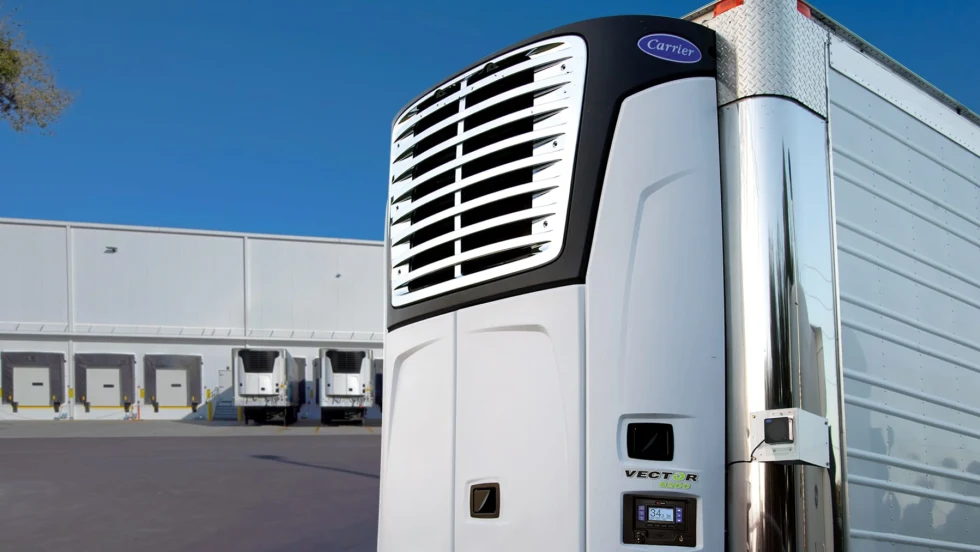
Carrier Transicold Adds All-Electric TRU for Stationary Cold Storage
Carrier Transicold’s new Vector 8200 all-electric transport refrigeration unit gives fleets a diesel-free option for temporary refrigerated and frozen trailer storage.
Read More →