




Dart Goes Lightweight
Dart Transit, a pioneer in high-cube trailers for hauling low-density freight, is now seeking lower tare weight to serve customers who ship heavier cargoes

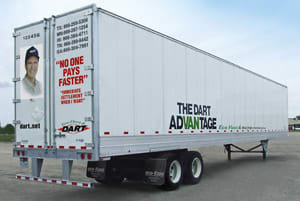
This photo shows features of Dart Transit's Eco Trailer, a 53-by-102 van built by Hyundai in Tijuana, Baja Calif. Double-sheet sidewall was designed and patented by Dart's president, Dave Oren. (Photo courtesy of Dart Transit Co.)
Dart Transit, a pioneer in high-cube trailers for hauling low-density freight, is now seeking lower tare weight to serve customers who ship heavier cargoes.
The result is a unique design that includes a double-sheet-and-post sidewall that's stronger yet lighter than those in plate-type trailers that constitute the great majority of its 7,800-unit fleet.
The Eco Trailer, as the company calls it, is part of Dart's Eco Fleet, a name chosen "to help promote the idea that we can haul more freight with fewer trucks," explains Dave Oren, Dart's president and the third generation involved in management of the family-owned company. There are also Eco Tractors with basic lightweight specifications and modified for optimum weight distribution.
"The trailer we pioneered has become so universal now, and we want to broaden our capabilities," Oren says of the currently common 53-foot-long by 102.3-inch-wide dry van. The Eco Trailer, also a 53-by-102, "can still handle the bulk but can also handle the weight. Customers tell us that they are more interested in putting more weight in the trailers, and they're pretty excited about this."
Beverages and paper products are the primary cargoes hauled in dedicated fashion by the Eco rigs. Nine of the newly configured tractor-trailers can handle shipments that would otherwise require 10 typical rigs, the company figures. This reduces operating costs, pollution and highway traffic.
Oren says he's not an engineer, but 30 years of experience in dealing with equipment helped him design and patent the sidewall. It uses a pair of aluminum sheets laid over vertical posts instead of a plate trailer's single metal sheet. Other features include wide-base single wheels and tires, and on-board tire inflation and weighing.
An Eco Trailer weighs 12,720 pounds versus 13,800 for a typical plate trailer with standard dual wheels and tires. "There's some mystery to this," Oren comments. "It should come out to be 700 or 800 pounds less according to manufacturer statements, but it scales at about 1,000 less."
Four "super singles," as Oren calls the wide-base tires and wheels, save 300 to 400 pounds over duals. The Michelin wide-base singles mount on steel wheels rather than aluminum because Oren wants to avoid theft. "We don't have a lot of experience with aluminum wheels," he says, but "my feeling is that they would be stolen" from trailers. He specs standard-width axles and offset wheels because wide-track axles are more expensive and not cost-effective.
Materials and products used in the Eco Trailers are common and readily available from various suppliers, and Oren selected those that would achieve the goals of light weight, efficient operation and low maintenance.
Dart began testing the design in 2004. Successful operation thus far led to it acquiring 100. An open-ended contract with the builder might result in another 300 or more, depending on experience. "Hyundai got the order because Hyundai would build them" with his sidewall design, he says.
In the sidewall, two 0.05-inch aluminum sheets are affixed to 0.4-inch-square vertical posts. The twin sheeting results in stiffness with light weight, and a sidewall is only 1 inch thick so the trailer's inside width is a high-cube-style 101 inches. The sheets' inside and outside surfaces are smooth to avoid pallet snagging and to reduce air drag at highway speeds. Battering of inside sheets usually does not spread to the outer sheets, so good appearance is maintained. And puncturing of an outside sheet leaves the inner sheet intact to keep out dirt and water.
Each sheet's length is 49 inches and its height averages 111 inches, with forward sheets of the wedge-shaped trailer being slightly lower and rear sheets taller. Bottom rails are 20 inches tall and double as interior liners. Other features of an Eco Trailer include:
* Composite laminated oak-and-fiberglass floor from Havco, which provides strength and protection against moisture damage to the wood and water intrusion to the trailer's interior.
* On-board weighing using an air-pressure gauge plumbed into the air suspension, to allow maximum legal loading. Depending on suspension and wheel-tire types, air pressure will indicate weight on the trailer's tandem. Oren says he has made up charts that convert pounds per square inch on a gauge to loaded pounds. The Eco Trailers use Hendrickson's Vantraax suspensions.
* Automatic inflation systems from Pressure Guard keep tires aired up for maximum casing and tread life and cargo loading.
* Andersen Eco-Flaps, with perforations that allow air flow to flow through for reduced drag and fuel consumption.
Prototype trailers from 2004 are performing well, Oren says, and if production models hold up, much of the entire fleet might eventually have the Eco design. Dart, based in Eagan, Minn., runs nationwide.
Eco Tractors
Dart Transit also has begun modifying its independent contractors' power units to Eco Tractor status, with the aim of light weight and maximum legal axle loadings. The goal is a top tare weight of 17,000 pounds including fuel and a driver for a tractor, typically a Freightliner Columbia with a 70-inch integral sleeper and a 12.8-liter Mercedes-Benz 4000 diesel.
Fixed fifth wheels are moved forward between 12 and 16 inches, based on a formula devised by Dave Oren, Dart's president. This transfers some weight to the front axle and increases available capacity of tandem drive axles. Another result of moving the fifth wheel is that the gap between tractor and trailer is shortened, which cuts air turbulence and reduces fuel consumption.
Wide-base tires and wheels are a consideration, but so far none have been retrofitted to the already lightweight tractors.
All of Dart Transit's tractors are owner-operated. The company says if you're a contractor interested in hauling heavier freight, the company has worked out a financing arrangement to help finance the needed modifications.
From the February 2010 issue of Heavy Duty Trucking.
More Equipment

How Volvo Updated Its D13 for EPA 2027 [Watch]
Volvo’s updated D13 promises lower emissions without sacrificing performance or fuel economy. Take a closer look at what changed inside the engine in this HDT Spotlight video.
Read More →
Michelin Tire Improves Efficiency and Durability for Regional Fleets
The Michelin X Multi Energy D2 is a regional haul drive tire engineered to help fleets improve fuel efficiency, durability and traction in demanding stop-and-go operations.
Read More →
ZF Expands Commercial Vehicle Push in North America
ZF is expanding its North American commercial-vehicle presence with new transmission applications, electrification, trailer technology and autonomous-driving systems.
Read More →
Tesla Wants a Self-Driving Semi. Are Cameras Enough?
Could Tesla’s camera-only autonomous driving technology work on an 80,000-pound Semi? In this commentary, HDT's Deborah Lockridge takes a look at Tesla, Cybercab, and how autonomous trucks see the road.
Read More →
Kodiak: Driverless Long-Haul Truck Launch on Track for 2026
Kodiak AI says its driverless long-haul safety case is 93% complete and it remains on track to begin commercial operations by year-end 2026.
Read More →
What DOT’s Automated Vehicle Strategy Means for Trucking
The U.S. Department of Transportation issued a new automated-vehicle strategy that outlines plans for driverless-truck regulations, cross-state freight corridors, and federal safety standards.
Read More →
East Coast Port Launches $45M Electric Truck Push
The Port Authority of New York and New Jersey announced millions in incentives for zero-emission drayage trucks, yard tractors, and new charging hubs near the port.
Read More →
PlusAI Going Public to Fund Autonomous Truck Launch
A SPAC deal could provide PlusAI with up to $300 million as it works toward a 2027 commercial launch of factory-built autonomous trucks.
Read More →
NHTSA Moves to Rewrite Truck Fuel-Economy Rules
The National Highway Traffic Safety Administration says it lacks authority to regulate medium- and heavy-duty truck engines separately from complete vehicles, but the existing standards have not yet been eliminated.
Read More →
Detroit Opens Orders for EPA 2027 Engines
Detroit isn’t starting from scratch to meet EPA 2027 diesel emissions standards. Its Gen 6 DD13 and DD15 engines keep much of today’s platform while updating the fuel and aftertreatment systems.
Read More →