




Cummins Previews 2010 ISX
If it hadn't been for the development of copper zeolite as a catalyst to use in reducing nitrogen oxides (NOx), Cummins might have been right alongside Navistar in using increased levels of exhaust gas circulatio
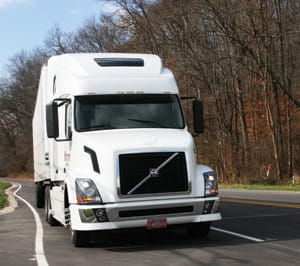
On the road with the ISX15 showed there's little for a driver to feel different from what went before. But there are new responsibilities with the need to keep the diesel exhaust fluid topped up. Photo by STF
If it hadn't been for the development of copper zeolite as a catalyst to use in reducing nitrogen oxides (NOx), Cummins might have been right alongside Navistar in using increased levels of exhaust gas circulation
to meet the Environmental Protection Agency's new stringent emissions regulations for 2010. But the copper zeolite led Cummins to abandon its early work to seek an in-cylinder NOx solution, and Cummins is squarely in the selective catalytic reduction camp for 2010.
In an exclusive briefing for Heavy Duty Trucking editors, Cummins engineers and marketing staff reviewed the ISX11.9 and ISX15 engines and technologies for 2010, including how the use of the copper zeolite has allowed them to pursue fuel-efficiency strategies that may beat other SCR engines in fuel savings.
Cummins for 2010
Originally, the strategy had been to develop medium-duty engines along an SCR route, and for the bigger, on-highway engines to use additional exhaust gas recirculation with no SCR. This strategy looked attractive for several reasons. For one thing, the power density required from medium-bore and smaller engines in vocational applications demanded that a solution other than power-robbing EGR be sought. Also, vocational trucks are most often centrally fueled, meaning few issues with obtaining on-the-road urea-based DEF for the exhaust aftertreatment process. Early indications were that fleets preferred not to have to deal with drivers replenishing an additional fluid on the truck when fueling out on the highway.
In the time since the original announcement, however, several factors led to a change of direction for Cummins on the big-bore side - the 15-liter ISX as well as an all-new 11.9-liter engine. While the 11.9-liter, scheduled for production in mid-2010, is a totally different engine, the XPI common-rail fuel injection system, the SCR aftertreatment, EGR components, engine controls and on-board diagnostics were purposely designed to mirror the 15-liter's, bringing the ISX11.9 fairly and squarely into the same ISX family.
A new catalyst
The big enabler that caused the change of technology direction, says Cummins, was the development of copper zeolite as the NOx reduction catalyst. Other SCR systems use a similar but different compound, iron zeolite, in the SCR chamber. Cummins says the copper compound brings some significant benefits that have allowed it to optimize the ISX and gain very useful reductions in NOx along with major fuel economy benefits.
Copper zeolite brings a much-enhanced efficiency to the exhaust aftertreatment, Cummins says, allowing for a more complete reduction of NOx to nitrogen and water vapor at lower exhaust temperatures. Cummins big-bore engines put out exhaust predominantly at temperatures in the 200-350 degrees C range (about 390 to 660 degrees Fahrenheit). Copper zeolite significantly outperforms iron zeolite at these temperatures. In fact, the efficiency approaches 100 percent in the conversion of NOx to nitrogen and water vapor. Iron zeolite has a lower efficiency - around 80 percent to 85 percent - at these temperatures, but is more efficient at high exhaust temperatures approaching 600 degrees C (about 1,100 degrees F).
According to Director of Engineering Tom Dollmeyer, the higher efficiency of the copper compound meant that very early in the three-year development cycle, Cummins was on the NOx compliance target. With that behind them, they set about optimizing engine controls and exhaust to make the best uses of the properties of the copper zeolite.
Going SCR was not actually an about-face for the company. In addition to the declared intent to use the technology for medium-duty engines, Cummins has been using SCR in Europe and other export markets for some time, and has actually been pursuing development since the 1990s on other power platforms.
Better fuel economy
Dollmeyer says the copper zeolite technology adoption brought a huge benefit to the 2010 program. By effectively dropping the aftertreatment on to the 2007 engine, Cummins was able to ratchet down to the 2010 standard virtually at a stroke (perhaps a gross oversimplification), making resources available to go after other deliverables. Key among those is enhanced drivability that makes it possible to gain additional fuel economy - even from less experienced or less economy-motivated drivers. The changes may allow the engines to easily beat the 5 percent fuel economy gains that have generally been predicted for 2010 engines using SCR.
This trick comes from a change to the fuel maps. These no longer have to be manipulated to meet specific emissions targets - particularly the transient (stop-and-go) operations that have been key to meeting EPA emissions limits. The long and the short of it is that the "sweet spot" on the fuel map is no longer an almost singular point, but a wide area of fuel and load that is way more forgiving of the driver. No longer is it necessary to follow a strict rpm regime to get good fuel economy, because the operating ranges are so much wider. A driver can be in the wrong gear, yet still get acceptable fuel economy. For instance, he can cruise in a gear lower than the fuel-efficiency optimum so he gets good performance in hilly terrain, without seriously impacting fuel usage.
More copper benefits
With slightly higher out-of-cylinder NOx permitted by the super-efficient copper zeolite, there are more of the gases that are necessary to burn off the soot passively in the diesel particulate filter. And with more NOx out, there's less particulate matter created at the same time - a double benefit.
With more passive regeneration, there's much less fuel injected into the DPF for active regenerations. In fact, they almost never happen, says Dollmeyer. What few active regen events there are exist more to test the emissions system and the on-board diagnostics.
So fuel savings through lower DPF activity is responsible for much of the overall improvement in economy. But there are other fuel gains. In the case of Cummins, it is highly likely the extreme high-pressure common rail XPI fuel system also plays a big part.
XPI has been under development for more than 10 years. The common-rail design provides a precise demand pressure independent of engine rpm - something impossible with unit injection - for excellent low engine speed injection pressure and injector spray pattern. This means the controls give up to five events per injection for pre- and post-injection control, meaning more complete combustion, lower flame temperatures, and as a bonus, less noise. That means less fuel used, less NOx produced, and a better environment in the cab for the driver.
On the road
The highlight of the visit to Cummins headquarters in Columbus, Ind., was a drive of the ISX15 rated in a typical over-the-road truckload carrier spec. With 425 horsepower and a SmartTorque 1,550/1,750 profile, the engine was in a development Volvo VN, featuring a production-intent installation complete in every detail except for the access door for the diesel exhaust fluid (DEF) tank in the driver-side skirt.
To check out the driver aspects of the 2010 ISX15, we took an all-too-short test loop around rural Indiana, heading from the Cummins tech center out to I-65 and south to Indiana 50 west. Then by Route 446 to 46 and back to Columbus. Although it was short, we covered 106 miles of freeway, state highway and some quite tricky hills, including an 8 percent and 10 percent grade. This is a regular development route for Cummins and is usually completed in 2 hours, much as I did.
To be honest, there was little to conclude from the drive. I think it would take a driver who has driven an '07 ISX on a regular basis to tell the differences with the 2010 ISX15. In Cummins development work, such experienced drivers have said they can detect and appreciate the changes for 2010.
My impres
More Equipment

How Volvo Updated Its D13 for EPA 2027 [Watch]
Volvo’s updated D13 promises lower emissions without sacrificing performance or fuel economy. Take a closer look at what changed inside the engine in this HDT Spotlight video.
Read More →
Michelin Tire Improves Efficiency and Durability for Regional Fleets
The Michelin X Multi Energy D2 is a regional haul drive tire engineered to help fleets improve fuel efficiency, durability and traction in demanding stop-and-go operations.
Read More →
ZF Expands Commercial Vehicle Push in North America
ZF is expanding its North American commercial-vehicle presence with new transmission applications, electrification, trailer technology and autonomous-driving systems.
Read More →
Tesla Wants a Self-Driving Semi. Are Cameras Enough?
Could Tesla’s camera-only autonomous driving technology work on an 80,000-pound Semi? In this commentary, HDT's Deborah Lockridge takes a look at Tesla, Cybercab, and how autonomous trucks see the road.
Read More →
Kodiak: Driverless Long-Haul Truck Launch on Track for 2026
Kodiak AI says its driverless long-haul safety case is 93% complete and it remains on track to begin commercial operations by year-end 2026.
Read More →
What DOT’s Automated Vehicle Strategy Means for Trucking
The U.S. Department of Transportation issued a new automated-vehicle strategy that outlines plans for driverless-truck regulations, cross-state freight corridors, and federal safety standards.
Read More →
East Coast Port Launches $45M Electric Truck Push
The Port Authority of New York and New Jersey announced millions in incentives for zero-emission drayage trucks, yard tractors, and new charging hubs near the port.
Read More →
PlusAI Going Public to Fund Autonomous Truck Launch
A SPAC deal could provide PlusAI with up to $300 million as it works toward a 2027 commercial launch of factory-built autonomous trucks.
Read More →
NHTSA Moves to Rewrite Truck Fuel-Economy Rules
The National Highway Traffic Safety Administration says it lacks authority to regulate medium- and heavy-duty truck engines separately from complete vehicles, but the existing standards have not yet been eliminated.
Read More →
Detroit Opens Orders for EPA 2027 Engines
Detroit isn’t starting from scratch to meet EPA 2027 diesel emissions standards. Its Gen 6 DD13 and DD15 engines keep much of today’s platform while updating the fuel and aftertreatment systems.
Read More →