




CSA's Cargo BASIC Demands More from Flatbed and Open Deck Carriers
Open-deck carriers will have a lot on their minds going forward

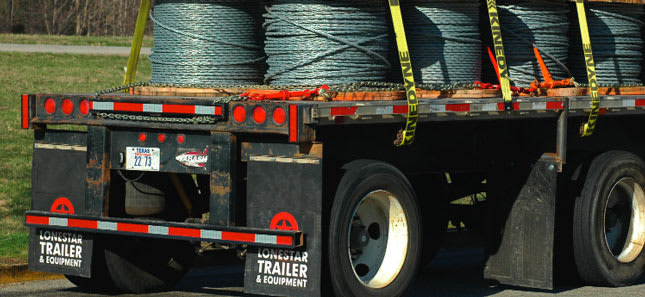
Carriers want fair and consistent enforcement of regulations that are understandable and teachable.
Open-deck carriers will have a lot on their minds going forward.
Coming out of a recession that hit the sector particularly hard, carriers using flatbed, lowboy and other open-deck trailers are facing shortages of equipment and drivers, and an 800-pound gorilla called CSA, the Federal Motor Carrier Safety Administration's new enforcement regime.
Open-deck operators are subject to all the usual enforcement and corresponding SMS BASIC scores, but to a greater degree than most other sectors, they have to deal with points accumulating on their Cargo BASIC scores.
One of the big issues is that open deck carriers are more likely to have violations because their violations are more visible, says Rob Abbott, vice president of safety at the American Trucking Associations.
"Based on the feedback we got from our members in the flatdeck industry and other sectors, we identified a number of problems with the methodology related to the Cargo BASIC," he says. "The methodology was not really effective at pointing the Federal Motor Carrier Safety Administration to carriers that were truly unsafe. That is, carriers with high Cargo BASIC scores are not necessarily unsafe carriers."
FMCSA agreed, after some discussion, to withhold that BASIC while it was re-engineered - including reworking some of the severity weights.
While that leaves open-deck carriers freer of the some of the burden of public scrutiny for the time being, peer-to-peer comparisons will still be a challenge.
"That's going to be very difficult for the agency to do, because they don't know who open deck carriers are. They aren't identified as such," Abbott says. "First, FMCSA will have to identify what makes an open deck carrier. For example, if more than say, 70 percent, of the fleet is open deck, would that make you an open deck carrier? Then, they have to set up a definition so they can make peer-to-peer comparisons."
Al Koenig, founder of Midwest Specialized Transportation in Rochester, Minn., was involved in the pilot runs of CSA in seven states. He says what we're seeing today is about what he expected based on the results of the pilot program.
"I'm not aware of any glaring problems so far, but there are going to be challenges to overcome," he says. "We need some way of getting all the states and various enforcement agencies reading from the same book. There are still disparities in how the rules are interpreted. And then we'll need some sort of arbitrator to help settle the inevitable disputes over the veracity of a citation. If a carrier is proved right, then the citation has to come off the record."
That concern is one all carriers share about all the SMS BASICs, but given the additional exposure in the cargo securement area, open-deck operators have real reason to be concerned.
The Commercial Vehicle Safety Alliance is aware of carriers' concerns and has been working for several years to identify inconsistencies in enforcement.
"We've had a data quality project under way for three years looking at just that," says Collin Mooney, deputy executive director of CVSA. "Under the previous system, the number of violations really didn't matter. They all sent the carrier the same message. Now, the numbers make a difference, and we're working within the ASPEN software infrastructure to 'hard code' the violations so they are recorded fairly and appropriately."
While industry calls for clarity and consistency in enforcement, some say it's time to take a hard look at driver training standards.
Lew Grill is a truck accident investigator and reconstructionist who also serves as an expert witness in truck crash litigation. He's seen his share of driver gaffes. For the most part, he says, drivers with the major flatdeck operations are pretty well trained, but there's still room for improvement in some sectors of the industry.
"I see problems with the drivers who aren't working in the for-hire industry, but for private companies, mining, utilities, and the fabricated steel industry," Grill says. "These guys maybe aren't getting the training the motor carriers provide and they're lacking certain knowledge."
It's the same with the cops, Grill says. "We've got local and county police officers conducting cargo securement inspections, and they often aren't to CVSA standards. Or they are enforcing certain state regulations interstate carriers may not be familiar with. Obviously there's still work to be done getting everyone on the same page."
At the present time, the SMS Cargo BASIC scores are not part of the carrier's public profile, but we hear shippers are asking for them. Carriers can access their own Cargo BASIC scores, and presumably pass them along to interested parties.
But before you do, you'd better check them out and make sure they are consistent with the rest of your profile. They may not be, and that might take some explaining.
From the June 2011 issue of HDT.
More Safety & Compliance

ZF Expands Commercial Vehicle Push in North America
ZF is expanding its North American commercial-vehicle presence with new transmission applications, electrification, trailer technology and autonomous-driving systems.
Read More →
Truck Drivers Need More Than Another Alert
Fleets have more visibility into truck health, safety events, and driver activity than ever. The next challenge is turning all that information into useful guidance for the person who has to decide what to do next.
Read More →
Tesla Wants a Self-Driving Semi. Are Cameras Enough?
Could Tesla’s camera-only autonomous driving technology work on an 80,000-pound Semi? In this commentary, HDT's Deborah Lockridge takes a look at Tesla, Cybercab, and how autonomous trucks see the road.
Read More →
What DOT’s Automated Vehicle Strategy Means for Trucking
The U.S. Department of Transportation issued a new automated-vehicle strategy that outlines plans for driverless-truck regulations, cross-state freight corridors, and federal safety standards.
Read More →
NYC Expands Speed, Pedestrian Safety Tech Across Fleet
New York City is expanding intelligent speed assistance and pedestrian-alert systems across its municipal fleet, moving the technologies from pilot programs into vehicle procurement and retrofit requirements.
Read More →
FMCSA Removes 110 Truck Driver Training Schools from Certified ELDT List
Federal regulators also are targeting more than 160 additional training providers and launching a nationwide audit of third-party CDL skills testers as part of a broader crackdown on trucking fraud.
Read More →
Beyond DOT Compliance: What Makes a Trucking Fleet Truly Safe?
A trucking fleet can follow every rule and still make unsafe decisions. The real test comes when safety conflicts with freight, productivity, or cost.
Read More →
Hours of Service Pilot Programs: FMCSA Readies for 2027 Rollout
Two pilot programs could eventually reshape hours-of-service rules, giving truck drivers options to pause their 14-hour clock or use longer split sleeper rest periods.
Read More →
New Guide Offers Pet Safety Tips for Truck Drivers
Hundreds of thousands of pets travel in truck cabs. A new safety guide from Volvo Trucks and the Center for Pet Safety offers practical advice for truck drivers who bring dogs and cats along for the ride.
Read More →
Medical Cards, English Proficiency Reshape Roadcheck Violations
Medical-card violations jumped to the top of the driver out-of-service list during CVSA’s 2026 International Roadcheck, while English-language proficiency violations appeared among the leading violations for the first time.
Read More →