





Related: The Hazards of Hauling Hemp
Commentary: Drug Testing Clearinghouse – It's About Time
A drug testing clearinghouse that prevents drivers who test positive for drugs from simply moving to a different fleet looks to be coming in 2020. And it's none too soon for a problem that seems to be getting worse, says Editor in Chief Deborah Lockridge.
May 10, 2019
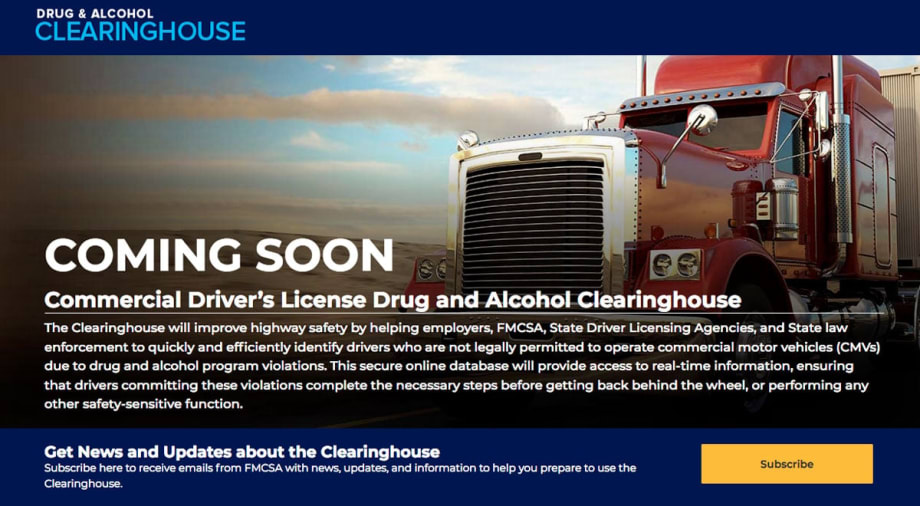
A drug testing clearinghouse that prevents drivers who test positive for drugs from simply moving to a different fleet looks to be coming in 2020. And it's none too soon for a problem that seems to be getting worse.
Image: FMCSA
3 min to read
For most of the nearly 30 years I’ve been covering trucking, the industry has been trying to get a federal clearinghouse put in place that will help prevent drivers who test positive for illegal drugs at one company from simply going down the road and getting a job at a different fleet.
It looks like the Federal Motor Carrier Safety Administration will finally have one in place in 2020. It’s none too soon, as several factors point to the likelihood that there are more drivers out there under the influence of drugs than the official statistics indicate – and that it’s getting worse.
The American Trucking Associations has lobbied for a national clearinghouse of positive test results pretty much ever since the federal government started required drug and alcohol testing of commercial truck drivers in the 1990s.
Finally, in late 2016, the FMCSA published a final rule to set up the Commercial Driver’s License Drug and Alcohol Clearinghouse, with a compliance date of January 2020.
Why has it taken so long? Other than the overall general slow rulemaking process, my guess is that there has been a sense of complacency. The positive drug test results as tracked by the agency remained around 2% or lower. But those numbers quite likely are higher, and may be on the rise, especially in light of the opioid crisis and increasing numbers of states legalizing marijuana use (which remains illegal for commercial truck drivers.)

Credit:
HDT File Image
Last year, Quest Diagnostics, one of the primary labs used to conduct employment drug and alcohol tests, reported that the transportation and warehousing industry saw a 21% increase in positivity rates between 2015 and 2017. And that was before four semi-synthetic opioids (including hydrocodone) were added to the federally mandated drug-testing panel for safety-sensitive workers in January 2018. Quest said that change has resulted in increases in year-over-year positivity rates for workers covered by these rules, including truck drivers.
Even more concerning is what fleets are discovering that use hair testing for pre-employment drug tests. Proponents of this testing method argue that hair testing has advantages over urine testing, including a longer detection window, easier collection, and results that are harder to fake. Among those proponents is the Alliance for Driver Safety & Security, an industry-based safety advocacy group for reducing large truck crashes.
One of the requirements for being a fleet member of the Alliance is using hair testing for pre-employment testing of drivers. When these fleets compare their hair-testing results to their urine-testing results, they find approximately nine times more people fail their hair test than the urine test, according to Lane Kidd, managing director of the Alliance.
Yet drivers who fail a hair test at one fleet can simply walk next door to a fleet that only does urine testing and have a far better chance of getting hired.
While hair testing results won’t be a part of the drug and alcohol clearinghouse, at least it’s a step in the right direction, and FMCSA appears to be making progress in meeting the January 2020 deadline. The agency recently announced a website, https://clearinghouse.fmcsa.dot.gov, with information and answers to frequently asked questions.
According to the website, sometime this fall, users will be able to establish an account that will allow access to the clearinghouse once it becomes operational on Jan. 6, 2020. (Although it wouldn’t surprise me if the agency asks for a deadline extension.)
Once it’s fully operational, whether that’s Jan. 6 or another date, use of the clearinghouse will be mandatory to report and query information about driver drug and alcohol program violations.
As with any regulation, there’s always the potential for unintended consequences. Carriers are concerned it could slow down hiring time, for instance. But in general, it’s a long-overdue move.
Subscribe to Our Newsletter
More Safety & Compliance

FMCSA Pauses Biennial-Update Enforcement Amid Motus Transition
Carriers whose updates were due on or after June 1 have more time, while FMCSA works to stabilize its new registration system and warns of phishing sites impersonating its new carrier registration system, Motus.
Read More →
ZF Expands Commercial Vehicle Push in North America
ZF is expanding its North American commercial-vehicle presence with new transmission applications, electrification, trailer technology and autonomous-driving systems.
Read More →
Truck Drivers Need More Than Another Alert
Fleets have more visibility into truck health, safety events, and driver activity than ever. The next challenge is turning all that information into useful guidance for the person who has to decide what to do next.
Read More →
Tesla Wants a Self-Driving Semi. Are Cameras Enough?
Could Tesla’s camera-only autonomous driving technology work on an 80,000-pound Semi? In this commentary, HDT's Deborah Lockridge takes a look at Tesla, Cybercab, and how autonomous trucks see the road.
Read More →
What DOT’s Automated Vehicle Strategy Means for Trucking
The U.S. Department of Transportation issued a new automated-vehicle strategy that outlines plans for driverless-truck regulations, cross-state freight corridors, and federal safety standards.
Read More →
NYC Expands Speed, Pedestrian Safety Tech Across Fleet
New York City is expanding intelligent speed assistance and pedestrian-alert systems across its municipal fleet, moving the technologies from pilot programs into vehicle procurement and retrofit requirements.
Read More →
FMCSA Removes 110 Truck Driver Training Schools from Certified ELDT List
Federal regulators also are targeting more than 160 additional training providers and launching a nationwide audit of third-party CDL skills testers as part of a broader crackdown on trucking fraud.
Read More →
Beyond DOT Compliance: What Makes a Trucking Fleet Truly Safe?
A trucking fleet can follow every rule and still make unsafe decisions. The real test comes when safety conflicts with freight, productivity, or cost.
Read More →
Hours of Service Pilot Programs: FMCSA Readies for 2027 Rollout
Two pilot programs could eventually reshape hours-of-service rules, giving truck drivers options to pause their 14-hour clock or use longer split sleeper rest periods.
Read More →
New Guide Offers Pet Safety Tips for Truck Drivers
Hundreds of thousands of pets travel in truck cabs. A new safety guide from Volvo Trucks and the Center for Pet Safety offers practical advice for truck drivers who bring dogs and cats along for the ride.
Read More →