




CNG: Monarch Beverage Spends $16.5 Million to Convert Fleet
Monarch Beverage Co. of Indianapolis is spending $16.5 million to convert its truck fleet to natural gas.

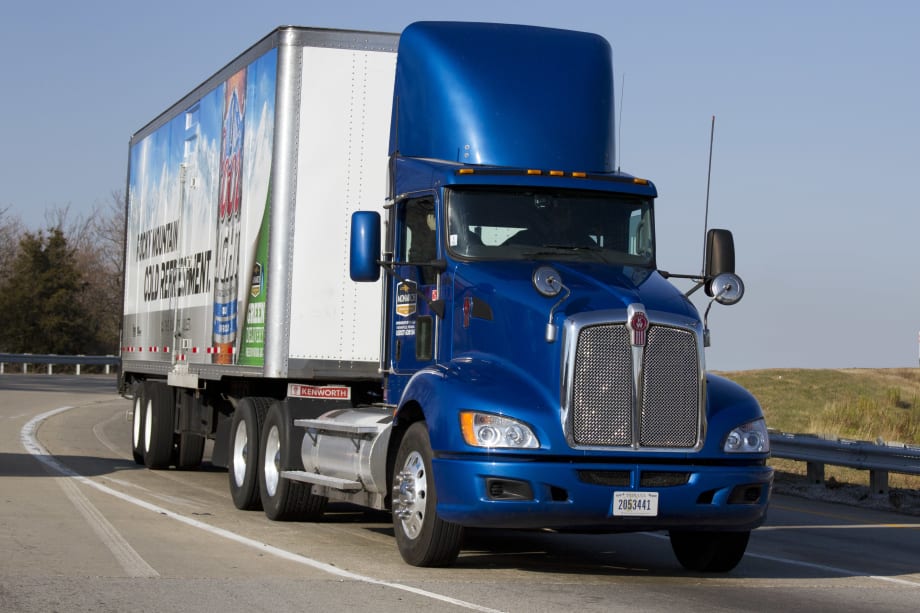
Monarch’s highway tractors
like this Kenworth T660 run enough
miles to pay off the investment in CNG equipment within three years, according to the fleet’s calculations.
The numbers are adding up for Monarch Beverage, which distributes scores of beer and wine products to retail customers in Indiana from a sprawling headquarters with a warehouse and terminal on the northeast side of Indianapolis. Its facilities are modern, attractive and efficient, and executives cultivate a positive and “green” image in all their operations.
Monarch’s highway tractors
like this Kenworth T660 run enough
miles to pay off the investment in CNG equipment within three years, according to the fleet’s calculations.
Their commitment to being green is why Monarch is spending $16.5 million to convert its truck fleet, which operates as E.F. Transit, to clean-burning natural gas. It has 110 tractors, and soon 85 of them will be new natural gas-burners with Cummins Westport ISL G and ISX12 G engines.
Green can also mean money, and compressed natural gas provides the means to save a lot of it, explains Fred Dufour, executive vice president, operations. The fleet has locked in its cost for several years at $1.70 per diesel equivalent gallon, minus a 50-cent-per-gallon federal tax credit (which runs through the end of this year, though Congress might extend it). Diesel fuel is pegged at $3.80 a gallon, though Dufour says he’s heard it could go to $5 and $6 per gallon.
Line-haul tractors average 80,000 miles annually and use enough fuel to mean good per-gallon savings, Dufour says. Delivery trucks, which run fewer miles, can piggyback onto the benefits. He figures running costs at 62 cents per mile for diesel and 22 cents for natural gas. That provides 40 cents a mile for maintenance, so it doesn’t matter that a set of spark plugs for the Cummins ISL G and ISX12 G engines costs $250.
Payback on the considerable investment on natural gas equipment should come in two and a half to three years, he’s calculated. The investment includes buying new tractors, each of which carries a $60,000 incremental cost; $2.3 million for a fast-fill CNG station on the premises; plus modifying the shop with natural gas-safe light fixtures, methane detectors and ventilation fans.
A buildup of gas will trigger alarms, activate the fans and open doors; the system will send an automatic alert to the local firehouse.
“We also had detectors put in the warehouse, even though they’re not required,” he says. “It’s for peace of mind.”
Dufour has arranged for his trucks to use another company’s CNG filling station along Interstate 65, near Lafayette, if need be.
At the home terminal, natural gas from a high-pressure main out front on Pendleton Pike is piped in to a filtration and pumping complex Monarch had installed across a paved lot from its truck shop and the fueling station. The equipment includes three high-pressure pumps (plus a concrete pad for a fourth, in case Monarch decides to build a public CNG station out near the street). The pumps send natural gas to dispensers used by tractors as they come in from their runs.
Generally, Monarch’s tandem-rear-axle road tractors pull vans loaded with palletized beer to the Chicago area, where the beer is traded for wine. They return to Indianapolis, offload and take beer ingredients to Cincinnati. There they pick up cases of beer and come back to the home terminal. The cycle repeats often.
Single-rear-axle delivery tractors pull bay-type beverage trailers and make regular rounds on routes within Indiana.
Tractors are Freightliner M2-112s and Kenworth T440s. Initial units have a pair of saddle tanks, each holding 40 diesel-gallon equivalents of CNG, but they have proven susceptible to rock damage. Newer ones have back-of-cab cabinets with either 100- or 112-DGE tanks. The tanks are Type 4, made of aluminum wrapped in composite material for lighter weight. Even so, a natural gas tractor weighs 2,000 to 3,000 pounds more than a diesel, DuFour says.
However, legislatures in Indiana and Ohio have passed laws providing an allowance of 2,000 pounds for a natural gas tractor. Dufour also has begun buying lightweight vans to make up some of the difference.
With wide-base single tires and wheels and aluminum crossmembers, they scale at 2,000 pounds less than older vans – more good numbers for this operation.
Natural gas engines available
The fleets described in the accompanying natural gas stories all use natural gas engines from Cummins Westport, a joint venture between Cummins Inc. and Westport Innovations. Its engines are offered by most Class 8 truck builders, and include:
ISL G: A spark-ignition, 8.9-liter engine based on the midrange-size but heavy-duty Cummins ISL9 diesel. It runs on 100% natural gas, so needs only a simple three-way oxygen catalyst in its exhaust system to meet emissions regulations. The ISL G has ratings from 250 to 320 horsepower and 730 to 1,000 pounds-feet. To compensate for modest power in Class 8 applications, an Allison automatic transmission is mandatory. The ISL G is available in various models from Freightliner, International, Kenworth, Peterbilt, Mack, Volvo and Crane Carrier Corp.
ISX12 G – A larger 11.9-liter spark-ignition engine based on Cummins’ ISX12 diesel. Introduced in March, the 12G has ratings from 320 to 400 horsepower and 1,150 to 1,450 pounds-feet. Higher output than the ISL G means the ISX12 G can power heavier rigs at highway speeds, and can be used with manual transmissions and as well as automatics. So far it’s offered (or soon will be) in various models by Freightliner, Kenworth, Peterbilt, Mack and Volvo.
A larger natural gas engine in limited service is the 15-liter Westport Innovations 15L dual-fuel. An extensively modified Cummins ISX15, the 15L uses diesel fuel for pilot ignition with natural gas as the main energy source. It requires diesel exhaust aftertreatment equipment but has strong ratings: 400, 450 and 500 horsepower with torque of 1,450, 1,650 and 1,850 pounds-feet. It’s called the GX by Kenworth and Peterbilt, which offer it in several models with LNG fuel systems.
In 2014, Cummins says it will begin production of an ISX15 G, also a spark-ignition engine based on the ISX15 diesel. Like the 12G, the 15G will burn only natural gas and use a maintenance-free three-way catalyst packaged as a muffler, with no other aftertreatment needed.
A Volvo 12.8-liter dual-fuel engine, based on the D13 diesel, is also due out sometime in 2014.
Navistar has slowed development of a 12.4-liter dual-fuel engine based on its MaxxForce 13, and no introduction date is set.
In addition, many natural gas engines and fuel systems are available for medium and light trucks. NGV America offers a list at www.ngvamerica.org/about_ngv/available_ngv.html.
More Fuel Smarts

Geotab Links Fleet Card to Vehicle Data
The new card combines fuel discounts with telematics-based purchase controls. Geotab’s analysis also points to potential savings from choosing lower-priced fuel stops.
Read More →
Fleet Economics Shape Electric Truck Outlook
ACT Research expects costs, charging infrastructure, and technology improvements to drive zero-emission commercial vehicle adoption as federal regulations and incentives retreat.
Read More →
Wex Adds Cardless Fuel Payments for Over-the-Road Customers
A new fuel card feature for Wex customers offers convenience and security.
Read More →

New California Law Could Shed Light on Electric Truck Prices
Why do battery-electric Class 8 trucks remain so expensive? A California bill signed by Gov. Gavin Newsom would give fleets and state agencies more visibility into what manufacturers charge.
Read More →
How Volvo Updated Its D13 for EPA 2027 [Watch]
Volvo’s updated D13 promises lower emissions without sacrificing performance or fuel economy. Take a closer look at what changed inside the engine in this HDT Spotlight video.
Read More →
Diesel Price Spike Shortens Payback for Natural Gas Trucks, Report Says
Energy Vision estimates fleets could recover the higher purchase price of an RNG-fueled Class 8 tractor in 1.3 to 2.8 years under current fuel-price scenarios.
Read More →
Calstart Becomes Catalyst Mobility, Reflecting Broader Focus
Calstart is now Catalyst Mobility, reflecting the nonprofit’s growing national role in clean transportation, including zero-emission trucks, infrastructure and incentive programs.
Read More →
Record Diesel Prices Squeeze Trucking Fleets
Average U.S. diesel prices have climbed to nearly $6 a gallon, surpassing the 2022 record as tight refinery capacity and Middle East disruptions keep fuel costs elevated.
Read More →
How Fuel Delivery Shapes Engine Performance
Fuel delivery depends on more than what happens at the injector. For fleet, maintenance and technical professionals, looking at the full path from pump to injector can provide useful context for understanding engine performance.
Read More →
East Coast Port Launches $45M Electric Truck Push
The Port Authority of New York and New Jersey announced millions in incentives for zero-emission drayage trucks, yard tractors, and new charging hubs near the port.
Read More →