




Class 6-7 Update: Changing Faces
Some manufacturers have enough existing trucks to last well into the new year, so are delaying the start of their 2011 model years, while others will begin them as soon as January

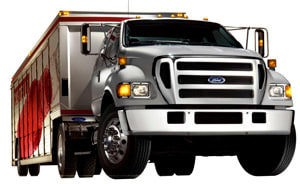
Ford's F-750 conventional, shown here, continues as a product of the Ford-Navistar Blue Diamond joint venture that builds the trucks in Escabedo, Mexico, basically using Ford cabs on International chassis.
Some manufacturers have enough existing trucks to last well into the new year, so are delaying the start of their 2011 model years, while others will begin them as soon as January.
Manufacturers are now installing EPA-'07-spec diesels in 2010-model trucks, and when they begin installing EPA-2010 diesels, those trucks will be called 2011 models. When they switch to the new, ultra-clean-burning diesels will determine the model-year switch. Not all have announced when their new model years will begin, or have disclosed their upcharges for the new, more expensive engines.
Builders are free to start a model year as much as 364 days ahead of the calendar year for which it's named, according to federal law. Thus the 2011 model year can start as soon as Jan. 2, 2010, and it will for a few builders. Others will begin later that month, or in February, March or beyond. One company that usually starts a model year in January will delay it until autumn because its new models with the 2010 diesels won't be ready until then.
Buyers don't complain about pull-ahead model years because it makes their motor vehicles seem newer than they are, and they're worth thousands of dollars more at trade-in time.
Medium-duty and some heavy-duty trucks have limited frame space, so builders who'll use diesels with selective catalytic reduction had to find ways to package the aftertreatment equipment completely under truck cabs. This will leave the backs of cabs and frame rails "clean" for mounting bulky bodies, like those for beverage and utility work that drape down on either side of a frame, and high-capacity dump beds mounted on multi-axle chassis where two or more lift axles are placed ahead of the tandem.
Builders tried to think of every application and have designed many ways to mount the equipment. Buyers and body upfitters must be sure to order the correct exhaust configurations to suit their hauling jobs and truck bodies, because except for the tail pipe, altering the exhaust system is strictly against EPA's rules.
SCR aftertreatment equipment will include a small tank for diesel exhaust fluid used with SCR, a dosing chamber where the fluid is sprayed into exhaust to break down oxides of nitrogen (NOx), and associated pumps, plumbing and electrical lines. DEF gauges with warning lights will be placed in instrument panels to tell drivers when fluid is ample or running low; engines will lose power when tanks are close to empty, providing a realistic incentive for drivers to replenish the DEF tank. The upside of SCR is better fuel economy - 3 to 6 percent better than now and maybe more, the builders claim.
To make room for the new equipment, smaller fuel tanks will be needed. This will cut 20 or more gallons from fuel capacity and require more frequent topping off. On the other hand, less fuel carried will partially make up for the aftertreatment equipment's weight, which builders estimate will total 200 to 300 pounds for a midrange truck and 350 to 600 pounds for a heavy truck.
All diesel-powered trucks will continue to use exhaust-gas recirculation, oxidation catalysts and diesel particulate filters. DPFs will be mounted next to the SCR equipment in "switchback" order for compact under-cab systems, or components will sit one after the other in the exhaust system under the frame or in the stack. Builders will place the SCR chamber ahead of or behind the DPF in the exhaust stream. Van and reefer bodies usually sit atop the frame rails, so there's ample room along frames to stretch out all SCR and DPF equipment between the cab and the rear axle.
Only Navistar International is avoiding SCR equipment on its EPA 2010 diesels because it's dealing with NOx entirely within its engines. Navistar says its system, called Advanced EGR, will save substantial weight and bulk on the chassis, and operators won't have the bother of having to top off the diesel exhaust fluid tanks. But fuel economy won't be much better than it is with current engines.
As for available Class 6 and 7 products, there are fewer this year as industrywide consolidations continued. Daimler Trucks North America eliminated its Sterling operations, and with it the Acterra line of medium- and medium-heavy trucks. General Motors was unsuccessful in attempts to sell its Class 4 through 7 and Baby 8 products to another manufacturer, so it pulled the plug on them early last summer, while in the throes of its bankruptcy. Gone are Chevrolet and GMC C-4500 through 8500 conventionals and T-6500 through 8500 tiltcabs. The heavier T series models were also sold as Isuzu's F series, and Isuzu is now pondering where it will build replacements.
Although many Sterling Acterras and Chevy/GMC C and T series trucks remain on dealers' lots, buyers of Class 6 and 7 trucks are otherwise left with nine nameplates compared with 13 not many years ago. Yet that's more than enough under the current sales circumstances, and when sales come back there will be many models among those nameplates to handle any hauling or working task.
Ford
Ford's F-650 and F-750 conventionals continue as products of the Ford-Navistar Blue Diamond joint venture that builds the trucks in Escabedo, Mexico, basically using Ford cabs on International chassis. Sole power is the Cummins 6.7-liter ISB, with ratings from 200 horsepower and 520 pounds-feet to 360 horsepower/800 pounds-feet. In April, the plant will begin installing EPA 2010-legal engines with SCR equipment hung on the main frame or packaged in wrap-around style under cabs' right side. Available are a variety of drivetrain components, including high-capacity single rear axles that take GVW ratings into Class 8. As in previous years, buyers can choose a two-door Regular cab or four-door Super and Crew cabs, all from the higher volume SuperDuty series. New interior trim for 2010 includes grey upholstery and panels, and available overhead and floor consoles. Ford does not offer any hybrid-drive trucks, but supplies chassis to specialty companies who outfit them with hybrid mechanisms.
Freightliner
The M2-106 is Freightliner's main Class 6 and 7 truck, and continues with two-door Regular and Extended cabs and a four-door Crew Cab. A V-for-vocational variant has a front frame extension to accommodate a front-drive PTO, hydraulic pump, snow plow or stabilizers. An M2e hybrid uses the Eaton electric-drive system with a 240-horsepower Cummins ISB. The ISB is also used in straight-diesel trucks since the Mercedes 926 diesel was phased out earlier this year. For 2010, engineers extensively upgraded the M2's electrical systems. A power distribution module was moved from the frame to inside the cab for better protection; as many as 10 Wired Rite auxiliary switches can be installed on the dash at the factory and plugged into later. A variety of functions, like wipers on when headlights are on, headlight flashing, and remote start with PTO re-engagement, can be programmed into the multiplexed chassis controls.
Hino
Hino's 2011 model year starts in January, when restyled Class 6 and 7 models appear. They get a blockier nose and a squarish chrome grille, and will be powered by the six-cylinder JO5E diesel that is being certified with an SCR aftertreatment system. The per-truck upcharge for the SCR system is $6,700. Hino's model designations suggest the approximate GVW rating (the first two numbers) and engine size in liters (the last number), and so it is for this segment, where Hino's models are rated from 23,000 to 33,000 pounds GVW. They include the 238, 258, 258LP (low-profile), 258ALP (low-profile with optional Eaton UltraShift), 268, 268A (optional Eaton US), and 338 and 338CT (conventional tractor). The 338 truck can be derated to 26,000 pounds so it can be operated by non-CDL drivers. The 338CT is a short-wheelbase 338 truck fitted with a fifth wheel, tractor-supply air valve and other equipment by Fontaine Modification, which is ope
More Equipment

How Volvo Updated Its D13 for EPA 2027 [Watch]
Volvo’s updated D13 promises lower emissions without sacrificing performance or fuel economy. Take a closer look at what changed inside the engine in this HDT Spotlight video.
Read More →
Michelin Tire Improves Efficiency and Durability for Regional Fleets
The Michelin X Multi Energy D2 is a regional haul drive tire engineered to help fleets improve fuel efficiency, durability and traction in demanding stop-and-go operations.
Read More →
ZF Expands Commercial Vehicle Push in North America
ZF is expanding its North American commercial-vehicle presence with new transmission applications, electrification, trailer technology and autonomous-driving systems.
Read More →
Tesla Wants a Self-Driving Semi. Are Cameras Enough?
Could Tesla’s camera-only autonomous driving technology work on an 80,000-pound Semi? In this commentary, HDT's Deborah Lockridge takes a look at Tesla, Cybercab, and how autonomous trucks see the road.
Read More →
Kodiak: Driverless Long-Haul Truck Launch on Track for 2026
Kodiak AI says its driverless long-haul safety case is 93% complete and it remains on track to begin commercial operations by year-end 2026.
Read More →
What DOT’s Automated Vehicle Strategy Means for Trucking
The U.S. Department of Transportation issued a new automated-vehicle strategy that outlines plans for driverless-truck regulations, cross-state freight corridors, and federal safety standards.
Read More →
East Coast Port Launches $45M Electric Truck Push
The Port Authority of New York and New Jersey announced millions in incentives for zero-emission drayage trucks, yard tractors, and new charging hubs near the port.
Read More →
PlusAI Going Public to Fund Autonomous Truck Launch
A SPAC deal could provide PlusAI with up to $300 million as it works toward a 2027 commercial launch of factory-built autonomous trucks.
Read More →
NHTSA Moves to Rewrite Truck Fuel-Economy Rules
The National Highway Traffic Safety Administration says it lacks authority to regulate medium- and heavy-duty truck engines separately from complete vehicles, but the existing standards have not yet been eliminated.
Read More →
Detroit Opens Orders for EPA 2027 Engines
Detroit isn’t starting from scratch to meet EPA 2027 diesel emissions standards. Its Gen 6 DD13 and DD15 engines keep much of today’s platform while updating the fuel and aftertreatment systems.
Read More →