




Class 3-5 Update: Model Year Mash-up
Look for altered model years from many builders after Jan. 1 as they prepare to begin installing EPA 2010-legal diesels in their commercial trucks at various points next year

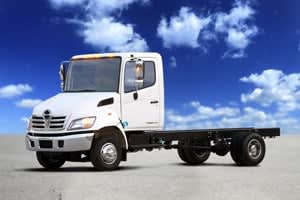
2010 engines push debut of some 2011 trucks well into the new year. Shown is Hino's model 145.
Look for altered model years from many builders after Jan. 1 as they prepare to begin installing EPA 2010-legal diesels in their commercial trucks at various points next year.
This means the current 2010 model year will end six to 15 months after it began, depending on builders' plans on how to title the newly equipped trucks. The new diesels will be significantly more expensive, and some makers say customers are pre-buying current vehicles to beat the price hikes.
Upcharges for the 2010-legal diesels in light- and medium-duty trucks will range from about $4,000 to $7,500 per truck, according to builders who have announced them. Some haven't, partly because they are delaying introduction of trucks with the new engines, which in turn is because of dismal sales - off 40 to 60 percent from last year, depending on vehicle class. Sales will come back as the economy does, and then a lot of pent-up demand will cause gradually increasing orders through 2012 and beyond, truck manufacturers believe.
Meanwhile, starting in January, diesels for most trucks, including Classes 3, 4 and 5, will meet new EPA emissions limits with selective catalytic reduction, or SCR, which injects a urea fluid into the exhaust stream to break down nitrogen oxide into harmless nitrogen and water. An exception is Navistar International, which is going with an in-cylinder solution it calls advanced exhaust-gas recirculation, or A-EGR.
Levels of NOx emitted by 2010 diesels will be 83 percent less than current 2007-legal diesels, except for builders who've earned credits and can sell diesels that can emit slightly higher amounts of NOx than the new standard otherwise allows.
Gassers still available
Another exception is gasoline power. Chrysler, Ford and General Motors will continue to offer gasoline V-8s in most of their commercial models. Ford has announced an entirely new 6.2-liter gasoline V-8 for its F-SuperDuty trucks. It will complement its previously described 6.7-liter Power Stroke V-8 diesel. Ford also says it is installing hardened valves and other parts to allow safe conversion to propane or natural gas fuel.
General Motors and the Dodge division of Chrysler have upgraded their existing gasoline V-8s with variable valve timing, cylinder deactivation and other advances to make them more powerful and economical. GM and Ford will mate those engines with 6-speed automatics to further enhance efficiency and responsiveness.
Although some commercial buyers chose gasoline engines during the height of $4- and $5-per gallon fuel in 2007-08, reasonable fuel prices since then have swung the advantage back to diesel for serious operators, at least those who put moderate to high annual miles on their trucks. Import brands never did dally with gasoline power because diesels are all they have for trucks, and they figured that diesels would again be favored after the madness ended. Hefty upcharges for EPA '10 diesels, though, might give gasoline another boost, and high fuel prices could come back.
EPA 2010 diesels = 2011-model trucks
All builders have accumulated stocks of unsold trucks that will be around for a while, and this affects each manufacturer's plans for building trucks with '10-legal diesels after Jan. 1. Most builders will title their EPA-'10-powered trucks as 2011 models. Some will begin that model year early, as soon as January and February in two cases. Others will delay fielding EPA-'10-powered trucks for months into calendar year 2010, extending their current 2010 model years accordingly.
In other words, most trucks getting 2010-legal diesels will be 2011s, and most trucks still getting EPA-'07-spec diesels will remain 2010s.
Historically, Japanese builders have been the most aggressive in pulling ahead model years, usually starting them in January of the previous calendar year, which is entirely legal under U.S. federal law. For the 2011 model year, Hino will change over in February. But Fuso will begin its '11 model year in the spring, Isuzu will wait until next summer, and Nissan Diesel America will delay its 2011 model year until next fall. In the meantime, all will continue selling '10-model trucks with EPA-'07 diesels.
Among the domestics, Chrysler and Ford will begin selling '11 models with '10-legal diesels in spring, and at that time will start titling them as '11s. General Motors, which is still in the commercial market with various Class 1, 2 and 3 models, will begin installing '10-legal diesels in some Class 2 and 3 trucks in late spring. These will initially be titled as 2010s, then become 2011s after the traditional summer plant shutdowns for vacations and product alterations.
Between now and then, GM will go through a "dark period" for diesels as supplies of the current Duramax V-8 run out and the upgraded '10-legal Duramax goes into production in spring. No diesel-powered trucks will be built from February until late May. Then the new Duramax begins going in '10-model heavy pickups and cab-chassis models. Orders closed in September for diesel-powered G-vans, but availability will resume with production of the new Duramax.
GM's killing of its medium-duty business last summer followed unsuccessful attempts to sell its line of Class 4 through 7 and baby 8 conventionals and tiltcabs. A proposed deal with Navistar International fell through the previous summer when details couldn't be agreed on and a shrinking market made the deal financially unfeasible for Navistar. GM's announcement that mediums would be discontinued came rather abruptly, in the midst of its bankruptcy. Some dedicated truck people within GM are not happy about it.
GM withdrawal hurts Isuzu
The GM withdrawal had serious effects on its partner, Isuzu Commercial Truck, for whom GM assembled a gasoline-powered Class 3 NPR and several Class 6 and 7 F models. The Fs and their GMC and Chevy T-series clones were built in Flint, Mich., using GM frames and various domestic components with Isuzu's 6H diesel and an Isuzu cab. The NPR Gas was made in Janesville, Wis., until April; it used a GM Vortec 6000 V-8 with a Hydra-matic transmission on a domestic frame with a cab from Japan.
The NPR Gas and diesel-powered Class 3 and 4 NPRs from Japan were also sold as Chevy and GMC W-series trucks. Isuzu says it's negotiating with GM to resume making the gasoline version of the NPR at another plant, and it's weighing its options on where to source the heavier F models. They could come from Japan or Isuzu could establish another domestic source.
What about service for Chevy and GMC W and T-series trucks? GM's commercial-truck dealers will keep their franchises and continue selling leftover trucks and servicing existing ones until October 2010, though many will phase out between now and then. An expanded network of Isuzu dealers will then take over; the network will grow from 225 now to between 325 and 350 by late next year, Isuzu says. Some GM W and T dealers might become Isuzu dealers, and some already are.
Another LCF casualty
Another recent low-cab-forward casualty was the International CityStar LC 500 and 600, which are Class 3 and 4 models that, under the Ford-Navistar Blue Diamond joint venture, are clones to the Ford LCF. Navistar and Ford agreed to drop them because low sales volume wouldn't support upgrading its MaxxForce 5 V-6 diesel to meet 'EPA-10 requirements. The CityStar-LCF was the only application for the V-6, and it might or might not return later. Slow sales also caused Navistar to withdraw its Class 5 DuraStar 4100 conventional, so the lightest Internationals are now Class 6 models.
Likewise gone with the shutdown last March of Sterling Truck is the Class 4 model 360 LCF, which was supplied by Fuso, a sister company. Also dropped were the Class 4 and 5 Bullet conventionals, which were rebadged and slightly restyled Dodge Ram 4500 and 5500 chassis-cab trucks from Chrysler. And after Daimler A
More Equipment

How Volvo Updated Its D13 for EPA 2027 [Watch]
Volvo’s updated D13 promises lower emissions without sacrificing performance or fuel economy. Take a closer look at what changed inside the engine in this HDT Spotlight video.
Read More →
Michelin Tire Improves Efficiency and Durability for Regional Fleets
The Michelin X Multi Energy D2 is a regional haul drive tire engineered to help fleets improve fuel efficiency, durability and traction in demanding stop-and-go operations.
Read More →
ZF Expands Commercial Vehicle Push in North America
ZF is expanding its North American commercial-vehicle presence with new transmission applications, electrification, trailer technology and autonomous-driving systems.
Read More →
Tesla Wants a Self-Driving Semi. Are Cameras Enough?
Could Tesla’s camera-only autonomous driving technology work on an 80,000-pound Semi? In this commentary, HDT's Deborah Lockridge takes a look at Tesla, Cybercab, and how autonomous trucks see the road.
Read More →
Kodiak: Driverless Long-Haul Truck Launch on Track for 2026
Kodiak AI says its driverless long-haul safety case is 93% complete and it remains on track to begin commercial operations by year-end 2026.
Read More →
What DOT’s Automated Vehicle Strategy Means for Trucking
The U.S. Department of Transportation issued a new automated-vehicle strategy that outlines plans for driverless-truck regulations, cross-state freight corridors, and federal safety standards.
Read More →
East Coast Port Launches $45M Electric Truck Push
The Port Authority of New York and New Jersey announced millions in incentives for zero-emission drayage trucks, yard tractors, and new charging hubs near the port.
Read More →
PlusAI Going Public to Fund Autonomous Truck Launch
A SPAC deal could provide PlusAI with up to $300 million as it works toward a 2027 commercial launch of factory-built autonomous trucks.
Read More →
NHTSA Moves to Rewrite Truck Fuel-Economy Rules
The National Highway Traffic Safety Administration says it lacks authority to regulate medium- and heavy-duty truck engines separately from complete vehicles, but the existing standards have not yet been eliminated.
Read More →
Detroit Opens Orders for EPA 2027 Engines
Detroit isn’t starting from scratch to meet EPA 2027 diesel emissions standards. Its Gen 6 DD13 and DD15 engines keep much of today’s platform while updating the fuel and aftertreatment systems.
Read More →