




Cargo Vans Update
Depending on how the segment is counted, the market for full-size cargo vans is up about 12% over last year, which in turn was up 14% over 2009, builder sources say


The Nissan Van (NV) is now in its first year of production. Fleets are beginning to evaluate the 1/2-, 3/4- and 1-ton trucks.
Depending on how the segment is counted, the market for full-size cargo vans is up about 12% over last year, which in turn was up 14% over 2009, builder sources say.
Plumbers, electricians and other skilled trades people are replacing old, worn trucks, partly because there aren't any good used ones on lots. Some tradesmen are buying "tall utility vehicles" with enclosed, cabinet-equipped utility bodies mounted on cutaway van chassis. These are easier to work out of than short-roof vans.
Fleets are also buying cutaways - the van equivalent of cab-chassis models - to mount various types of bodies, reflecting a resurgence, however weak, in the general economy. Cutaways are usually 25-26% of the van business, but are currently 35-36%, General Motors says.
Ford is doing especially well with its E-series, whose sales are up by 50% so far this year. The company says its market share has grown to 57%, and it's doing it with only gasoline engines. Its own PowerStroke diesel won't fit in the bays of its E-series trucks. Some wondered if Ford was wise to not engineer in a smaller diesel, but so far it has not been an impediment.
General Motors is a solid second with its G-series vans, and nine out of 10 are sold with gasoline engines. GM and its suppliers have begun turning out natural gas-fuel conversions for GM's gasoline V-8s. And GM's Wirtzville, Mo., plant is working overtime to meet demand for cargo and passenger vans.
In the world of walk-in vans, Navistar's Workhorse says it has taken a sales lead. That's because it offers gasoline power as well as diesel, propane and now compressed natural gas alternatives on "right-sized" chassis, according to the company.
Navistar is moving production of its Workhorse vans within Indiana, from Union City to Wakarusa, where it assembles its eStar electric van and Monaco motor homes. It will idle many of Monaco's activities in Oregon, and close the Union City plant by early next year.
Freightliner Custom Chassis says it leads in diesel sales, and a gasoline option offered since last year is becoming popular. It might be in second place overall, but FCCC's commercial chassis business is up 40% over last year.
Customers are favoring gasoline engines for these types of trucks because they cost far less to buy than diesels. Expensive exhaust-aftertreatment equipment to cut pollution, especially for 2010, has made diesels more costly than they're often worth to customers, chassis builders say. A diesel lasts longer, pulls heavy loads better, and uses at least 30% less fuel. But it costs $8,000 to $15,000 more than a gasoline engine, and you can buy a lot of gas with that.
Most 2010-model diesels use selective catalytic reduction, along with diesel particulate filters first employed in 2007, to achieve ultra clean-burning performance. Navistar's MaxxForce 7 has a DPF but no SCR, and is still among the highest-priced diesels in the walk-in van segment.
Gasoline engines are also in the ultra-clean emissions category and do it with far less equipment. The engines run two to three times longer than they did in the old days, so contribute to a low overall cost of ownership, especially for lower-mileage operations, often the norm in walk-in vans. The threshold where buying a diesel makes sense is 25,000 to 30,000 miles per year, or with high gross weights or where trucks see a lot of PTO time, say FCCC and Workhorse.
The two chassis makers offer GM gasoline engines. Both use GM's Vortec 6000 mated to an Allison 6-speed automatic, and Workhorse uses GM's Vortec 4800 V-8 with a Hydra-matic 6-speed in a lighter chassis.
Propane and CNG can fuel those engines from Workhorse, but the suppliers of alternative fuel systems are different than those GM uses. FCCC has no propane or natural gas options at present, but by the middle of next year should have a compressed-natural-gas option for the Vortec engine. It will replace the Cummins ISB natural gas engine dropped at the end of 2009.
GM's Chevrolet and GMC vans use the two gasoline V-8s along with the Vortec 4300 gasoline V-6 and the 2010-spec Duramax V-8 diesel. GM says its 4.8-liter gasoline V-8 is a heavy-duty engine designed for 150,000 miles of life at 99% reliability. Eight out of 10 buyers of 3/4-ton vans choose the standard-issue 4.8. It has 280 horsepower and 296 pounds-feet of torque, so can do a proper hauling job, but uses less gas than the stronger 6-liter V-8.
Ford uses only its Triton gasoline V-10 with a TorqShift 5-speed automatic in its F-59 stripped chassis, which it announced in 2009. It's based on the F-53 motor home chassis. The 6.8-liter V-10 is also offered in Ford's E-series, including an ambulance package that's also available with the Triton 5.4 V-8. It's selling well because its lower cost makes it obtainable for cash-strapped private and municipal ambulance fleets.
It's been 50 years since the E-series began as the Econoline compact van in 1961. It then competed with similar vehicles from Volkswagen, General Motors and Chrysler. By the late 1960s, the Econoline and the Chevy and GMC compact products morphed into full-size vans. These replaced the builders' pickup-based "panel trucks" which originated in the 1930s. The E-series has been the best-selling full-size van for 35 years, Ford says, and it works constantly to upgrade the E-150 and SuperDuty 250 and 350 models to keep it in a leader mode.
Ford, GM and Daimler Vans' Sprinter now constitute the full-size van category. Under DaimlerChrysler, the Dodge division dropped its B-series vans to offer the Sprinter, then dropped it after the two companies split. Chrysler is now waiting for the appearance of commercial vans from its current parent, Fiat of Italy.
At the end of August, Chrysler began building its new Ram Cargo Van, or C/V, a Class 1 offering based on the Dodge Grand Caravan. It features a flat floor with 1,800 pounds capacity, a 3,600-pound tow rating and a GVW of 5,150 pounds. A heavy-duty suspension, radiator and transmission oil cooler beef it up for commercial service. Blanked-out windows hide what's inside and give it a panel-truck look, while a 3.6-liter Pentastar V-6 with a 6-speed automatic provides propulsion and delivers an estimated 25 highway mpg.
The Sprinter continues to be sold by certain Freightliner dealers, plus some recently added Mercedes-Benz dealers. Daimler began building a Mercedes network for the Sprinter in early 2010, and says its plans are on track. It is relatively easy for some Mercedes auto dealers to take on the truck franchise because they are familiar with its 3-liter V-6 diesel and 5-speed automatic transmission, a powertrain used in certain Mercedes-Benz cars. It's famously fuel-efficient in the Sprinter, often delivering more than 20 mpg.
The new Nissan Van, or NV, has met sales expectations in its first six months on the market, says Nissan Commercial Vans. Dealers have sold about 3,000, mostly to retail customers but with some being evaluated by fleets. Two-thirds of sales are for the tall-roof version and the rest for the standard-height roof. That surprised executives, who thought they'd be about 50-50.
The NV comes with two gasoline engines, a 5.6-liter V-8 and a 4-liter V-6. The six, available in 1500 and 2500 HD versions, is taking a slight majority of sales because customers want to save fuel. There are no plans for a diesel, and if the current industry trend toward gasoline engines continues, Nissan won't have to worry about one.
Dealers who took on the commercial van franchise had to devote people, facilities and equipment to the truck, which is bigger and heavier than anything else in the Nissan lineup. In the next six months, Nissan will begin offering passenger vans, but the emphasis now is on full-body cargo vans. No cutaway cab-chassis variants are planned.
More Equipment

ZF Expands Commercial Vehicle Push in North America
ZF is expanding its North American commercial-vehicle presence with new transmission applications, electrification, trailer technology and autonomous-driving systems.
Read More →
Tesla Wants a Self-Driving Semi. Are Cameras Enough?
Could Tesla’s camera-only autonomous driving technology work on an 80,000-pound Semi? In this commentary, HDT's Deborah Lockridge takes a look at Tesla, Cybercab, and how autonomous trucks see the road.
Read More →
Kodiak: Driverless Long-Haul Truck Launch on Track for 2026
Kodiak AI says its driverless long-haul safety case is 93% complete and it remains on track to begin commercial operations by year-end 2026.
Read More →
What DOT’s Automated Vehicle Strategy Means for Trucking
The U.S. Department of Transportation issued a new automated-vehicle strategy that outlines plans for driverless-truck regulations, cross-state freight corridors, and federal safety standards.
Read More →
East Coast Port Launches $45M Electric Truck Push
The Port Authority of New York and New Jersey announced millions in incentives for zero-emission drayage trucks, yard tractors, and new charging hubs near the port.
Read More →
PlusAI Going Public to Fund Autonomous Truck Launch
A SPAC deal could provide PlusAI with up to $300 million as it works toward a 2027 commercial launch of factory-built autonomous trucks.
Read More →
NHTSA Moves to Rewrite Truck Fuel-Economy Rules
The National Highway Traffic Safety Administration says it lacks authority to regulate medium- and heavy-duty truck engines separately from complete vehicles, but the existing standards have not yet been eliminated.
Read More →
Detroit Opens Orders for EPA 2027 Engines
Detroit isn’t starting from scratch to meet EPA 2027 diesel emissions standards. Its Gen 6 DD13 and DD15 engines keep much of today’s platform while updating the fuel and aftertreatment systems.
Read More →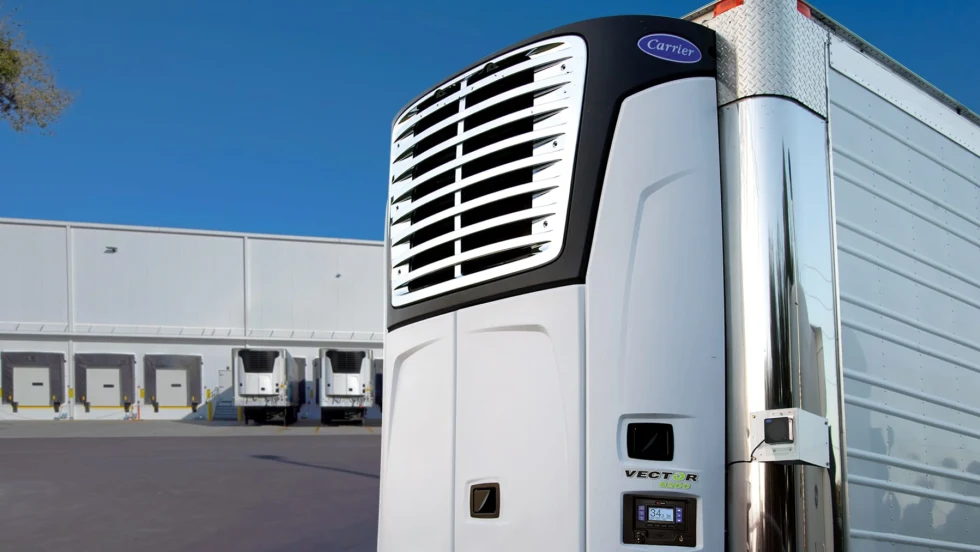
Carrier Transicold Adds All-Electric TRU for Stationary Cold Storage
Carrier Transicold’s new Vector 8200 all-electric transport refrigeration unit gives fleets a diesel-free option for temporary refrigerated and frozen trailer storage.
Read More →
A Closer Look at Kenworth’s Electric T880E Vocational Truck [Video]
Learn more about Kenworth's T880E battery-electric vocational truck at the Paccar Technical Center, including its range, applications, upfitting considerations, and PTO options, in this HDT Spotlight video.
Read More →