




Big 3 Going for CNG-Gasoline Bi-Fuel Systems in Pickups
Detroit's Big Three light-truck builders are embracing compressed natural gas, if not as the dominant fuel of the future then as a major alternative to gasoline and diesel

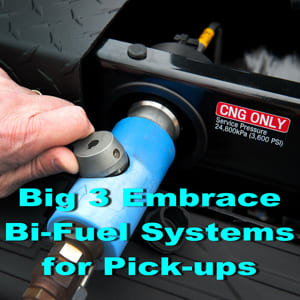
General Motors, Ram Trucks and Ford all announced bi-fuel CNG-gasoline systems for heavy pickups. Photo courtesy of GM
Detroit's Big Three light-truck builders are embracing compressed natural gas, if not as the dominant fuel of the future then as a major alternative to gasoline and diesel.
Rising prices for the two traditional fuels and falling prices for natural gas got manufacturers developing products with the help of suppliers. The fruits of their labors were unveiled this week at the Work Truck Show in Indianapolis.
General Motors, Ram Trucks and Ford all announced bi-fuel CNG-gasoline systems for heavy pickups. This addresses "range anxiety" because CNG fueling stations are still rare in America. Ram puts the number at 1,500 while GM says it's about 1,000. But there are plenty of 'gas' -- which we'll carefully call gasoline -- stations, so no worries, except the customer will be back to shelling out lots of bucks to tank up.
One supplier, Westport Light Duty, states outright that CNG is the best alternative fuel, and a CNG truck will cost far less to operate than hybrids or electric vehicles over a lifetime. Both of those still rely on expensive lithium-ion batteries which impose costly upcharges, which are difficult to recoup based on fuel savings alone. CNG now makes a good business case on its own, and without government subsidies that have been necessary to make hybrids and EVs affordable.
In principle there are many similarities among the three companies' products, though each OE's system takes a slightly different form, primarily in the exact pickup models they'll initially be offered in. CNG will be the principal fuel chosen by the system. All have both gasoline and CNG gauges, but drivers will not be able to switch them from one fuel to another.
None of the products is cheap, with one priced about $10,000 over a gasoline-only truck and several thousand over a diesel. But because natural gas is cheap at $1.50 to $2.50 per gasoline-gallon-equivalent, or GGE, potential savings in fuel purchases could pay off the premiums in a few years. In recent days, gasoline and diesel have approached or exceeded $4 per gallon in many areas, and $5 in California.
The three builders' bi-fuel systems all will use gasoline V-8s with hardened exhaust valves and valve seats, separate gas injectors and fuel lines, pressurized gas and conventional gasoline tanks, and electronic controls programmed to operate the systems. All will run primarily on CNG. When that tank is emptied, they will automatically and seamlessly switch to gasoline.
All will run on gasoline only, but the natural gas tank ought to be refilled as soon as possible to save money on fuel. All lose some power and torque while running on natural gas, but drivers will hardly notice, the builders say.
Westport LD, part of Westport Innovations that makes heavy-duty engines larger trucks, is partnering with Ford in a bi-fuel system for SuperDuty F-250 and F-350 pickups. WiNG, for Westport Natural Gas, comprises CNG components added to freshly built Fords with specially prepped 6.2-liter V-8s. A WiNG engine will run primarily on CNG and switch to gasoline if the gas tank is empty. It will start on gasoline or CNG.
The WiNGed trucks will come with Regular, Super and SuperCrew cabs, with short or long pickup beds, and with two- or four-wheel drive. Other configurations might be added later, Ford says. The CNG tank is in a cabinet behind the cab, and the gasoline tank is below the bed, as usual. Westport says the CNG system's weight is 200 pounds with the tank empty.
WiNG's incremental price is $9,750, with a 32-gallon gasoline tank and a 14.4-gasoline-gallon-equivalent CNG tank. A 24-GGE tank is available for another $1,200. Fleet purchases will be less. Using both fuels, range will be as much as 630 miles, executives said.
Starting this May, Westport will add the CNG equipment in a facility next to Ford's Kentucky Truck Plant east of Louisville. Production will ramp up gradually, and sales will be handled through certain Ford truck dealers, perhaps as many as 200, willing to train technicians to service and repair the bi-fuel trucks.
All parts will be stocked in one distribution center and overnighted to any dealer that needs them for repairs. This means any crippled truck will wait at least one night for the part to come in, and probably all weekend if a truck goes down on a Friday, not because the dealer didn't happen to have a part in stock but because that part will always be sitting in a distant warehouse. If customers complain, this approach might be changed, Westport says.
Instead of farming out the work to a supplier, Chrysler's Ram brand will manufacture a bi-fuel pickup in its own plant in Mexico. This will save several thousand dollars over a supplier-installed system, executives said, though they didn't release the actual price.
The bi-fuel package was engineered with the help of engineers at Fiat, Chrysler's parent and a major supplier of natural gas vehicles and equipment to Europe and other markets. It includes a gas-prepped 5.7-liter Hemi V-8 that uses gasoline only for start-up, so if the truck runs out of gasoline, it's down -- which a gasoline-only truck would be anyway, Ram execs smilingly pointed out. Then it switches to CNG until that's exhausted, and switches back to gasoline.
Like the other systems, the Ram's CNG tanks are in a cabinet behind the cab while the gasoline tank in between frame rails beneath the bed. The CNG tank holds 18.2 GGEs and the gasoline tank is 8 gallons; Canadian customers can choose a 35-gallon gasoline tank. CNG-only range is 255 miles, and the backup gasoline supply extends that to 367 miles.
Ram is starting out in the bi-fuel business with a single pickup model: a four-wheel-drive 2500 Heavy Duty Crew Cab with an 8-foot-long bed. This is what natural gas groups identified as the most useful to potential users, who will want to get a work crew and materials to a job site, Ram executives said. If demand calls for other models, they might be added.
General Motors has also fingered one basic model for its bi-fueler: a 2500 HD Extended Cab, though it can be had with a short or long box and two- or four-wheel drive. It'll be sold as a Chevrolet Silverado or GMC Sierra. The trucks will be produced in Indiana. They'll emerge from GM's Fort Wayne plant with a gas-prepped Vortec 6-liter V-8 and travel to nearby Union City, where IMPCO Automotive will install the CNG equipment.
GM people emphasize that this is not an upfit, because IMPCO is a Tier One supplier whose precise manufacturing processes are in synch with GM's. IMPCO will install the Bosch CNG fuel system and mount the tanks in the bed. The tanks will be in special cabinet attached to the frame, not the bed floor.
The system has been rigorously tested for starting and running in very cold and hot temperatures and at high altitudes. And the truck has been crash-tested multiple times to ensure integrity of the gas system.
The Vortec engine starts on gasoline only and will run on either fuel; it will not start on CNG. Although CNG is the preferred fuel, the natural gas tank holds 17 GGEs and the gasoline tank holds 36 gallons; together they give a 650-mile range. The CNG tank has an aluminum liner and a composite wrap for strength. The CNG system weighs 450 pounds, which is subtracted from the truck's payload. It will tow 9,500 to 15,000 pounds.
GM has not finalized pricing on the bi-fuel system, but will in time to begin taking orders in April. Production starts late this year. GM is also working on a propane-only system for a G-van cutaway chassis. The partner for this is Knapheide, a supplier better known for making utility bodies.
Ford works with Roush on propane conversions for several truck engines. Propane, known as "autogas" overseas where it is very popular, is an inexpensive alternati
More Equipment

ZF Expands Commercial Vehicle Push in North America
ZF is expanding its North American commercial-vehicle presence with new transmission applications, electrification, trailer technology and autonomous-driving systems.
Read More →
Tesla Wants a Self-Driving Semi. Are Cameras Enough?
Could Tesla’s camera-only autonomous driving technology work on an 80,000-pound Semi? In this commentary, HDT's Deborah Lockridge takes a look at Tesla, Cybercab, and how autonomous trucks see the road.
Read More →
Kodiak: Driverless Long-Haul Truck Launch on Track for 2026
Kodiak AI says its driverless long-haul safety case is 93% complete and it remains on track to begin commercial operations by year-end 2026.
Read More →
What DOT’s Automated Vehicle Strategy Means for Trucking
The U.S. Department of Transportation issued a new automated-vehicle strategy that outlines plans for driverless-truck regulations, cross-state freight corridors, and federal safety standards.
Read More →
East Coast Port Launches $45M Electric Truck Push
The Port Authority of New York and New Jersey announced millions in incentives for zero-emission drayage trucks, yard tractors, and new charging hubs near the port.
Read More →
PlusAI Going Public to Fund Autonomous Truck Launch
A SPAC deal could provide PlusAI with up to $300 million as it works toward a 2027 commercial launch of factory-built autonomous trucks.
Read More →
NHTSA Moves to Rewrite Truck Fuel-Economy Rules
The National Highway Traffic Safety Administration says it lacks authority to regulate medium- and heavy-duty truck engines separately from complete vehicles, but the existing standards have not yet been eliminated.
Read More →
Detroit Opens Orders for EPA 2027 Engines
Detroit isn’t starting from scratch to meet EPA 2027 diesel emissions standards. Its Gen 6 DD13 and DD15 engines keep much of today’s platform while updating the fuel and aftertreatment systems.
Read More →
Carrier Transicold Adds All-Electric TRU for Stationary Cold Storage
Carrier Transicold’s new Vector 8200 all-electric transport refrigeration unit gives fleets a diesel-free option for temporary refrigerated and frozen trailer storage.
Read More →
A Closer Look at Kenworth’s Electric T880E Vocational Truck [Video]
Learn more about Kenworth's T880E battery-electric vocational truck at the Paccar Technical Center, including its range, applications, upfitting considerations, and PTO options, in this HDT Spotlight video.
Read More →