





Last summer, we wrote about why trucking may not be a leading economic indicator this cycle. What’s changed?
Are Trucking Share Prices an Accurate Economic Predictor?
Jeff Kauffman, HDT's contributing economic analyst, takes a look at economic and trucking indicators reflecting an upcoming economic downturn.
April 25, 2023

4 min to read
Transportation share prices have been under pressure since the Silicon Valley Bank crisis on March 10, sparking concern about a potential recession, given the historical nature of transport averages leading the broader market.
Freight transport shares underperformed in the fourth quarter of 2022. However, they had been outperforming from Jan. 1 through the banking crisis, up 6% compared to the S&P up 3.4%. They are 3.2% higher in the month of April, outperforming the S&P’s 0.4% return.
So, do transportation share prices really give us a reliable look at the economy?
While tempting, we prefer to look at the checklist below for indicators that an economic downturn is on the way.
Truck tonnage leads rail carloads, which leads industrial production, which leads corporate profits and GDP. While no single indicator is infallible, we thought it an interesting time to take inventory of some key leading indications of activity and see where the tea leaves take us.
General Indicators of Economic Trouble Brewing
1. The Institute for Supply Management’s ISM index: This index, an indicator of U.S. economic activity based on a survey of purchasing managers at more than 300 manufacturing firms, had dropped to 46.3, well into contracting economy status. This normally leads truck tonnage by two to three months. This index turned negative four months ago, and the American Trucking Associations’ truck tonnage was down 4.6% in March.
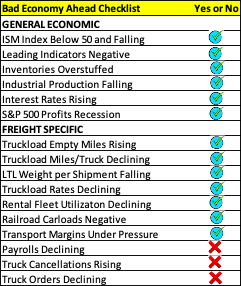
This checklist tracks indicators that an economic downturn is on the way.
Source: Vertical Research Partners
2. The Index of Leading Economic Indicators: This index also typically leads truck tonnage by about six to nine months. This indicator is down 7.8% and had been negative for nine months.
3. High Inventories: Even though inventory growth has slowed, business inventories are still rising at a 9.1% rate — in excess of business sales.
4. Declining Industrial Production: While not negative yet, industrial production is precariously close to zero growth and continues to slide lower.
5. Rising Interest Rates: The Fed continues to raise interest rates and likely won’t stop until the summer. In the meantime, 5% short-term rates have caused a financial crisis already, but we are only starting to see the impacts of tighter credit.
6. A ‘Profits Recession:' S&P earnings data started the year with an expectation of 7% growth. Now, earnings are expected to decline by 4% this year and are falling. Corporate profits are the lifeblood of job growth, wage growth, capital spending, and travel/entertainment. While some segments of the economy remain relatively vibrant, these important leading indicators all have a seat at the “negative table.”
What Freight Transportation Indicators Are Saying About Recession
1. Increasing Truckload Empty Miles: This implies that there is less freight available close by and drivers have to travel further to find their next load.
2. Lower Truckload Miles Per Truck: In recent earnings reports, average miles per truck were down 4.8%.
3. LTL Weight per Shipment Falling: This may be complicated by the normalization of freight from markets affected by the COVID-19 Omicron variant last winter, but average weight per shipment is down 5.8% so far this year. This implies fewer goods on each LTL pallet.
4. Spot Rates and Truckload Rates Declining: While spot rates have stabilized down 20%, they are not rising seasonally, and truckload reported yields are falling sequentially at a 6% rate this quarter — the most rapid decline since 2008.
5. Rental Fleet Utilization Falling: We expect better evidence of this in Ryder’s upcoming earnings report, but the writing was on the wall last quarter.
6. Railroad Carloads Negative: Some will blame bad service, but while automotive, energy and construction commodities remain in growth mode, chemical, metals, trade (intermodal), housing, and paper and packaging are weak or weakening — all of which are cyclical in nature.
7. Transportation Company Margins Under Pressure: We are seeing some of the largest margin declines since the Covid lockdowns and on par with past recessions. Truckload margins are down about 7 percentage points so far this month in reports. ACT Research is only modeling a 1 percentage point decline for the year.
The only factors that we didn’t check off on our list are declining payrolls, equipment cancellations, and lower orders — which, if truck profits continue to decline, will come in time.
Our point is, we don’t need stock market averages to tell the story — economic and trucking industry indicators are pointing toward worse times ahead, and trucking/freight leads the general economy.
While we are heading into what may be the best-telegraphed downturn we have seen in our careers, that doesn’t mean we yet know the depth, duration, or pace of decline that lies ahead. Nor do we know what the recovery will look like — only that the storm clouds are gathering.
Subscribe to Our Newsletter
More Fleet Management

Why Private Fleets Are Taking More Freight
Private fleets are putting their own trucks on demanding customers and high-cost lanes as companies seek greater control over service, costs, and capacity.
Read More →
Sponsored•September 16, 2026
Color Match Smarter: Tools That Restore & Perform
For fleet managers and collision repair professionals keeping heavy-duty trucks on the road, getting the color right the first time isn't just about appearance — it's about efficiency, turnaround time, and bottom-line results. Discover how today's digital color tools are transforming the repair process from guesswork to precision.
Read More →
FMCSA Pauses Biennial-Update Enforcement Amid Motus Transition
Carriers whose updates were due on or after June 1 have more time, while FMCSA works to stabilize its new registration system and warns of phishing sites impersonating its new carrier registration system, Motus.
Read More →


Sponsored•September 14, 2026
2026 Blueprint for Countering Smarter Supply Chain Theft
Cargo theft is no longer just the cost of doing business. It's a multi-billion-dollar criminal enterprise exploiting vulnerabilities across your fleet, drivers, and supply chain.
Read More →
Sponsored•September 1, 2026
How Telematics Improves Visibility, Control, and Performance in Refrigerated Fleets
Explore how telematics help refrigerated fleets improve visibility, uptime, efficiency, compliance, and cargo protection across connected cold chain operations.
Read More →
What the U.S.-Canada Trade War Means for Trucking
Escalating U.S.-Canada tariffs could disrupt cross-border freight, reduce truck volumes, raise costs, and create new uncertainty for carriers on both sides of the border.
Read More →
What Are Trucking’s Top Concerns for 2026?
The American Transportation Research Institute wants to know what's worrying trucking fleet managers, drivers, and other stakeholders in its annual Industry Issues survey.
Read More →
American Trucking Associations Looks for a New Leader
ATA President and CEO Chris Spear abruptly left his job at the association on August 21, at a pivotal time for the trucking industry.
Read More →
Public Wi-Fi Cybersecurity Risks: How Truck Drivers and Fleets Can Protect Their Data
Public Wi-Fi can expose truck drivers and fleets to credential theft, malware, and other cyber threats. Here’s how to reduce the risk on the road.
Read More →
For Nicky Cupp, Fleet Innovation Starts With Frustration
HDT Truck Fleet Innovator Nicky Cupp turns everyday pain points at Fraley & Schilling into opportunities for better technology and smarter processes.
Read More →