




App Helps Prevent Rollovers, Brake Fade on Grades
How do we keep drivers from driving too fast through curves or descending mountain slopes? By showing them precisely how fast they should be driving. A new app called Road-Aware can do just that.

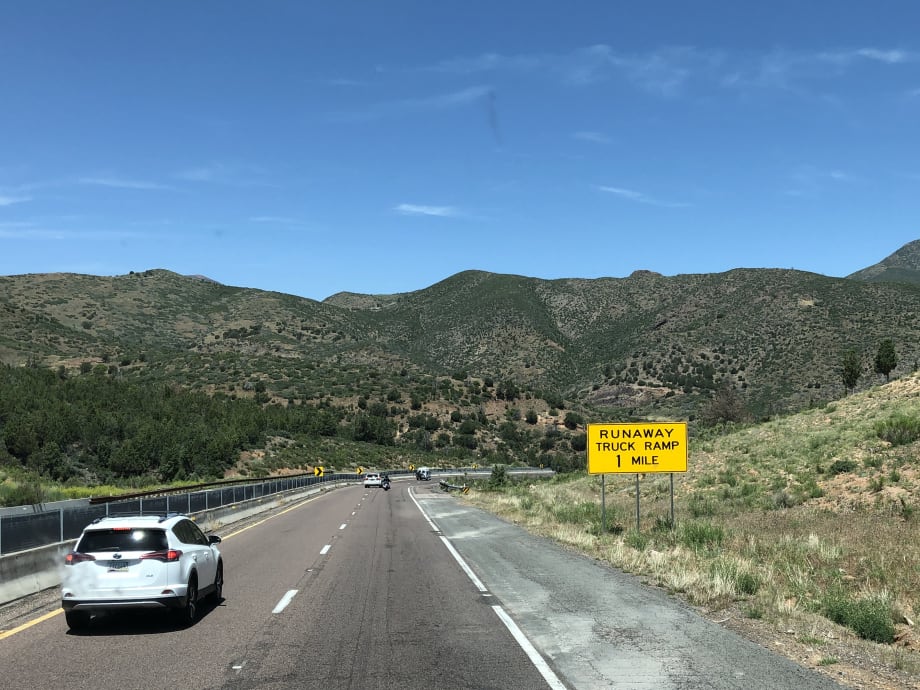
Drivers often rely too heavily on their service brakes when descending long grades, rather than using engine brakes only and saving the service brakes for emergencies.
Photo: Jim Park
How fast should drivers be going when descending long mountain grades or rounding sharp curves? The short answer is much slower than most drivers do, but it's not easy to determine a safe speed. Signage is generally unhelpful, as it often applies to passenger cars. And since every load is different, there's little point to posting specific recommendations that will be seen as too slow by some and too fast by others.
A company called Road-Aware Safety Systems may have the correct answer. Over the past couple of years, the company has been developing an application that can calculate a safe speed for trucks on curves and slopes based on actual road conditions and vehicle configuration. It began with a data collection exercise where the app was installed in about a dozen trucks that ran regularly over some very challenging terrain.
"Data we collected over that six-month period revealed that not some, but all observed drivers ran perilously close to their vehicle tip-over thresholds on the curves and well above full engine-brake speeds on slopes," says Road-Aware Managing Director Garth Lawrence.
Road-Aware is a tablet-based application that gives drivers advanced warnings and maximum safe-speed recommendations so they can safely navigate difficult road segments. The app provides those recommendations by combining GPS location and accurate three-dimensional road geometry data with actual vehicle dynamics – truck configuration and load. These are not arbitrary suggestions, but engineering-based calculations.
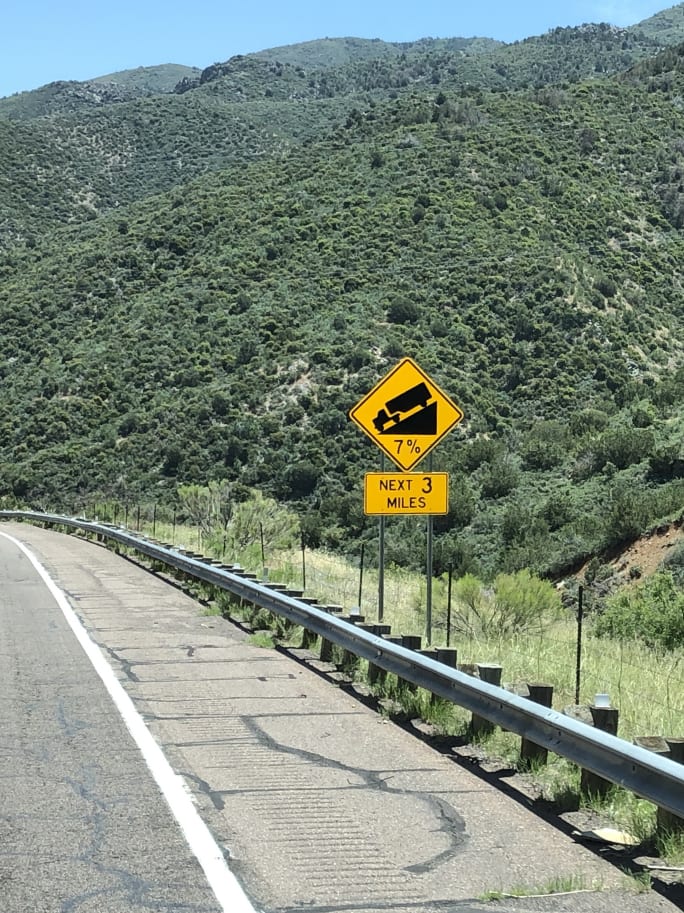
Estimating proper speed on long grades is difficult because of vague signage and possibly over-confidence in the equipment.
Photo: Jim Park
Lawrence, who comes from the mapping industry, had recently completed an unrelated project making highly detailed terrain maps of much of the U.S. He had gathered precise data on elevations and grades as well as roadway curve radii, which he layered over detailed GPS maps to create an extensive and highly accurate map database.
"We knew there was an issue within the trucking industry of drivers operating too fast on some curves and slopes," Lawrence says. "My partner, an engineer named Brian Bullock, looked at the equations for roll-over thresholds and stopping speeds on slopes and concluded we could help solve this problem. That's when we started work on Road-Aware."
Historically, driver have descended grades and taken sharp curves by the seat of their pants, Lawrence says. There's little guidance from road signs. "Typically, road signage advises drivers to slow down, but the signs provide no other details. They certainly don't take vehicle dynamics and brake performance into account. Consequently, drivers do not take them seriously."
When braking on long slopes, drivers understand the need to reduce speed but are operating under a false sense of security. They underuse their engine brakes and snub or drag the service brake to check speed increases. This inevitably increases brake temperature, which reduces the brakes' stopping power – known as brake fade. Like the 100 times the driver may have descended that hill previously, they are still under control and still have some service braking capability left, but it's seriously diminished. If on the 101st time down the hill an animal steps onto the road or they run into stopped traffic, the ability to stop is jeopardized.
As Yale sociologist Charles Perrow puts it, "Murphy's Law is wrong – what can go wrong usually goes right." But then one day a few of the bad choices come together, and history and previous experience go right out the window.
"In the case of a tight curve, the roll-over event begins at the rear of the trailer, and drivers are not aware that their loaded trailers are at the edge of stability on these curves," Lawrence points out. "The tractor feels stable at these speeds because it has a lower center of gravity and thus the tip-over threshold speed is much higher than the trailer. The feeling of being stable coupled with familiarity of the route leads to average speeds creeping up, until there is no room for errors or needed adjustments."
Develop and Test the Theory
While developing Road-Aware, Lawrence partnered with an Arizona-based mine-hauling carrier to collect data from a portion of its fleet that hauls liquid and powdered material in bulk tankers to and from various mine sites in the state – some of which are located in challenging environments.
In the fall of 2018, Lawrence installed tablets in 10 tractors operated by experienced drivers operating on routes with tight curves and steep descents. Over 1,000 runs across eight difficult road segments were recorded and analyzed during the trial. A total of 261 runs were collected with the system operating in the background (collecting data) to establish baseline data. Another 768 run were used to review driver behavior with Road-Aware active.
To determine the maximum speed that drivers should be driving on certain tight curves, the trucks were measured and analyzed for the center of gravity, the compliance effects of springs, tires, undercarriage, etc., to determine the static roll threshold for each fully loaded trailer. Using the radius of various curves, the roll-threshold could be calculated and a recommended speed displayed on the tablet.
During the course of the study, there was one opportunity to validate the calculations when a rollover occurred in a curve on an active mine property. The truck was loaded with approximately 25 tons of ore concentrate. Based on calculations, the roll-over threshold speed at the crash site was determined to be 29 to 33 mph. Information from the truck's GPS tracking system indicated the speed 100 feet before the rollover occurred was 34 mph.
Downhill Braking
Driving heavily loaded trucks on steep 6-8% grades presents obvious risks -- on top of higher brake maintenance costs for fleets. While running the Road-Aware trial last fall, Lawrence observed drivers using incorrect downhill driving techniques, namely snubbing their brakes to maintain speed, rather than using only the engine brake and saving the service brakes for possible emergency stops.
"In about half of the slope runs, drivers reduced their speed by using brake snubbing to slow the truck, but even that did not get down to the recommended safe descent speed," Lawrence says. "Many times, we saw drivers running 20 mph or more over the recommended safe descent speed, driving right past a runaway truck ramp that the Arizona DOT says is used about twice a week by runaway trucks. For some reason, drivers seem more willing to accept 'advice' regarding speed in curves, but they are much more cavalier about slopes."
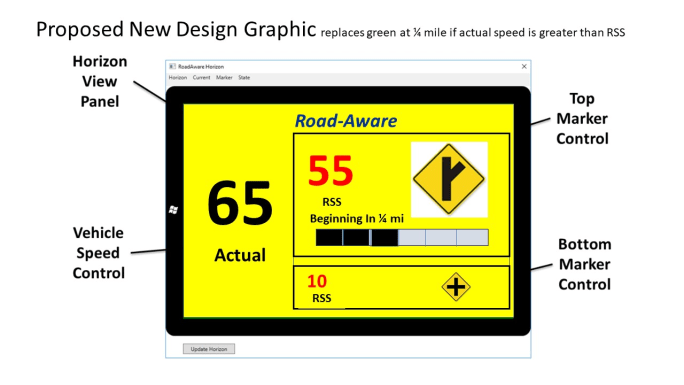
The Road-Aware app provides driver with a warning when approaching a sharp curve or a steep slope showing the vehicle's actual speed and the recommended speed, based on calculated vehicle dynamics and the geometry of the road.
Photo: RoadAware
Again, Lawrence puts some of the problem down to the vague warnings drivers see urging them to slow down or use a lower gear, some of it to complacency and to some extent over-confidence in their equipment, but it could be a shortcoming in the CDL training as well.
Most truck driving schools in the U.S. do not teach mountain driving as part of the basic curriculum, and the information in the CDL manual is vague and incomplete. Drivers learn what they can get away with in terms of speed, but they really are not aware of how close to the edge of the envelope they might be.
"We found on curves, when we began displaying the maximum recommended speed, everybody dropped their speed, which was very encouraging," he says. "What we saw on slopes, is that they seem to believe as long as they have their service brakes everything will work out okay. Clearly there's an issue going down these slopes that those drivers really aren't aware of.
"In about half the slope runs we recorded drivers reduced their speed by using brake snubbing to slow the truck but did not reach the recommended safe descent speed," Lawrence said. "Many times, we saw drivers running +20 mph over the recommended safe descent speed, driving right by a runaway ramp site."
Reviewing CDL training material and the driver operating manuals for the trucks the fleet operated, Lawrence found some inconsistent messages regarding braking techniques.
The CDL manual references the snubbing method as "a supplement to the braking effect of the engine," while never mentioning the use of an engine brake device, such as a Jacobs compression brake. The brake-snubbing technique increases brake temperature, increases wear, and increases risk when having to make an unexpected stop on the hill for wildlife, for example, or a disabled vehicle.
"Driver manuals in the trucks we looked at advised drivers to stay at a speed that allowed the engine brake only to slow the truck, and not to use the service brakes at all," Lawrence notes. "That speed would of course vary with the weight of the truck and the steepness of the grade, but the emphasis should be on striving to not need to use the service brakes at all, just the engine brake to control the descent speed."
As before, with a little engineering and a few calculations, Road-Aware was able to calculate an "engine-brake-only" descent speed, based on the weight of the truck and the engine's retarding capability. When presented to driver, they got feedback such as "I'm a professional, you can't tell me how to drive," and "going that slow will add time to my trip." In fact, slowing down did add time to the trip. About two and a half minutes, the data revealed.
The Road-Aware App
The apparent utility of an app like Road-Aware is that it's based on actual road geometry real vehicle dynamics. Brian Bullock, the engineer behind Road-Aware, told Truckinginfo.com that the app in its current form – at this point a dedicated fleet app built around the fleet's specific needs – will be available this summer.
"We have focused on bulk haulers up to this point,and we're confident in our vehicle dynamics calculations and the road geometry data," Bullock says. "We can further customize the application for any type of bulk trailer and tractor combination with accurate engine torque and horsepower data and engine-brake retarding capability."
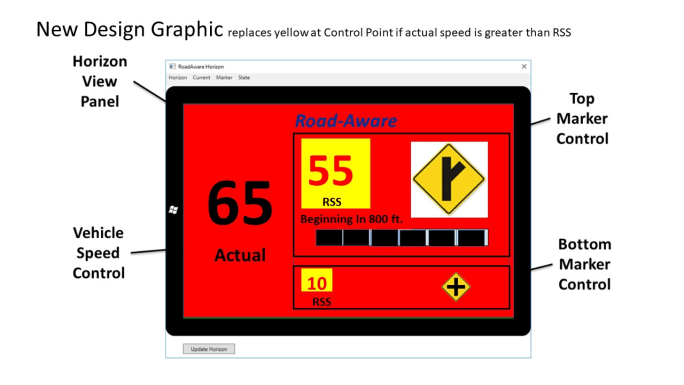
The in-cab display turns from yellow to red when a change of speed is immediately required.
Photo: RoadAware
An expanded version that includes all Class 1 and Class 2 highways in the U.S. with customizable truck and load configurations should be available in about a year's time.
"It's a highly customizable application where a fleet can plug its own data in, such as type of tractor, engine ratings and trailer configurations – dry van, flatbed, livestock, bulk, etc., as well as the load characteristics, such as weight and high, medium or low center-of-gravity," he says. "We can even set it up to be fleet- or terminal-specific. Once we have the data on the fleet and what it does, we simply load it into the backside of the app."
The application also features full reporting capabilities so fleets can monitor drivers' performance. A scorecard is in the works to help fleets evaluate drivers and identify problems before they turn into calamities.
It's cross-platform compatible, and functions on Apple, Android and Windows smartphones and tablets. Road-Aware will offer the app as a standalone product, but the company is also in talks with other telematics providers to have it included in their offerings and to the OEM directly to have it installed at the factory.
For more information, visit www.road-aware.com.
More Safety & Compliance

FMCSA Pauses Biennial-Update Enforcement Amid Motus Transition
Carriers whose updates were due on or after June 1 have more time, while FMCSA works to stabilize its new registration system and warns of phishing sites impersonating its new carrier registration system, Motus.
Read More →
ZF Expands Commercial Vehicle Push in North America
ZF is expanding its North American commercial-vehicle presence with new transmission applications, electrification, trailer technology and autonomous-driving systems.
Read More →
Truck Drivers Need More Than Another Alert
Fleets have more visibility into truck health, safety events, and driver activity than ever. The next challenge is turning all that information into useful guidance for the person who has to decide what to do next.
Read More →
Tesla Wants a Self-Driving Semi. Are Cameras Enough?
Could Tesla’s camera-only autonomous driving technology work on an 80,000-pound Semi? In this commentary, HDT's Deborah Lockridge takes a look at Tesla, Cybercab, and how autonomous trucks see the road.
Read More →
What DOT’s Automated Vehicle Strategy Means for Trucking
The U.S. Department of Transportation issued a new automated-vehicle strategy that outlines plans for driverless-truck regulations, cross-state freight corridors, and federal safety standards.
Read More →
NYC Expands Speed, Pedestrian Safety Tech Across Fleet
New York City is expanding intelligent speed assistance and pedestrian-alert systems across its municipal fleet, moving the technologies from pilot programs into vehicle procurement and retrofit requirements.
Read More →
FMCSA Removes 110 Truck Driver Training Schools from Certified ELDT List
Federal regulators also are targeting more than 160 additional training providers and launching a nationwide audit of third-party CDL skills testers as part of a broader crackdown on trucking fraud.
Read More →
Beyond DOT Compliance: What Makes a Trucking Fleet Truly Safe?
A trucking fleet can follow every rule and still make unsafe decisions. The real test comes when safety conflicts with freight, productivity, or cost.
Read More →
Hours of Service Pilot Programs: FMCSA Readies for 2027 Rollout
Two pilot programs could eventually reshape hours-of-service rules, giving truck drivers options to pause their 14-hour clock or use longer split sleeper rest periods.
Read More →
New Guide Offers Pet Safety Tips for Truck Drivers
Hundreds of thousands of pets travel in truck cabs. A new safety guide from Volvo Trucks and the Center for Pet Safety offers practical advice for truck drivers who bring dogs and cats along for the ride.
Read More →