





Liability Nightmare: Your DOT Medical Exam Forms Probably Have Errors
Answers to 5 Frequently Asked Questions About Truck Driver Medical Exams
Interstate truck drivers are required to take a physical qualification examination and receive a Medical Examiner’s Certificate every other year to confirm that they are healthy enough to safely perform their job. What do their employers need to know?
February 6, 2025
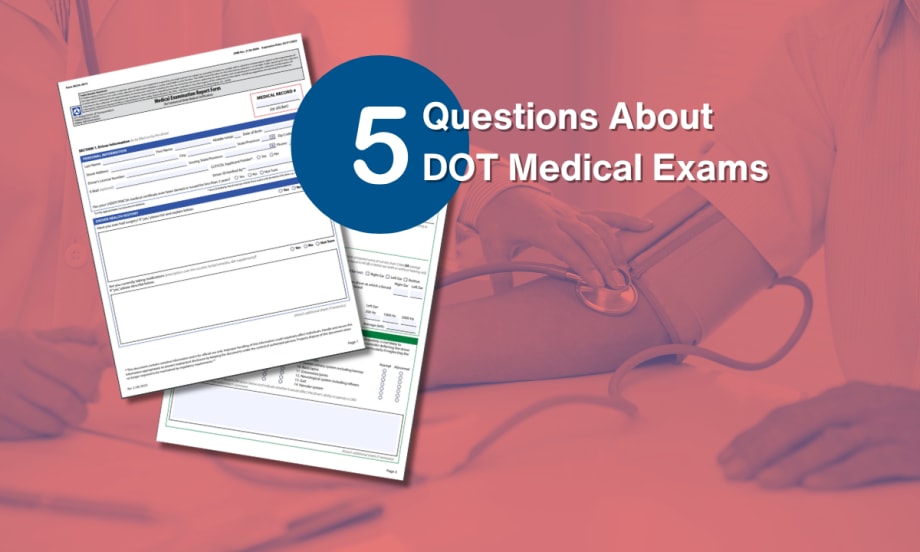
The motor carrier a driver works for is responsible for ensuring that driver is medically qualified to operate a commercial motor vehicle in interstate commerce.
Image: HDT Graphic
4 min to read
Commercial motor vehicle drivers are responsible for their own safety, as well as the safety of others on the road. That's why interstate truck drivers are required to take a physical qualification examination and receive a Medical Examiner’s Certificate every other year to confirm that they are healthy enough to safely perform their job.
For example, drivers must be able to hear sounds around them, see road signs and stay awake, explains the Cleveland Clinic. Some health conditions or medications may affect their ability to do this. Some conditions may put drivers at risk for medical emergencies that, if they happen on the road, put them and others in danger.
The motor carrier a driver works for is responsible for ensuring that driver is medically qualified to operate a commercial motor vehicle in interstate commerce.
In the case of a crash tied to an unforeseen medical condition, plaintiff attorneys will no doubt be looking closely at the DOT-mandated physical -- whether a driver has a valid medical card, as well as whether there were any errors made during the process of getting the card.
1. How do I choose a medical examiner for my trucking company?
Choosing a medical examiner is important.
First, the regulations require examinations to be performed by a medical examiner meeting the definition in Sec. 390.5. A licensed optometrist may perform the vision portion of the examination.
Second, one especially important consideration in the selection of a medical examiner is a familiarity with the Federal Motor Carrier Safety Regulations. It’s the motor carrier’s responsibility to ensure that the medical examiner is informed of the minimum medical requirements and the characteristics of the work to be performed.
Since 2014, medical exams performed on interstate commercial motor vehicle drivers may only be performed by examiners listed on the National Registry of Certified Medical Examiners (NRCME). Motor carriers must document in a “note” that they verified that the examiner appears on the NRCME website.
2. What are the requirements for medical examiners?
Medical examiners are required to successfully complete required training and pass a certification test before being listed on the NRCME. This is in accordance with Subpart D to Part 390, National Registry of Certified Medical Examiners.
3. What does a physical exam mean in this context?
Physical examinations are mandatory for commercial motor vehicle drivers to ensure they’re physically qualified to drive. Such exams must be repeated at least every two years, although medical examiners can choose to set a more frequent renewal cycle based on a driver’s medical condition.
A successful medical exam results in the issuance of a Medical Examiner’s Certificate — also known as the wallet card or med card — which serves as the driver’s proof of being physically qualified.
At all times, drivers and motor carriers must be able to show proof of being physically qualified to drive, either through the medical card or (for drivers with commercial driver’s licenses) by means of a current driving record from the state.
4. When is a medical exam required?
An exam is required before the first time a driver drives a motor vehicle that is subject to the regulations. The driver must pass a physical exam and be given a medical examiner’s certificate.
A physical exam and new medical examiner’s certificate are required at least every 24 months. The original or a photographic copy of the medical examiner’s certificate must be provided to the driver to carry and/or provide to the motor carrier and state licensing agency.
In addition to the initial exam and the routine physical exam every 24 months, any driver who has received a physical or mental injury or disease that has impaired their ability to perform normal duties must have a physical examination and obtain a new medical examiner’s certificate.
5. What are the physical qualification requirements?
These exact requirements can be found in 49 CFR 391.41(b). A person is physically qualified to drive a commercial motor vehicle if the person:
Has all limbs and fingers (or a skill performance evaluation certificate).
Has no hand, finger, arm, foot, or leg impairment that interferes with any necessary tasks.
Has no history or clinical diagnosis of diabetes mellitus treated with insulin unless they meet the requirements in 391.46.
Has no cardiovascular disease, respiratory disfunction, high blood pressure, vascular disease, functional disease, psychiatric disorder, or any other condition that could impair or interfere with work.
Meets the vision requirements with or without using corrective lenses, or meets the alternative vision standard requirements with vision in the better eye per 391.44.
Meets the hearing requirements.
Does not use any prohibited drugs or substances, unless prescribed by a licensed medical practitioner.
Has no history or clinical diagnosis of diabetes mellitus treated with insulin unless they meet the requirements in 391.46.
Subscribe to Our Newsletter
More Safety & Compliance

FMCSA Pauses Biennial-Update Enforcement Amid Motus Transition
Carriers whose updates were due on or after June 1 have more time, while FMCSA works to stabilize its new registration system and warns of phishing sites impersonating its new carrier registration system, Motus.
Read More →
ZF Expands Commercial Vehicle Push in North America
ZF is expanding its North American commercial-vehicle presence with new transmission applications, electrification, trailer technology and autonomous-driving systems.
Read More →
Truck Drivers Need More Than Another Alert
Fleets have more visibility into truck health, safety events, and driver activity than ever. The next challenge is turning all that information into useful guidance for the person who has to decide what to do next.
Read More →
Tesla Wants a Self-Driving Semi. Are Cameras Enough?
Could Tesla’s camera-only autonomous driving technology work on an 80,000-pound Semi? In this commentary, HDT's Deborah Lockridge takes a look at Tesla, Cybercab, and how autonomous trucks see the road.
Read More →
What DOT’s Automated Vehicle Strategy Means for Trucking
The U.S. Department of Transportation issued a new automated-vehicle strategy that outlines plans for driverless-truck regulations, cross-state freight corridors, and federal safety standards.
Read More →
NYC Expands Speed, Pedestrian Safety Tech Across Fleet
New York City is expanding intelligent speed assistance and pedestrian-alert systems across its municipal fleet, moving the technologies from pilot programs into vehicle procurement and retrofit requirements.
Read More →
FMCSA Removes 110 Truck Driver Training Schools from Certified ELDT List
Federal regulators also are targeting more than 160 additional training providers and launching a nationwide audit of third-party CDL skills testers as part of a broader crackdown on trucking fraud.
Read More →
Beyond DOT Compliance: What Makes a Trucking Fleet Truly Safe?
A trucking fleet can follow every rule and still make unsafe decisions. The real test comes when safety conflicts with freight, productivity, or cost.
Read More →
Hours of Service Pilot Programs: FMCSA Readies for 2027 Rollout
Two pilot programs could eventually reshape hours-of-service rules, giving truck drivers options to pause their 14-hour clock or use longer split sleeper rest periods.
Read More →
New Guide Offers Pet Safety Tips for Truck Drivers
Hundreds of thousands of pets travel in truck cabs. A new safety guide from Volvo Trucks and the Center for Pet Safety offers practical advice for truck drivers who bring dogs and cats along for the ride.
Read More →