




Analysis: Expect More of the Same From the Economy
With tax reform enacted, so far GDP has only grown at 2.3% annual rate in the first quarter of 2018, slightly down from the end of 2017. We were hoping for a boost in growth, but so far that hasn't happened. Analysis by Business Contributing Editor Evan Lockridge.

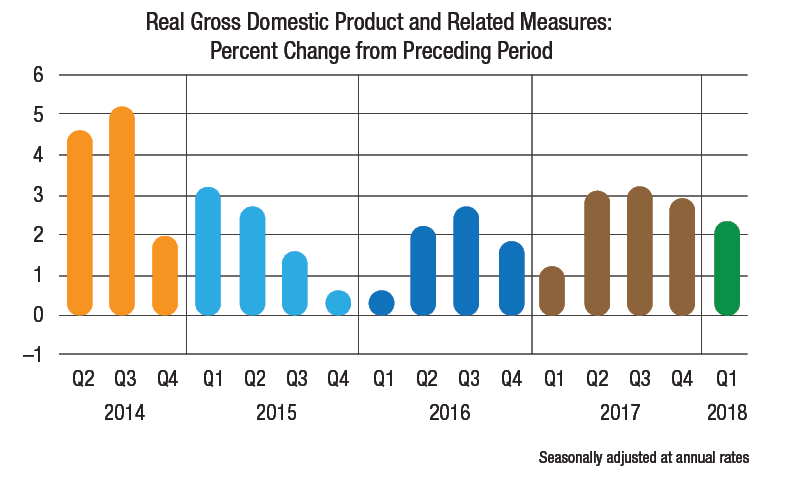
While first-quarter economic growth was higher than the previous two years, consumer spending numbers raise concerns.
Source: U.S. Department of Commerce
Tax reform was supposed to make the U.S. economy great again. Days of the gross domestic product expanding at an annual rate of pre-Great Recession levels of 3% or better were to return. But that hasn’t happened so far.
Let’s look at the GDP in the first quarter of the year, the beginning of when tax reform took effect. The GDP expanded again, at a 2.3% annual rate. But that’s down from a rate of 2.9% in the final quarter of 2017, before tax reform took effect.
So what happened? The biggest contributor to the economy, consumer spending, slowed its increase to an annual pace of 1.1%, down from a 4% annual growth rate in the fourth quarter, according to the first of three Commerce Department’s GDP estimates, released in late April.
“As a consumer-based economy, the fastest way to derail the U.S. economy is a slowdown in overall spending patterns,” said Stifel Chief Economist Lindsey Piegza.
To be fair, the U.S. economy has historically experienced weaker growth at the start of a new year compared to the previous quarter, as consumers spend amid the holiday season. And in fact, this was the best first-quarter GDP performance since the first quarter of 2015.
But it was no better than last year’s 2.3% average rate of expansion.
In other words, so far, the economy isn’t doing measurably better than before the tax laws took effect.
“Tax reform ... was expected to mitigate that typical pattern [of lower first quarter performance],” Piegza said. “What we saw instead was consumers spending in anticipation of a possible bump in after-tax take-home pay – an increase which for many failed to materialize into a meaningful increase in income and thus, offered minimal support to first-quarter consumption.”
In other words, the backbone of the American economy, consumers, so far hasn’t seen that big of a boost in pay from lower tax rates.
Don’t get me wrong – there were winners in this tax reform package. Large companies, including many in trucking, saw their maximum tax rate drop 40%. The result has been greatly increased quarterly profits. And while this is good for their businesses, there are questions as to how much it will translate into faster growth for the economy, especially in light of first-quarter GDP performance.
The average Joe is getting little federal tax relief as the cost of living continues to rise. While surveys show consumer confidence/sentiment is high, the overall gains in the surveys are for those at the higher end of the income ladder.
Looking ahead, the Federal Reserve is expected to increase interest rates more this year and into 2019, raising borrowing costs while cutting into spending. Plus there are indications consumers are going to pay higher prices for goods due to increasing freight rates triggered by tight capacity, coupled with higher retail inflation. I wouldn’t bet the economy is going to kick into high gear with sustained growth of 3% or better.
Related: Rising Interest Rates Got You Down?
More Fleet Management

Color Match Smarter: Tools That Restore & Perform
For fleet managers and collision repair professionals keeping heavy-duty trucks on the road, getting the color right the first time isn't just about appearance — it's about efficiency, turnaround time, and bottom-line results. Discover how today's digital color tools are transforming the repair process from guesswork to precision.
Read More →
FMCSA Pauses Biennial-Update Enforcement Amid Motus Transition
Carriers whose updates were due on or after June 1 have more time, while FMCSA works to stabilize its new registration system and warns of phishing sites impersonating its new carrier registration system, Motus.
Read More →
2026 Blueprint for Countering Smarter Supply Chain Theft
Cargo theft is no longer just the cost of doing business. It's a multi-billion-dollar criminal enterprise exploiting vulnerabilities across your fleet, drivers, and supply chain.
Read More →


How Telematics Improves Visibility, Control, and Performance in Refrigerated Fleets
Explore how telematics help refrigerated fleets improve visibility, uptime, efficiency, compliance, and cargo protection across connected cold chain operations.
Read More →
What the U.S.-Canada Trade War Means for Trucking
Escalating U.S.-Canada tariffs could disrupt cross-border freight, reduce truck volumes, raise costs, and create new uncertainty for carriers on both sides of the border.
Read More →
What Are Trucking’s Top Concerns for 2026?
The American Transportation Research Institute wants to know what's worrying trucking fleet managers, drivers, and other stakeholders in its annual Industry Issues survey.
Read More →
American Trucking Associations Looks for a New Leader
ATA President and CEO Chris Spear abruptly left his job at the association on August 21, at a pivotal time for the trucking industry.
Read More →
Public Wi-Fi Cybersecurity Risks: How Truck Drivers and Fleets Can Protect Their Data
Public Wi-Fi can expose truck drivers and fleets to credential theft, malware, and other cyber threats. Here’s how to reduce the risk on the road.
Read More →
For Nicky Cupp, Fleet Innovation Starts With Frustration
HDT Truck Fleet Innovator Nicky Cupp turns everyday pain points at Fraley & Schilling into opportunities for better technology and smarter processes.
Read More →
Adam Buttgenbach’s Approach to Electric Trucks: Start With Where They Fit
HDT Truck Fleet Innovator Adam Buttgenbach helped PepsiCo build one of North America’s largest EV fleets by focusing on where electric trucks make operational sense.
Read More →