




An Automatic Yes: Transmission Trends
It's not driver laziness that's pushing buyers to order more automatic or automated transmissions, say manufacturers

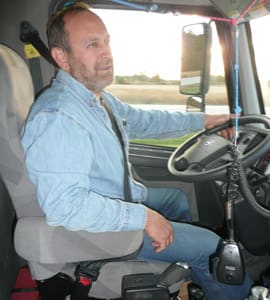
Once they're used to work-saving AMTs, drivers usually like them. One happy cruiser is Perry Allen, who drives a Volvo VHD dump truck with an I-Shift for Klink Trucking out of Ashley, Ind. (Photo by Tom Berg)
It's not driver laziness that's pushing buyers to order more automatic or automated transmissions, say manufacturers.
It's sound business reasons, including easier and safer operation, longer driveline life and usually better fuel economy. Manual transmissions are getting scarce in medium- and light-duty trucks, and there's definitely a trend toward more automatic and automated transmissions in heavy-duty trucks and tractors as well.
To be sure, about 80 percent of heavies are still ordered with manual transmissions, according to Eaton Corp., the maker of almost all of them. A manual costs thousands less than a self-shifter, and it's a fine, long-lasting piece of equipment in the hands of a competent driver. If treated right, a manual box can go a million miles or more. A clutch can, too, but that requires a master driver who starts the truck gently and can smoothly "float shift" so the clutch stays engaged most of the time and its facings don't wear. More typically, the clutch will have to be replaced two or three times in that period and probably adjusted fairly often (though self-adjusting clutches have become popular).
But self-shifting gearboxes are steadily catching on, and now have 20 percent of the Class 8 market, says Eaton, which also makes automated mechanical transmissions, or AMTs. Fleets buying AMTs say the automated transmissions drastically cut training time for novice drivers because there's no double-clutching or multi-speed gear selection to learn. Some report longer life for U-joints and driveshafts, which clumsy drivers can break when rough shifting of manual transmissions sends shocks through the driveline.
Safety, too
Safety is another reason for moving away from manuals. One fleet reported a substantial drop in accident rates because drivers can concentrate on traffic and where their rigs are instead of what gear to be in. Most get better fuel economy, because a modern AMT will shift correctly all the time, while even the best drivers grow tired and sometimes get a little sloppy. Fleet managers also report that veteran drivers at first don't like AMTs, but soon change their minds when they see how much work they save; some stay with a company when they'd otherwise quit because they like their auto-shifters so much.
Eaton has been working on automated mechanical transmissions for more than 30 years, starting in the 1970s for the U.S. Army, whose drivers were usually young and inexperienced in the ways of clutch and gearshift operation. The Army wanted an alternative to the Allison automatic transmissions it had begun buying, and which have since become all but standard on tactical wheeled vehicles (the military term for specially built, medium- to heavy-duty on/off-road cargo trucks). Automatics make immense sense in the military, whose drivers are still young and largely inexperienced, and that's increasingly true in the civilian world, where drivers often have other primary duties.
Fully automatic transmissions now go into a large majority of Class 5 through 7 medium-duty trucks. At the start of this decade, about half of all trucks had automatics, but now it's closer to eight out of 10, industry sources say. Most are Allisons, from a company with quite a history. It traces its roots to 1909 and race-car activities by James Allison, one of the founders of the Indianapolis Motor Speedway. By World War I he was producing airplane engines, and afterwards his company continued as a supplier to the expanding aviation industry. After his death in 1928 the company was bought by General Motors, which during World War II put Allison engineers to work on torque-converter automatic transmissions for military battle tanks and rail diesel cars. Both products were released in 1949.
The birth of the automatic
Allison introduced its first commercial-truck transmission in 1956, and in subsequent decades developed the popular AT, MT and HT automatics with planetary gear sets that provided variable ratios, and hydraulic controls. In the 1990s came electronic controls that grew increasingly sophisticated, and by the turn of the century Allison had begun producing its more advanced World series automatics. These include light-, medium- and heavy-duty versions with 4, 5 and 6 speeds and tightly controlled locking and unlocking of torque converters. These are available from most truck builders in many countries. Recently Allison - bought from GM in 2007 by private investors - introduced Optimized Shift Scheduling, which tailors shifting logic to a truck's application, and a Second Reverse gear, a "creeper" ratio in 4000 series heavy-duty transmissions.
A competitor to Allison is Aisin Seiki of Japan. Its automatic transmission activities began in 1969 as Aisin Warner, a joint venture with Borg Warner that ceased in 1987. Aisin Seiki now produces automatics for commercial vehicles, while an affiliate, Aisin AI, is a high-volume maker of manual and automatic transmissions for cars and light trucks worldwide. Aisin automatics are used in a number of imported low-cab-forward trucks, though Allisons are also used by LCF builders. Chrysler uses an Aisin 6-speed automatic in its Class 2 through 5 Dodge Ram Heavy Duty pickups and chassis-cab models powered by the Cummins Turbo Diesel.
Light trucks, including most used for commercial applications, are almost all equipped with automatics. Those with 6-speed manuals from ZF and New Process are rare, and Ford is dropping manuals completely from its 2011-model SuperDuty pickups and cab-chassis models. Ford designs and builds its own automatics, including 4- and 5-speeds for its E- and F-150 trucks and a 5-speed it calls TorqShift for its E- and F-250 and heavier models. Ford has developed a 6-speed version for the upcoming SuperDuties. The TorqShift 6 will be standard with a new 6.7-liter Power Stroke diesel and 6-liter gasoline engine.
Better ratio coverage
General Motors has meanwhile designed 6-speed versions of its Hydra-matic series of automatics, and is using them in its 1500 series Silverado and Sierra pickups and in heavier gasoline-powered pickups. GM uses Allison's 1000 series 6-speed in pickups that get the Duramax diesel. Like Ford, GM notes that 6-speed transmissions provide greater ratio coverage that allow good startability and overdrive cruising capability compared to older 5- and 4-speed automatics. For now the bigger transmissions are mated to high-displacement engines, but they will probably migrate down to smaller engines as customers demand greater fuel economy.
Allison's 2000, 3000 and 4000 series World automatics are used in light-medium, medium and heavy trucks, respectively. Allisons are known to be rugged and dependable, and cushion the driveline against shock. A manager of an electric utility fleet in the South once commented that he did away with stocks of spare U-joints and driveshafts needed with manual transmissions after he converted to Allisons. Except for vehicle size and weight, Allison-equipped trucks are almost as easy to drive as automobiles. Eaton has long compared its automated mechanical transmissions with Allisons, and tries to sell against them.
Some competition
In the 1990s and into the 2000s, ArvinMeritor successfully competed against Eaton with manual gearboxes and partially automated transmissions, including the Engine Synchro Shift. The ESS electronically synchronized engine speed with the next gear, easing double-clutching by the driver. Under a joint venture, Meritor also sold an AMT called the FreedomLine, which was a North American version of the AS Tronic from ZF of Germany. But Meritor left the transmission business after aggressive business activity by Eaton; it sued Eaton for alleged antitrust behavior and won in court, but an outcome remains in legal limbo as Eaton ponders an appeal. Neither company will talk about it now.
The increasing appetite for heavy AMTs is
More Equipment

How Volvo Updated Its D13 for EPA 2027 [Watch]
Volvo’s updated D13 promises lower emissions without sacrificing performance or fuel economy. Take a closer look at what changed inside the engine in this HDT Spotlight video.
Read More →
Michelin Tire Improves Efficiency and Durability for Regional Fleets
The Michelin X Multi Energy D2 is a regional haul drive tire engineered to help fleets improve fuel efficiency, durability and traction in demanding stop-and-go operations.
Read More →
ZF Expands Commercial Vehicle Push in North America
ZF is expanding its North American commercial-vehicle presence with new transmission applications, electrification, trailer technology and autonomous-driving systems.
Read More →
Tesla Wants a Self-Driving Semi. Are Cameras Enough?
Could Tesla’s camera-only autonomous driving technology work on an 80,000-pound Semi? In this commentary, HDT's Deborah Lockridge takes a look at Tesla, Cybercab, and how autonomous trucks see the road.
Read More →
Kodiak: Driverless Long-Haul Truck Launch on Track for 2026
Kodiak AI says its driverless long-haul safety case is 93% complete and it remains on track to begin commercial operations by year-end 2026.
Read More →
What DOT’s Automated Vehicle Strategy Means for Trucking
The U.S. Department of Transportation issued a new automated-vehicle strategy that outlines plans for driverless-truck regulations, cross-state freight corridors, and federal safety standards.
Read More →
East Coast Port Launches $45M Electric Truck Push
The Port Authority of New York and New Jersey announced millions in incentives for zero-emission drayage trucks, yard tractors, and new charging hubs near the port.
Read More →
PlusAI Going Public to Fund Autonomous Truck Launch
A SPAC deal could provide PlusAI with up to $300 million as it works toward a 2027 commercial launch of factory-built autonomous trucks.
Read More →
NHTSA Moves to Rewrite Truck Fuel-Economy Rules
The National Highway Traffic Safety Administration says it lacks authority to regulate medium- and heavy-duty truck engines separately from complete vehicles, but the existing standards have not yet been eliminated.
Read More →
Detroit Opens Orders for EPA 2027 Engines
Detroit isn’t starting from scratch to meet EPA 2027 diesel emissions standards. Its Gen 6 DD13 and DD15 engines keep much of today’s platform while updating the fuel and aftertreatment systems.
Read More →