




Alt Fuel Aftermarket Options: Propane Autogas Proves Affordable, Environmentally Friendly
Michael Taylor from the Propane Education and Research Council answers some common questions about converting a fleet to propane and outlines the benefits of switching to a more environmentally friendly option.
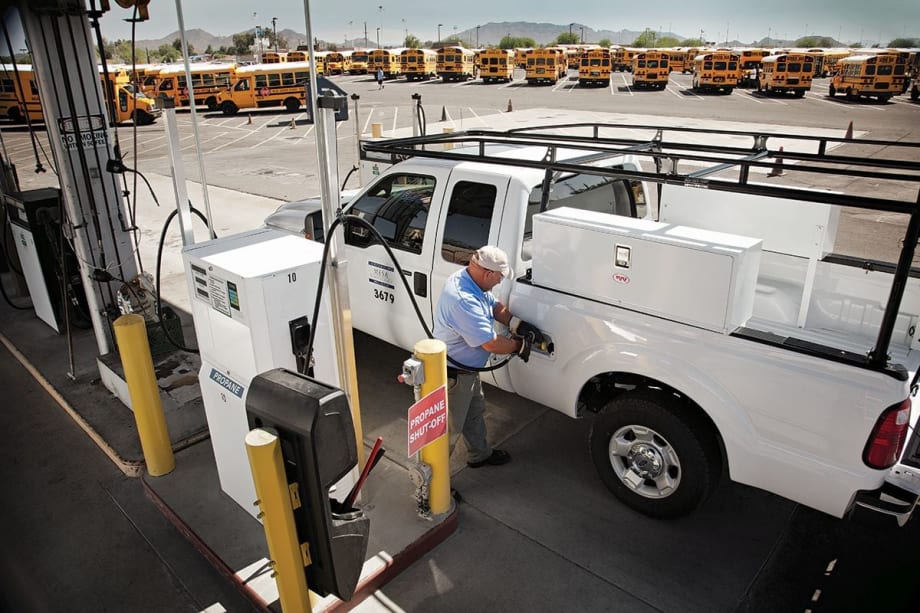
Photo via PERC.
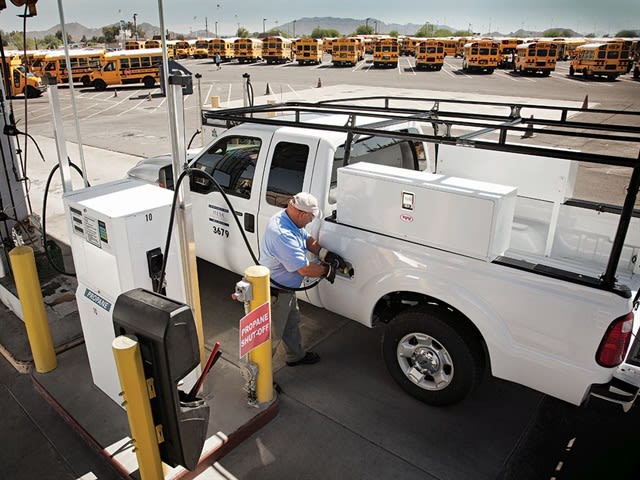
Photo via PERC.
What are the available conversion kits and equipment options for fleets looking to convert to propane autogas? Who manufactures them?
Propane autogas is the third most common fuel in the U.S., surpassed only by gasoline and diesel. More than 23 million vehicles on the road today operate on propane autogas, leading to an array of innovations in OEM-supported vehicles and aftermarket options.
A complete list of certified propane autogas fuel systems by manufacturer can be located on our website at propane.com. EPA- and CARB-dedicated mono-fuel and bi-fuel systems are listed by manufacturer, engine, vehicle platform and year. If you do not find the system you are looking for, please contact the manufacturer for assistance.
How much does a typical conversion cost?
Propane autogas fuel systems costs vary by vehicle type, engine and options required to meet a fleet's needs, most notably the number and usable capacity of fuel tanks. Typical conversion costs can range from $5,000 to $7,000. For accurate pricing, we recommend contacting the manufacturer for the most precise pricing available.
Additionally, it’s important to note that while there is an up-front cost associated with converting a vehicle or buying a new dedicated propane autogas model, the low cost of fuel compared with gasoline and diesel often translates to a quick return on investment. Most fleets that make the switch recoup their investment within 18 months of use.
How much time, on average, does a gasoline to propane autogas conversion take? What about a diesel conversion?
An autogas conversion performed on a gasoline engine will vary based on the complexity of the fuel system purchased and the vehicle in which it is installed. If there are no factors related to system or vehicle complexity to complicate the conversion process, a typical gasoline to propane autogas conversion can be performed in as few as one to two days.
Most upfitters will work with fleets to determine a schedule or conversion cadence that works for their business needs. For fleets making a larger series of conversions, there is often a plan in place over time to convert the vehicles so operations are not affected day-to-day.
There are no certified dedicated or bi-fuel systems available for diesel engines today.
What are some misconceptions regarding efficiency of propane autogas in medium- and heavy-duty truck engines?
The most common misperception with propane autogas vehicles is that propane autogas lacks the much needed horsepower and torque for medium- and heavy-duty vehicles. This misconception is out of touch with modern equipment offerings and is simply not true. Today, propane autogas provides more than adequate power for 33,000 GVWR vehicles in school transportation, package delivery, energy and a number of other vocations and applications for today's fleets.
Another common misconception centers around a perceived lack of service and maintenance available for vehicles once they are purchased. Roush CleanTech, Blue Bird Corp., Freightliner Custom Chassis Corp, Thomas Built Buses, ICOM and all of our supplier partners provide state-of-the-art online and in-person training for technicians which match today's conventional fueled technologies’ training. Support after the sale is not a challenge for propane autogas. In fact, to ensure support is available for our customers, PERC has partnered with NAFTC to develop a propane-autogas-specific curriculum which can be modified to include classroom training in school and vocational settings.
Last but not least, a popular misconception is there's a lack of propane infrastructure available to meet fleets’ needs. One distinct advantage that propane autogas enjoys over other alternative fuels is affordable refueling infrastructure options. In fact, propane autogas infrastructure is one of the most affordable of any fuel. A single pump, dispenser, and tank can typically be installed for just $50,000 and most propane providers will work with you to cover the cost of on-site infrastructure in exchange for a fuel contract. Additionally, public propane autogas refueling stations can be found in every state.
Today, propane autogas delivers power, performance, and state-of-the-art training for technicians and managers which ensures a positive experience for our propane autogas customers.
Does converting a vehicle to propane autogas void any warranties? Do conversions meet current EPA and CARB standards?
PERC promotes the utilization of EPA- and CARB-certified systems for all on-road vehicles. A complete list of certified systems can be located on our website at propane.com.
The Magnusson-Moss Act prohibits manufacturers from voiding warranty coverage simply when an option is added to the vehicle. that the warranty can only be voided if the component is proven to have affected the performance of the vehicle and/or altered vehicle emissions systems making it noncompliant with EPA and CARB requirements. Converting a vehicle to operate on propane autogas does not violate the OEM warranty. PERC supplier partners work within the required guidelines to ensure OEM warranty coverage is not comprised, and in addition, each partner provides comprehensive warranty coverage for their systems.
What are the requirements for garaging and maintenance of propane autogas vehicles?
If a fleet's existing maintenance and repair facilities are code compliant for gasoline and diesel engine repairs and maintenance, most likely the facility is code compliant for propane autogas. Unlike other alternative fuels, propane autogas facilities require no additional gas detection and ventilation equipment. PERC always recommends checking with local authorities having jurisdiction to ensure the facility in question is compliant with established codes, guidelines and requirements.
Do converted and dedicated propane autogas vehicles meet current anti-idling policies and restrictions?
In an effort to reduce fuel costs and extend engine life, all fleets should enforce policies and procedures directly aimed at minimizing or eliminating excessive engine idling whenever possible. Propane autogas saves on fuel costs, which reduces fleet operational budgets while improving the overall financial condition of a fleet.
Unlike diesel fuel, propane autogas is a clean fuel and does not require additional emissions technology components like diesel particulate filters or extra fluids like DEF to meet EPA and CARB emission standards. Propane autogas in its natural state is nontoxic and a non-contaminant of air, land, and water resources. It is not restricted by or required to comply with anti-idling laws and requirements.
Excessive idling is a serious offense, and fleets should be aware of any laws against it in their area. The American Transportation Research Institute provides a compendium of idling regulations online at atri-online.org.
What are the benefits of using aftermarket propane autogas systems? How do aftermarket options stack up again dedicated options?
PERC's propane autogas growth strategies are based in the provision of advanced OEM-dedicated products as well robust aftermarket dedicated and bi-fuel systems. Both OEM-dedicated products and bi-fuel systems are required to meet stringent EPA and/or CARB certification requirements.
Aftermarket systems provide fleets that do not have the funds to purchase and replace existing vehicles, or simply choose not to purchase dedicated OEM options, the option to convert existing vehicles to propane autogas and enjoy the immediate cost savings and environmental benefits of the fuel. Additionally, bi-fuel vehicles can help alleviate “range anxiety” among fleets that do not use centralized refueling or want the flexibility to fill up with gasoline if needed.
Because conversions cost less up-front than purchasing a new dedicated option, fleets can also achieve a much shorter ROI than if they were required to replace the vehicles. Still, most fleets that purchase new realize their full ROI within 18 months due to propane autogas’ affordability compared with gasoline.
Do any incentives exist to assist fleets looking to convert to propane autogas?
Many states — such as Florida, Texas, California, and Ohio — have adopted their own alternative fuel incentive programs. A full list of federal and state incentives can be located at www.afdc.energy.gov/laws/search or at propane.com.
Michael Taylor, a 22-year veteran of the school transportation industry, is director of propane autogas business development at the Propane Education & Research Council (PERC).
More Fuel Smarts

How Volvo Updated Its D13 for EPA 2027 [Watch]
Volvo’s updated D13 promises lower emissions without sacrificing performance or fuel economy. Take a closer look at what changed inside the engine in this HDT Spotlight video.
Read More →
Diesel Price Spike Shortens Payback for Natural Gas Trucks, Report Says
Energy Vision estimates fleets could recover the higher purchase price of an RNG-fueled Class 8 tractor in 1.3 to 2.8 years under current fuel-price scenarios.
Read More →
Calstart Becomes Catalyst Mobility, Reflecting Broader Focus
Calstart is now Catalyst Mobility, reflecting the nonprofit’s growing national role in clean transportation, including zero-emission trucks, infrastructure and incentive programs.
Read More →

Record Diesel Prices Squeeze Trucking Fleets
Average U.S. diesel prices have climbed to nearly $6 a gallon, surpassing the 2022 record as tight refinery capacity and Middle East disruptions keep fuel costs elevated.
Read More →
How Fuel Delivery Shapes Engine Performance
Fuel delivery depends on more than what happens at the injector. For fleet, maintenance and technical professionals, looking at the full path from pump to injector can provide useful context for understanding engine performance.
Read More →
East Coast Port Launches $45M Electric Truck Push
The Port Authority of New York and New Jersey announced millions in incentives for zero-emission drayage trucks, yard tractors, and new charging hubs near the port.
Read More →
California Bill Could Shed Light on Electric Truck Prices
Why do battery-electric Class 8 trucks remain so expensive? A California bill headed to Gov. Gavin Newsom would give fleets and state agencies more visibility into what manufacturers charge.
Read More →
Detroit Opens Orders for EPA 2027 Engines
Detroit isn’t starting from scratch to meet EPA 2027 diesel emissions standards. Its Gen 6 DD13 and DD15 engines keep much of today’s platform while updating the fuel and aftertreatment systems.
Read More →
Zero-Emission Truck Corridor Planned for West Coast
California, Oregon, Washington, British Columbia and Baja California are coordinating plans for truck charging and hydrogen fueling from Canada to Mexico.
Read More →
A Closer Look at Kenworth’s Electric T880E Vocational Truck [Video]
Learn more about Kenworth's T880E battery-electric vocational truck at the Paccar Technical Center, including its range, applications, upfitting considerations, and PTO options, in this HDT Spotlight video.
Read More →