




Advancements in Clean Fuel Technology to Further Reduce Carbon Emissions
Advancements in clean diesel technology will continue to deliver major reductions in black carbon emissions in both the U.S. and worldwide, said Allen Schaeffer, the executive director of the Diesel Technology Forum
Advancements in clean diesel technology will continue to deliver major reductions in black carbon emissions in both the U.S. and worldwide, said Allen Schaeffer, the executive director of the Diesel Technology Forum.
Schaeffer highlighted the advancements in diesel technology and fuel in response to the new study published in The Journal of Geophysical Research-Atmospheres that stated black carbon emissions are the second most important contributor to global warming, behind carbon dioxide. The study evaluated climate forcing of black carbon during the industrial era (i.e. 1750 to 2000).
"While there continues to be ongoing debate about the role of black carbon on the earth's climate, the diesel industry continues to move forward and produce more fuel-efficient diesel engines that have both lower emissions of carbon dioxide and near-zero levels of emissions of particulate (soot)," Schaeffer said.
Diesel Truck and Buses Have Reduced NOx Emissions by 99% And Particulate Emissions by 98%
A complete transformation of diesel technology in the U.S. has taken place in the last decade that has virtually eliminated particulate emissions from new diesel engines across the board. For example, emissions from heavy-duty diesel trucks and buses have been reduced by 99% for nitrogen oxides - an ozone precursor - and 98% for particulate emissions, which include black carbon.
Today, clean diesel technology with near zero emissions is standard equipment in nearly all off?road diesel vehicles and equipment such as construction equipment, agricultural vehicles, stationary generators, locomotives and marine vehicles.
Because of the investments in new technology it now takes 60 of today's technology trucks to emit the same level of PM emissions as a single truck built in 1988, according to Shaeffer.
Diesel Responsible For Less Than 6% of Particulate Emissions in U.S.
"Numerous studies and reports from the U.S. Environmental Protection Agency, researchers and health organizations are highlighting the benefits and importance of clean diesel technology in reducing black carbon emissions in the U.S.," Schaeffer said. "Thanks to the switch to ultra-low sulfur diesel fuel coupled with advances in diesel engine design and emissions control technology, fine particulate emissions have been virtually eliminated from new diesel vehicles and equipment in the U.S.
"Today diesel engines are responsible for less than six percent of all particulate emissions in the U.S.," Schaeffer said.
Black Carbon to Decline by 86% by 2030
Schaeffer said that according to the EPA's 2012 Report on Black Carbon to Congress, the U.S. currently accounts for about 8% of the global black carbon emissions, with 52% of that coming from mobile sources, and 93% of the mobile sources attributed to diesel engines.
On top of the 32% reduction from 1990-2005, EPA projects this percentage will decline by 86% by 2030 largely due to controls on new mobile diesel engines.
"Much of the progress in clean diesel technology in the U.S. can be attributed to the systems based approach that recognized the essential aspect of cleaner, ultra-low sulfur diesel fuel as being the foundation for making large scale changes in engine design and enabled the use of emissions control technology that today result in near zero emissions of particulate matter," Schaeffer said.
"Today, lower-sulfur diesel fuels are not widely available or utilized in all parts of the world. The World Fuels Charter, established by engine and vehicle manufacturers in the U.S., Japan and Europe, lays out such a blueprint for aligning fuel composition and implementation policies with environmental and other societal objectives.
"Whether or not this new study results in more scientific consensus on the role of black carbon emissions on the earth's climate remains to be seen. We do know that the most dramatic changes in history to fuels and emissions levels from diesel engines have occurred after the study period o 1750 to 2000. We look forward to understanding how these changes to both the levels of emissions and their composition inform current scientific understanding and future policy choices," Schaeffer said.
California Air Quality Improvements Aided By Diesel Advancements
The California Air Resources Board has identified the top 10 contributors to PM. Diesel engines and equipment rank as the 8th and 9th highest contributors, Schaeffer said, behind: 1) wildfires, 2) residential fuel combustion, 3) managed burning & disposal, 4) paved road dust, 5) unpaved road dust, 6) fugitive windblown dust, and 7) farming operations.
According to the CARB, diesel particulate emissions from on-road heavy-duty trucks have declined from 7.5% in 1990 to 3.8% in 2008, with future projections in 2020 for the category to account for only 1.6% of all emissions.
More Fuel Smarts

How Fuel Delivery Shapes Engine Performance
Fuel delivery depends on more than what happens at the injector. For fleet, maintenance and technical professionals, looking at the full path from pump to injector can provide useful context for understanding engine performance.
Read More →
East Coast Port Launches $45M Electric Truck Push
The Port Authority of New York and New Jersey announced millions in incentives for zero-emission drayage trucks, yard tractors, and new charging hubs near the port.
Read More →
California Bill Could Shed Light on Electric Truck Prices
Why do battery-electric Class 8 trucks remain so expensive? A California bill headed to Gov. Gavin Newsom would give fleets and state agencies more visibility into what manufacturers charge.
Read More →

Detroit Opens Orders for EPA 2027 Engines
Detroit isn’t starting from scratch to meet EPA 2027 diesel emissions standards. Its Gen 6 DD13 and DD15 engines keep much of today’s platform while updating the fuel and aftertreatment systems.
Read More →
Zero-Emission Truck Corridor Planned for West Coast
California, Oregon, Washington, British Columbia and Baja California are coordinating plans for truck charging and hydrogen fueling from Canada to Mexico.
Read More →
A Closer Look at Kenworth’s Electric T880E Vocational Truck [Video]
Learn more about Kenworth's T880E battery-electric vocational truck at the Paccar Technical Center, including its range, applications, upfitting considerations, and PTO options, in this HDT Spotlight video.
Read More →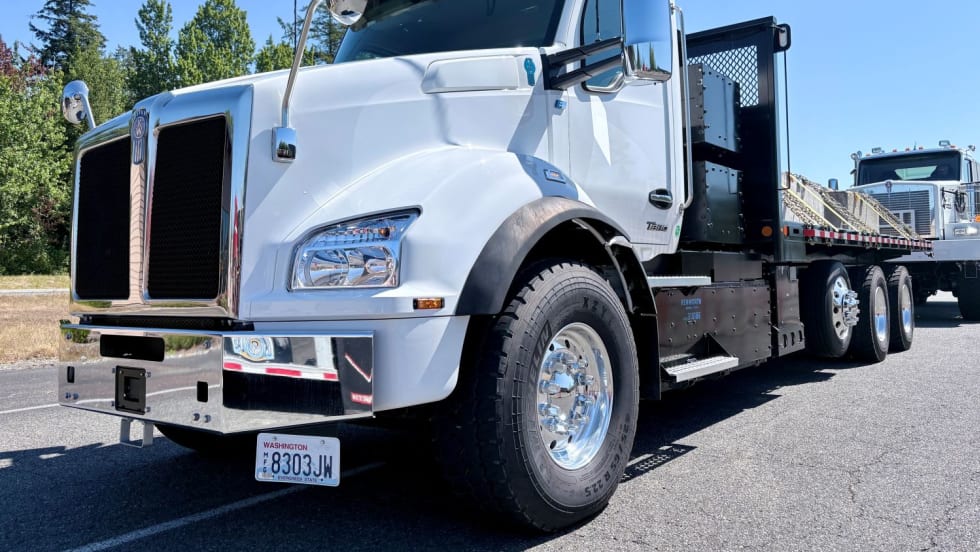
Kenworth T880E Brings EV Power to Vocational Trucks
A closer look at the Kenworth T880E’s range, charging, powertrain and upfit options — and where fleets are showing the most interest.
Read More →
Jennie Abarca Is Proving Electric Trucks Can Do the Job
HDT Truck Fleet Innovator Jennie Abarca is building confidence in fleet electrification one load at a time while openly sharing the challenges she encounters along the way as a small-fleet owner.
Read More →
Cummins Adjusts 2027 Engine Rollout After EPA Proposal
The engine maker will gradually introduce its new Model Year 2027 diesel engines while continuing to offer current models during the transition, citing the EPA's proposed emissions rule changes.
Read More →
EPA Proposal Could Ease 2027 Truck Costs and Buying Uncertainty
The proposal doesn't change the tougher NOx standard, but it would revise key implementation requirements that manufacturers say have driven up costs and complicated fleet purchasing decisions.
Read More →