





Related: Figuring Out DPF Maintenance
8 Steps to Better MPG Through Maintenance
We asked leading fleet maintenance managers and the North American Council for Freight Efficiency for tips on how preventive maintenance can help improve fuel economy.
June 20, 2016
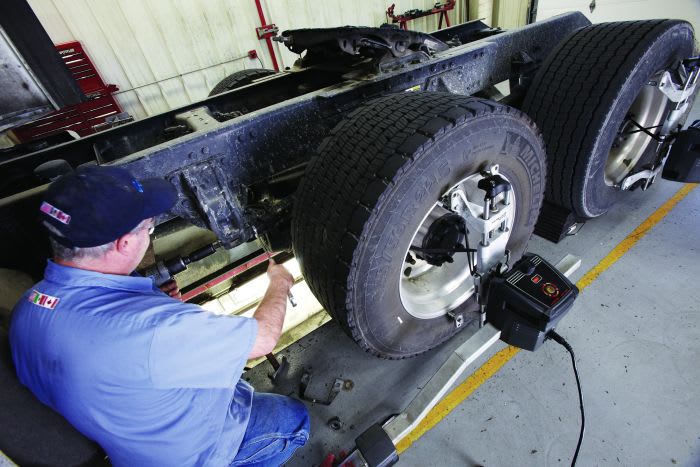
Proper alignment is an often-overlooked maintenance task that can have a significant effect on fuel economy. Photo: Paul Hartley
3 min to read
Proper alignment is an often-overlooked maintenance task that can have a significant effect on fuel economy.Photo: Paul Hartley
We asked leading fleet maintenance managers and the North American Council for Freight Efficiency for tips on how preventive maintenance can help improve fuel economy.
1. Use data to identify possible problems. “If we suspect a truck is having mpg problems, we will schedule it in for what we call a fuel economy check,” says Bill Bliem, senior VP, fleet services, for New Jersey-based NFI. “This includes valve and overhead adjustment, air filter minder check, alignment, fuel flow, etc.”
2. Take care of your tires. Maintaining correct air pressure in tires equates to fuel savings. For every 10 psi of under-inflation, a 10% reduction in fuel economy can result, according to NACFE. Improper wheel alignment can rob fuel efficiency by creating rolling resistance and also cause premature tire wear.
“The biggest thing we do maintenance wise and our biggest fuel economy pick up is tire pressure and alignment,” Bliem says.
3. Change your oil. Too little or too much engine oil can create more friction and rob power. Clean oil lubricates better than dirty oil, so pay attention to oil change intervals. Explore the use of lower-viscosity oils to improve fuel economy.
Gerry Mead, senior VP of maintenance for Chattanooga-based U.S. Xpress, recommends oil intervals based on your fleet’s operations. “OEMs set a limit, but is that limit good for your operation and type of oil?” he notes. “Oils break down and that takes away from its properties to cut down on wear. As oils break down they are less fuel-efficient. We have a zero overdue mentality.”
4. Let the engine breathe. A restricted air intake system (air filter, air cooler, and tubing) or exhaust system will decrease engine power output. Check components at regular PMs and fix any leaks. These leaks can be particularly hard to find, as leaking air is not as noticeable as fuel or oil, but their repair will improve engine operation and fuel efficiency.
5. Maintain air conditioning. The air conditioning compressor requires horsepower to operate, lessening the amount available to create and maintain forward momentum. An air conditioning system that is not operating near optimum efficiency requires even more power. Make sure the condenser and evaporator coils are clean and free from obstructions, the drive belt is in good condition, and the refrigerant level is at the proper level (too full is an issue too).
6. Maintain engine cooling fan. The main engine cooling fan requires a lot power to operate on today’s hotter-running, low-emissions engines. Ensure the fan clutch is operating correctly so the fan runs only when needed. A fan that runs constantly causes a significant reduction in economy.
7. Clean DPFs regularly. Clean diesel particulate filters improve fuel economy by about 2 to 3%, according to NACFE. Diesel particulate filter cleaning — Somewhere around 200,000 miles is a good time to clean these filters, but it does vary widely by engine/truck maker and duty cycle.
8. Maintain aero devices. That money you spent on aerodynamic trucks and trailer aero devices can be wasted if they’re not working right. Always maintain the aerodynamic panels and devices, whether they came with the tractor or trailer or are aftermarket add-ons. They won’t do their job correctly if they’re damaged. Replace or repair them as soon as possible.
Subscribe to Our Newsletter
More Fuel Smarts

How Volvo Updated Its D13 for EPA 2027 [Watch]
Volvo’s updated D13 promises lower emissions without sacrificing performance or fuel economy. Take a closer look at what changed inside the engine in this HDT Spotlight video.
Read More →
Diesel Price Spike Shortens Payback for Natural Gas Trucks, Report Says
Energy Vision estimates fleets could recover the higher purchase price of an RNG-fueled Class 8 tractor in 1.3 to 2.8 years under current fuel-price scenarios.
Read More →
Calstart Becomes Catalyst Mobility, Reflecting Broader Focus
Calstart is now Catalyst Mobility, reflecting the nonprofit’s growing national role in clean transportation, including zero-emission trucks, infrastructure and incentive programs.
Read More →

Record Diesel Prices Squeeze Trucking Fleets
Average U.S. diesel prices have climbed to nearly $6 a gallon, surpassing the 2022 record as tight refinery capacity and Middle East disruptions keep fuel costs elevated.
Read More →
Sponsored•September 9, 2026
How Fuel Delivery Shapes Engine Performance
Fuel delivery depends on more than what happens at the injector. For fleet, maintenance and technical professionals, looking at the full path from pump to injector can provide useful context for understanding engine performance.
Read More →
East Coast Port Launches $45M Electric Truck Push
The Port Authority of New York and New Jersey announced millions in incentives for zero-emission drayage trucks, yard tractors, and new charging hubs near the port.
Read More →
California Bill Could Shed Light on Electric Truck Prices
Why do battery-electric Class 8 trucks remain so expensive? A California bill headed to Gov. Gavin Newsom would give fleets and state agencies more visibility into what manufacturers charge.
Read More →
Detroit Opens Orders for EPA 2027 Engines
Detroit isn’t starting from scratch to meet EPA 2027 diesel emissions standards. Its Gen 6 DD13 and DD15 engines keep much of today’s platform while updating the fuel and aftertreatment systems.
Read More →
Zero-Emission Truck Corridor Planned for West Coast
California, Oregon, Washington, British Columbia and Baja California are coordinating plans for truck charging and hydrogen fueling from Canada to Mexico.
Read More →
A Closer Look at Kenworth’s Electric T880E Vocational Truck [Video]
Learn more about Kenworth's T880E battery-electric vocational truck at the Paccar Technical Center, including its range, applications, upfitting considerations, and PTO options, in this HDT Spotlight video.
Read More →