




Related: What's Hot in Medium-Duty for 2018
5 Compliance Tips for Straight-Truck Drivers
With the rising interest in providing last-mile delivery services, more and more fleets are looking at adding straight trucks to their operations. But a question often asked of compliance experts is, 'what rules do I have to follow?' It's a simple question that lacks a simple answer.
by Rick Malchow
December 21, 2017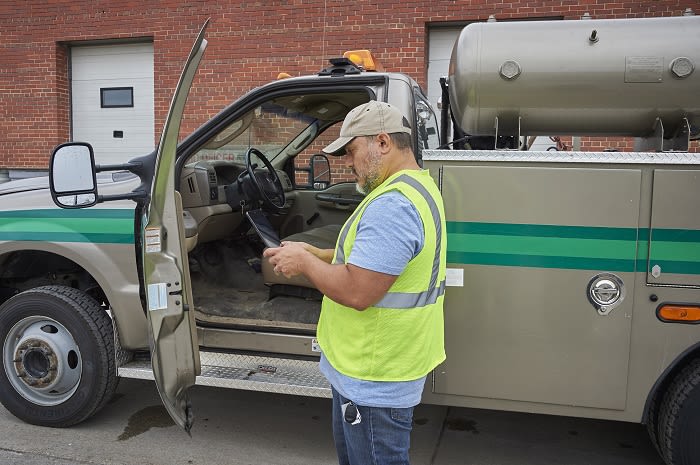
With more fleets looking at adding straight trucks to their operations because of the rising interest in providing last-mile delivery services, the issue of safety becomes more complicated than just simply answering, “Since I have a straight truck, what rules do I have to follow?” Photo: J.J. Keller
5 min to read
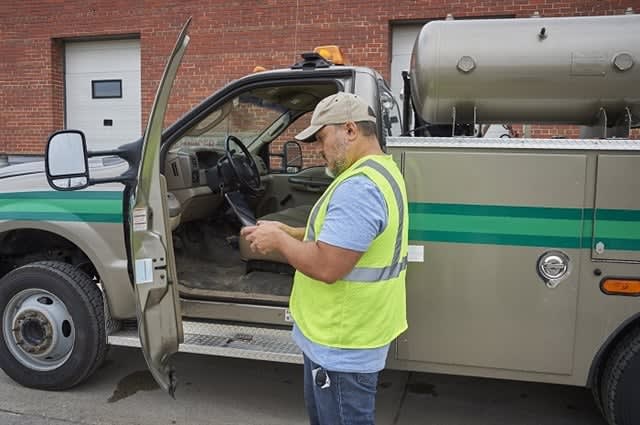
With more fleets looking at adding straight trucks to their operations because of the rising interest in providing last-mile delivery services, the issue of safety becomes more complicated than just simply answering, “Since I have a straight truck, what rules do I have to follow?”Photo: J.J. Keller
With the rising interest in providing last-mile delivery services, more and more fleets are looking at adding straight trucks to their operations. But a question often asked of compliance experts is, “I have a straight truck; what rules do I have to follow?” A simple question that lacks a simple answer.
The answer could be all of them, some of them, or none of them. That’s because there are hundreds — if not thousands — of different types of straight trucks used in nearly as many types of operations. Straight trucks carry their load on the vehicle itself as opposed to on a trailer, which means the term encompasses pickup trucks on the small end of the scale to very long and heavy vehicles on the other end of the spectrum.
1. Know if you’re operating interstate or intrastate
This seems straightforward enough: If your vehicle never leaves the state you’re intrastate, right? Not so fast. If the cargo on board began its journey will end its journey out of state, you likely are continuing an interstate movement. Examples of this are picking up or dropping off something at an airport, seaport, rail yard, cross dock, or potentially at a warehouse or distribution center. This is important because when engaged in interstate transport, the federal rules apply. If strictly operating intrastate, the state’s rules apply.
2. Know your weight – Part A
There’s more than just the gross weight to be concerned with. A straight truck driver should also be aware of the weight the vehicle is rated for and registered for.
In addition to staying within the legal limits, knowing the vehicle weight helps determine what rules to follow due to the three primary definitions of a commercial motor vehicle. The definition that casts the broadest net is the general definition found in 49 CFR 390.5. This definition includes vehicles that operate on a highway in interstate commerce with a weight of 10,001 pounds or more – rated or actual – by themselves or in combination with a trailer. Vehicles that meet this definition need to follow all of the applicable Federal Motor Carrier Safety Regulations. These include the regulations for driver qualifications, parts and accessories necessary for the safe operation of motor vehicles, vehicle inspections, vehicle markings, DOT registration, driving, and hours of service.
If the vehicle has an actual or rated weight of 26,001 pounds or more, or is operating with a trailer with a rated or actual weight of 10,001 or more and the combination is 26,001 pounds or more (again rated or actual), then the commercial driver’s license and drug and alcohol testing program regulations need to be followed.
When a vehicle has three axles or has a registered or actual weight of over 26,000 pounds, by itself or in combination, and will be crossing state lines, the vehicle needs to participate in the International Fuel Tax Agreement and the International Registration Plan. If the vehicle rarely crosses state lines, trip permits can be used in lieu of permanent IFTA and IRP credentials.
3. Know your weight – Part B
The actual maximum weight that a straight truck can carry may be below the rated value of the vehicle. The federal and state rules limit the weight that can be carried on any axle or set of axles. Tandem drive axles, for instance, top out in most states at 34,000 pounds. Once that weight is reached, the vehicle can take on no more cargo without rebalancing.
Straight trucks can be rated by the manufacturer well below what can fit in the vehicle. A driver who takes on 13,000 pounds in a vehicle with a curb weight of 14,000 pounds for a total gross weight of 27,000 pounds can be subject to citations for being over the rated weight of the vehicle, over the registered weight vehicle, and be placed out of service for not having a CDL.
4. Know your vehicle and equipment
The federal driver qualification rules state that “a person is qualified to drive a motor vehicle if he/she . . . can, by reason of experience, training, or both, safely operate the type of commercial motor vehicle he/she drives.”
Even when a driver is not subject to the FMCSRs, it is hard to argue that a driver shouldn’t know how to safely operate the vehicle or the equipment required to complete an assignment. Fines and violations pale in comparison to civil litigation awards – this is particularly true when a plaintiff’s attorney can effectively argue that the driver or company had “a complete and utter disregard for the safe operation of the vehicle or for the motoring public.”
5. Know who to call – and when
By the nature of the role, drivers of straight trucks need to be able to think and act independently. That doesn’t mean that they should work – or feel like they work – in a vacuum. Typically, when a situation goes from bad to worse, it is a direct result of poor decisions. When there is a series of poor decisions, a situation can go from bad to disastrous or even catastrophic. Poor decisions are often a combination of not having or seeing the available options, stress, and the desire for a rapid resolution. What is often clear after a serious accident, service failure, violation, or citation is that the driver waited until after the chain of events to communicate rather than to proactively ask for assistance.
The bottom line
Straight trucks should not be viewed as a tractor-trailer’s cute little brother or sister. Safe operation requires nearly the same level of training and skill. Depending on the operation and the driver’s responsibilities at a customer or job site, much more training and skill may be necessary. In addition, many of the hours of operation of a straight truck are run in the challenging conditions of heavy traffic, tight spaces, or off-highway job sites. Rather than viewing the operators through the lens of “what rules don’t apply to a straight truck,” a better question that offers a clearer picture is, “How can we best equip the driver for safe and productive operation?”
Rick Malchow is editor, transport management, for J.J. Keller & Associates, which offers products and services to help ensure safety and compliance. This article was authored under HDT editorial standards to provide useful information to our readers.
Subscribe to Our Newsletter
More Safety & Compliance

FMCSA Pauses Biennial-Update Enforcement Amid Motus Transition
Carriers whose updates were due on or after June 1 have more time, while FMCSA works to stabilize its new registration system and warns of phishing sites impersonating its new carrier registration system, Motus.
Read More →
ZF Expands Commercial Vehicle Push in North America
ZF is expanding its North American commercial-vehicle presence with new transmission applications, electrification, trailer technology and autonomous-driving systems.
Read More →
Truck Drivers Need More Than Another Alert
Fleets have more visibility into truck health, safety events, and driver activity than ever. The next challenge is turning all that information into useful guidance for the person who has to decide what to do next.
Read More →
Tesla Wants a Self-Driving Semi. Are Cameras Enough?
Could Tesla’s camera-only autonomous driving technology work on an 80,000-pound Semi? In this commentary, HDT's Deborah Lockridge takes a look at Tesla, Cybercab, and how autonomous trucks see the road.
Read More →
What DOT’s Automated Vehicle Strategy Means for Trucking
The U.S. Department of Transportation issued a new automated-vehicle strategy that outlines plans for driverless-truck regulations, cross-state freight corridors, and federal safety standards.
Read More →
NYC Expands Speed, Pedestrian Safety Tech Across Fleet
New York City is expanding intelligent speed assistance and pedestrian-alert systems across its municipal fleet, moving the technologies from pilot programs into vehicle procurement and retrofit requirements.
Read More →
FMCSA Removes 110 Truck Driver Training Schools from Certified ELDT List
Federal regulators also are targeting more than 160 additional training providers and launching a nationwide audit of third-party CDL skills testers as part of a broader crackdown on trucking fraud.
Read More →
Beyond DOT Compliance: What Makes a Trucking Fleet Truly Safe?
A trucking fleet can follow every rule and still make unsafe decisions. The real test comes when safety conflicts with freight, productivity, or cost.
Read More →
Hours of Service Pilot Programs: FMCSA Readies for 2027 Rollout
Two pilot programs could eventually reshape hours-of-service rules, giving truck drivers options to pause their 14-hour clock or use longer split sleeper rest periods.
Read More →
New Guide Offers Pet Safety Tips for Truck Drivers
Hundreds of thousands of pets travel in truck cabs. A new safety guide from Volvo Trucks and the Center for Pet Safety offers practical advice for truck drivers who bring dogs and cats along for the ride.
Read More →