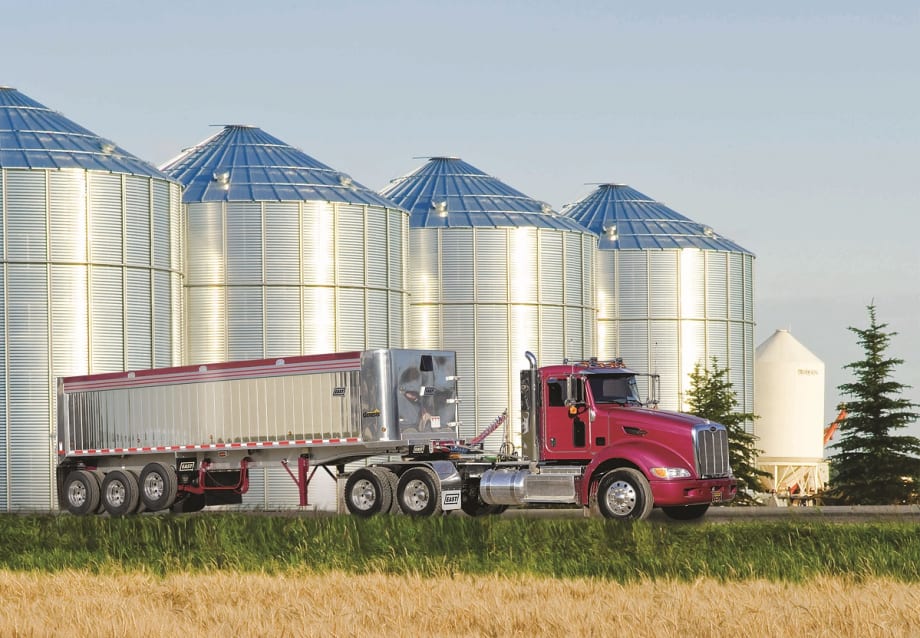
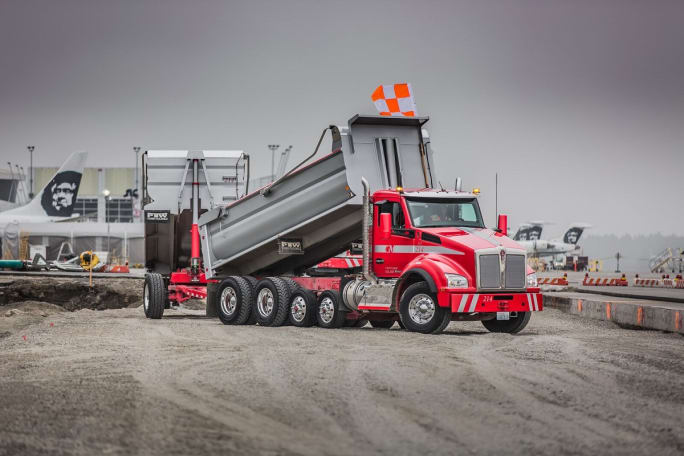
Heavy-duty dump trailers increasingly are featuring lighter-weight materials and even sensors and automation.
Photo: East Manufacturing
6 min to read
In the past, a heavy-duty dump trailer simply needed to be tough enough to survive grueling construction sites and everyone was generally pretty pleased. But today, market demands, economic concerns, and changing fleet preferences dictate new designs and materials used in their construction.
Ad Loading...
New materials for light weight and durability
Aluminum was once a rarity in dump trailer designs, says Corey May, engineering manager for Manac, a heavy-duty trailer manufacturer with operations in both Canada and the U.S. But as manufacturers work to design lighter trailers that are still durable enough for heavy construction applications, aluminum in body panels is becoming more commonplace — as are other lighter-weight materials, he says.
“We are designing with a lot more exotic materials today,” May explains. “A new, high-strength structural steel called ‘Strenx’ is a common one, because it offers a thinner structural thickness to trailer walls and tailgates, which allows us to lighten the design overall. And an emphasis on lightweighting is where the majority of the trailer market is going today.”
Ad Loading...
May says Strenx allows Manac engineers to shave as much as 1,500 to 2,000 pounds off of a conventional dump trailer design while still maintaining strength characteristics similar to older, all-steel models. “We’re looking at a new Hardox AR500 product as well,” May notes. “Early reports are it is wear-resistant to the point that it enhances trailer durability by as much as 30%.”
When it comes to choosing the right material for trailers for your fleet, there are many factors beyond weight, including the application at hand, the materials being hauled, and your company’s operations.
Ralph LoPriore, director of fleet assets for Gary Merlino Construction/Stoneway Concrete, in Seattle, says, “Today, with Hardox 8-inch-thick trailer bodies, we have a material that is both super strong and lightweight enough to handle tough payloads,” he says. “I know they use a lot of aluminum dump bodies back east. But today, I can spec a steel trailer as light, or lighter, than some aluminum options. And I can still carry boulders or broken concrete thanks to the steel liners we put in the box.”
LoPriore also says steel bodies are easier for his technicians to maintain. “It’s hard to find technicians today, and even harder to find guys who can fabricate aluminum,” he says. “Steel welding equipment is commonplace on pretty much any construction site or fleet shop, and used all the time. But even if you can find a fabricator, aluminum is very hard to get clean enough to weld — particularly if you’re hauling asphalt. It does look great behind a truck. But I prefer steel bodies and make up the difference in weight by spec’ing lighter engines, transmissions and other components.”
That said, aluminum dump trailers remain popular in many vocational hauling applications. East Manufacturing has been using aluminum to build trailers since 1968, and touts the durability of it by noting that first trailer is still operational today.
Ad Loading...
“In today’s competitive environment, there is a strong emphasis in trimming weight wherever possible,” says Chris Cooler, dump product manager for East. “Finding the right weight vs. cost ratio for optimum payload remains a primary objective among owners. And aluminum dump trailers are a popular option for achieving those goals.”
Recent advances in materials technology have resulted in steel trailers and bodies that are as light as — or even lighter than — aluminum ones, says Ralph LoPriore, with Gary Merlino Construction in Seattle.
Photo: Gary Merlino Construction
Automation and sensors
Anytime you can confidently let technology remove a driver interface, you make it easier on the driver and help ensure optimal operation of the equipment. Cooler says that trend is affecting dump trailers, too. East is now offering automatically deployed lift axles and rear suspension dumps with auto-reinflate to help make drivers more efficient.
“With automatically deployed lift axles, the axle air-ride bag pressure is monitored, and the system raises the lift axle when the pressure falls below a preset level indicating the trailer is empty,” he says. “This saves on tire and brake wear, reducing operating costs. When the trailer is loaded, the pressure in the bags will rise above the preset level, and the system will automatically lower the axle.”
The rear suspension dump also has an auto-reinflate system, Cooler says. This feature allows the driver to flip a switch in the cab to exhaust the air in the rear axle suspension to improve cornering in tight areas such as parking lots, and is especially useful on longer trailers. The auto-reinflate feature automatically fills the rear suspension once the trailer speed rises above 10 mph. This system helps reduce tire wear and prevents the driver from accidentally leaving the air exhausted when he gets back on the road.
And more technology-driven features are likely on the way. Manac’s Corey believes that sensors that either alert the driver or automatically lower the dump body when a certain speed is exceeded will be common safety features in the near future.
Ad Loading...
“We’re also watching some interesting developments in Europe,” he adds. “Germany recently introduced new regulations requiring insulated trailers with sensors for asphalt haulers. The system is designed to ensure asphalt is put down at specific temperatures to ensure smoother road surfaces. If the load temperature drops below a designated point, the driver and fleet are alerted and the truck is routed back to the asphalt plant to get a fresh load of material. We believe it’s likely similar regulations and systems could come to North America in the future.”
Taking tarps to the next level
Tarping a loaded dump trailer is not a driver’s favorite job. But with a majority of states requiring tarps covering loose-material payloads, it has to be done.
Jeff Boyd, vice president of sales and marketing for tarping system manufacturer Aero Industries, says that’s why tarp suppliers are increasingly turning to electric- and semi-automated tarp deployment and retraction systems.
“A lot of fleets are tempted to put a cheap, manual system on their trailers just so they can check the ‘Compliant’ box,” Boyd says. “But we’re also seeing an increasing number of fleets that realize that they need to make it easier — and safer — for their drivers to cover loads and retract a tarp when they reach their destination. To put it simply, the easier it is for the driver, the more thorough the tarping job will be and the more secure the load will be.”
The main driver for this trend, Boyd says, is safety — both on the jobsite and on the road. The benefits of a tarping system are obvious at highway speeds, as is the importance of keeping material inside a dump body and off of John Q. Public’s minivan. “But we’re also talking to fleets who look at busy, crowded jobsites with rain and snow and mud — and they want their drivers inside the cabs of their trucks, where it’s safe, as much as possible,” Boyd says.
Ad Loading...
And in an age where a driver shortage is an ongoing fact of life for fleets, Boyd says many fleets want to avoid rotator cuff and other joint injuries that can occur from manually cranking tarps — as well as reduce the chance of slips, falls and other injuries.
The end result is an increasingly sophisticated array of electric- and automatic tarping systems, many of which can be operated right from the driver’s seat of a truck.
A box with wheels to haul materials is one of transportation’s earliest technologies. But it is obvious that the evolution of dump trailers is far from over.
The Impact of Tariffs on Dump Trailers
One of the most immediate concerns dump trailer manufacturers face right now is supply chain uncertainty due to the Trump administration’s tariffs and trade wars. To date, manufacturers say, market disruption has been minimal. But price increases and other issues are starting to surface.
“Tariffs have resulted in material cost increases, leading OEMs to increase trailer pricing as much as 10% to 12% over a 12-month period on all trailers,” says Chris Cooler, dump product manager for East Manufacturing. “The material price increases have affected both steel and aluminum with nearly every supplier, which eventually trickles down to the consumer.”
Corey May is engineering manager for trailer-maker Manac, which has operations in both Canada and the U.S. He says the company has seen the price of materials used to construct trailers go up, but so far it has been able to pass those increases along to customers with minimal disruption. “The main issue has been increases in aluminum being imported from Canada,” he notes.
East’s Cooler holds out hope that any pain inflicted by the tariffs will be temporary. “By restricting the import of the products, components and raw materials, we anticipate that U.S. manufacturers will be stronger and more competitive in the future.”
Volvo’s updated D13 promises lower emissions without sacrificing performance or fuel economy. Take a closer look at what changed inside the engine in this HDT Spotlight video.
The Michelin X Multi Energy D2 is a regional haul drive tire engineered to help fleets improve fuel efficiency, durability and traction in demanding stop-and-go operations.
ZF is expanding its North American commercial-vehicle presence with new transmission applications, electrification, trailer technology and autonomous-driving systems.
Could Tesla’s camera-only autonomous driving technology work on an 80,000-pound Semi? In this commentary, HDT's Deborah Lockridge takes a look at Tesla, Cybercab, and how autonomous trucks see the road.
The U.S. Department of Transportation issued a new automated-vehicle strategy that outlines plans for driverless-truck regulations, cross-state freight corridors, and federal safety standards.
The Port Authority of New York and New Jersey announced millions in incentives for zero-emission drayage trucks, yard tractors, and new charging hubs near the port.
The National Highway Traffic Safety Administration says it lacks authority to regulate medium- and heavy-duty truck engines separately from complete vehicles, but the existing standards have not yet been eliminated.
Detroit isn’t starting from scratch to meet EPA 2027 diesel emissions standards. Its Gen 6 DD13 and DD15 engines keep much of today’s platform while updating the fuel and aftertreatment systems.