2021 HDT Fact Book: Sustainability Focus Not Slowed By Pandemic
The COVID-19 pandemic did not slow down commitments to sustainability in the supply chain. Interest in not only energy savings and renewable energy increased significantly. Here’s the sustainability data you need to know from HDT’s 2021 Fact Book.
Heavy Duty Trucking’s annual Fact Book is designed to provide a snapshot of the current state of the industry, where it’s been, and where it’s going. These numbers can help you in planning and benchmarking your fleet, and in telling trucking’s story to others.
Graphic: HDT
2 min to read
Sustainability is becoming more and more important to trucking. Government regulations, shipper demands, and public opinion are driving a push toward vehicles, technology, and operational shifts that improve greenhouse gas emissions and air pollution and address other environmental and societal concerns.
Ad Loading...
The COVID-19 pandemic did not slow down commitments to sustainability in the supply chain. Interest in not only energy savings and renewable energy, but also human rights protection, worker welfare and safety, increased significantly over the last year, according to a recent report from the MIT Center for Transportation & Logistics and the Council of Supply Chain Management Professionals.
Although the survey didn’t ask shippers and third-party logistics companies about how they plan to choose carriers in the years ahead, “for trucking fleets, I think we can read that pressures to be part of their large shippers’ sustainability efforts did not relent under the pandemic year,” MIT’s David Correll told HDT. “Given that … it seems harder than ever now to imagine a reason that this pressure would not continue.”
Ad Loading...
Walmart, for example, has committed to reach net-zero emissions from all its vehicles and its transportation network by 2040. Knight-Swift plans to cut GHG emissions in half by 2035, and FedEx announced a goal to achieve global carbon-neutral operations by 2040.
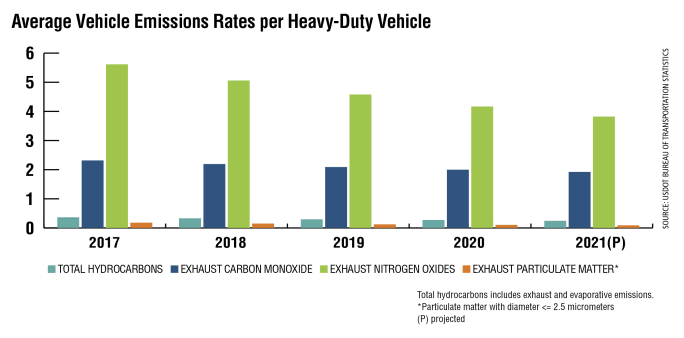
The average emissions rates per heavy-duty vehicle has steadily declined since 2005, according to the U.S. Department of Transportation’s Bureau of Transportation Statistics. BTS defines heavy-duty vehicles as those with more than two axles or four tires.
In 2021, the bureau projects emissions to be the lowest on record, and for the numbers to continue to decrease until 2030 (the last year of BTS projections in this dataset).
The emissions rates are in grams per mile, and are based on the national average age distributions, vehicle activity, temperatures, inspection/maintenance and antitampering programs in that calendar year.
Source: USDOT Bureau of Transportation Statistics
The State of Sustainable Fleets report found that in 2019 and 2020, 83% of clean-vehicle early adopter fleets plan to increase their use of natural gas, propane, battery-electric, and hydrogen fuel cell electric vehicles in the next five years. The report, produced by clean technology consulting firm Gladstein, Neandross & Associates, noted that even during the pandemic last year, the growth of clean technologies continued to rapidly accelerate. It saw an increase in fleet orders and deliveries for natural gas and battery-electric vehicles as well as for lower carbon renewable fuels.
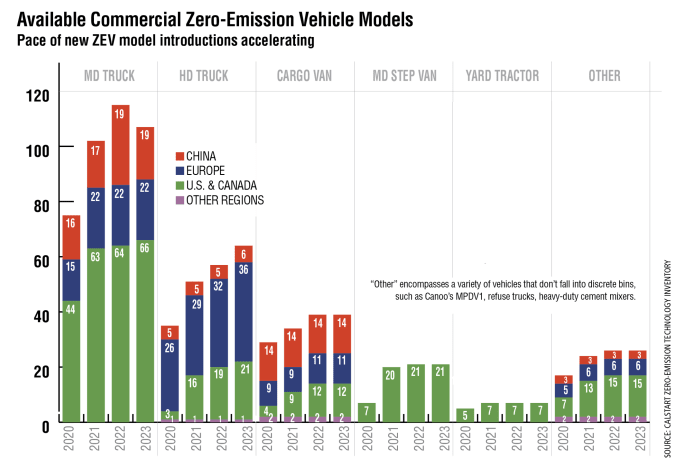
The overall number of available zero-emission commercial vehicle models is on a strong upward trajectory globally despite the economic impacts of the global pandemic, according to Calstart’s Zero-Emission Technology Inventory. The United States will see an even sharper uptick in available zero-emission heavy-duty truck models compared to other global markets in the next few years, rising 250% from just eight models in 2020 to 28 models on the market in 2023. Last year at this time, only 16 heavy-duty trucks were expected to be available by 2023.
Meanwhile, traditional diesel drivetrains continue to get greener. The Environmental Protection Agency’s Phase 2 Greenhouse Gas Standards for Medium and Heavy-Duty Engines and Vehicles went into effect with model year 2021. When fully phased in by 2027, these standards will require GHG reductions of up to 25% from MD/HD vehicles and 4-5% from engines.
But as the State of Sustainable Fleets Report points out, traditional drivetrains face increasingly stringent regulatory initiatives (including outright bans) and growing expectations from sustainability-oriented customers and the public.
Ultimately, the pace of widespread fleet adoption of new sustainable vehicle technologies comes down to whether they can compete with traditional drivetrains in terms of performance and total cost of ownership.
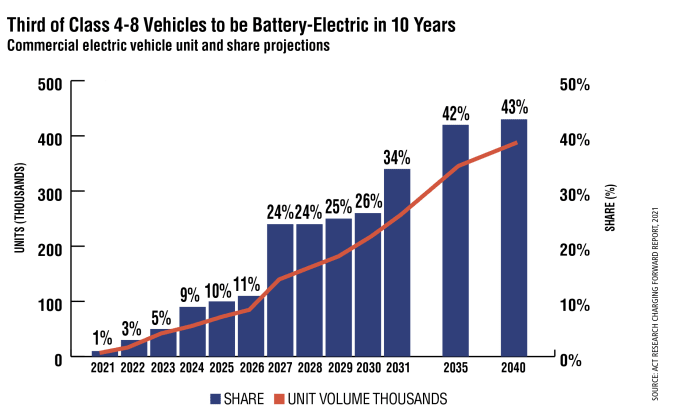
According to ACT Research, by 2035, about 40% of the Class 4-8 market in the U.S and Canada will be electric vehicles, with gains achieved due to a compelling business case, particularly as battery costs drop and stricter emissions regulations make vehicles with internal combustion engines more expensive.
Source: ACT Research Charging Forward Report, 2021
Trucking is an increasingly data-driven industry. Numbers matter. There’s no end to the available software and analytics available to fleets today to help them analyze and improve their operations.
But sometimes you want to look at statistics and data to help give you the big picture, and this is what Heavy Duty Trucking’s annual Fact Book issue is all about. It’s designed to provide a snapshot of the current state of the industry, where it’s been, and where it’s going. These numbers can help you in planning and benchmarking your fleet, and in telling trucking’s story to others. And it can serve as a reference guide throughout the year.
This is the seventh year for the HDT Fact Book. Check out the other published sections of the Fact Book:
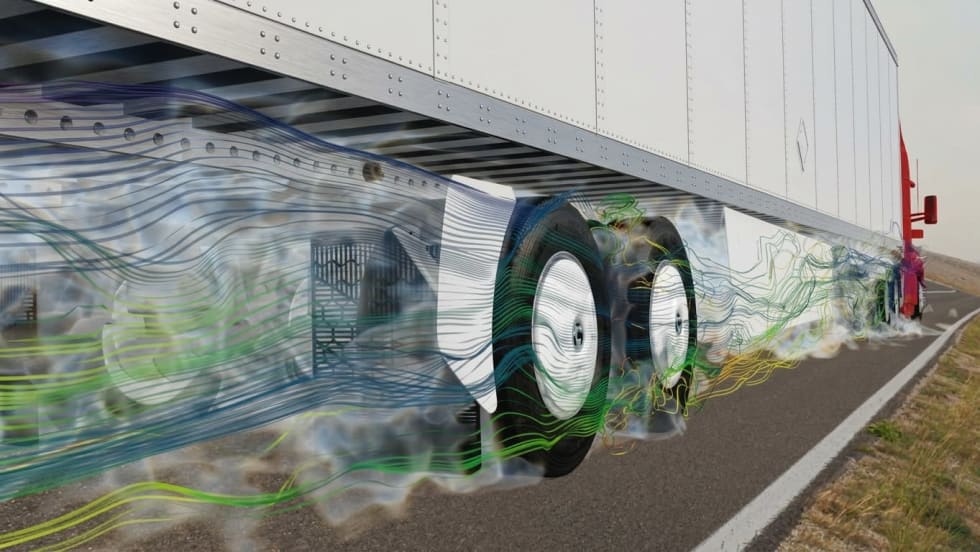
The lighter trailer aerodynamic system installs in less than 45 minutes, according to the company, with potential payback in under a year depending on fuel prices and trailer mileage.
Diesel prices have eased from September’s record high, but doubts about additional Russian supply and limits on dyed-diesel tax relief mean trucking fleets still face expensive fuel. And prices could go higher.
Can better fuel economy help pay for driver raises? In this podcast, GP Transco explains how small efficiency gains create room to reinvest in its people.
What’s another tenth of a mile per gallon worth? GP Transco shares how equipment upgrades and driver coaching turn small gains into meaningful fuel savings.
Operating-cost savings have overtaken sustainability goals as the leading reason surveyed fleets are adopting battery-electric terminal tractors, according to new NACFE research.
The new card combines fuel discounts with telematics-based purchase controls. Geotab’s analysis also points to potential savings from choosing lower-priced fuel stops.
ACT Research expects costs, charging infrastructure, and technology improvements to drive zero-emission commercial vehicle adoption as federal regulations and incentives retreat.
Why do battery-electric Class 8 trucks remain so expensive? A California bill signed by Gov. Gavin Newsom would give fleets and state agencies more visibility into what manufacturers charge.