While repair and maintenance costs decreased considerably in 2019, moving from 17.1 cents per mile in 2018 to 14.3 cents per mile in 2019, the industry could see an increase in maintenance costs driven by a strong demand for trucking.
2021 HDT Fact Book: Maintenance Costs Expected to Rise
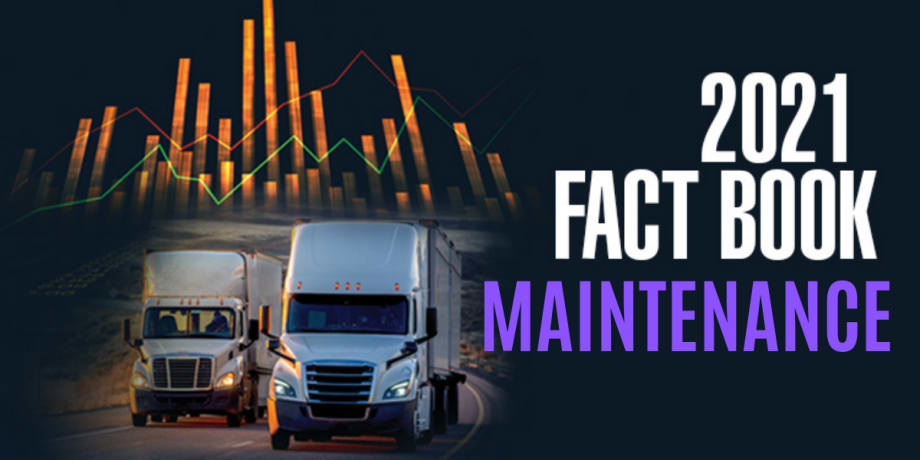
While repair and maintenance costs decreased considerably in 2019, the industry could see an increase in maintenance costs driven by a strong demand for trucking. Here's the maintenance you need to know from HDT's 2021 Fact Book.

Heavy Duty Trucking’s annual Fact Book is designed to provide a snapshot of the current state of the industry, where it’s been, and where it’s going. These numbers can help you in planning and benchmarking your fleet, and in telling trucking’s story to others.
Graphic: HDT
The cost per mile for repair and maintenance has increased by 39% since 2008 due to more advanced technology in trucks. On top of that, the demand for trucking in 2020 and into 2021 alone could also grow those numbers.

Repair and maintenance costs have increased 24% since 2012 — a counterintuitive increase given the record sales of new trucks and trailers. From 2012 to 2018, overall motor carrier operational costs have increased more than 11.6% — exceeding the 10.8% inflation rate for that same time period.
Source: American Transportation Research Institute
With demand driven by the essential nature of the business during the COVID-19 pandemic and the subsequent boom in the U.S. e-commerce market, maintenance costs could increase due to more miles being driven per truck, ATRI officials said in a 2020 report analyzing the operational costs of trucking.
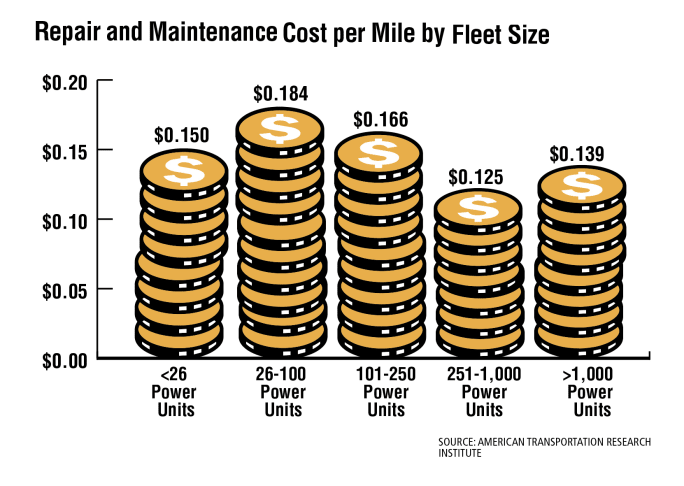
Recent maintenance costs in the industry are of course also dependent on several factors, including fleet type and size.

Large fleets typically have their own maintenance facilities, which can mean lower costs as opposed to using outside providers for repair and maintenance.
Source: American transportation Research Institute
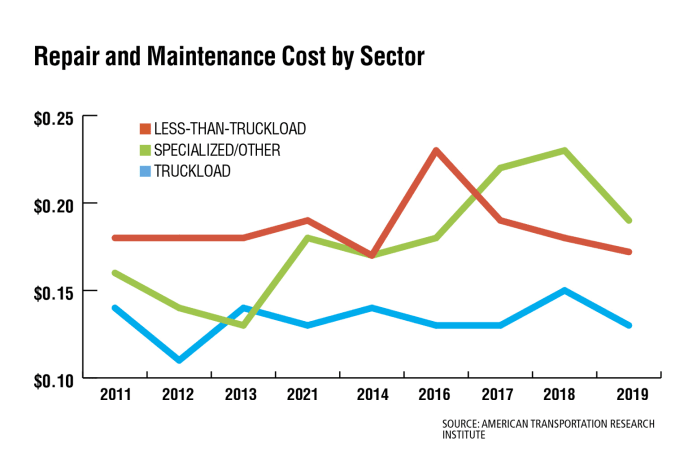
Repair and maintenance costs remained highest for specialized fleets in 2019 at 18.7 cents per mile. Truckload carriers reported the lowest line-item repair cost at 12.8 cents per mile on average, while less-than-truckload carriers reported about 16 cents per mile on average, according to ATRI’s report.

Repair and maintenance costs remained higher for specialized fleets than other fleets in 2019 at 18.7 cents per mile. Truckload carriers reported the lowest line-item repair cost at 12.8 cents per mile on average.
Source: American transportation Research Institute
What remains a constant is the type of repairs being made the most often.
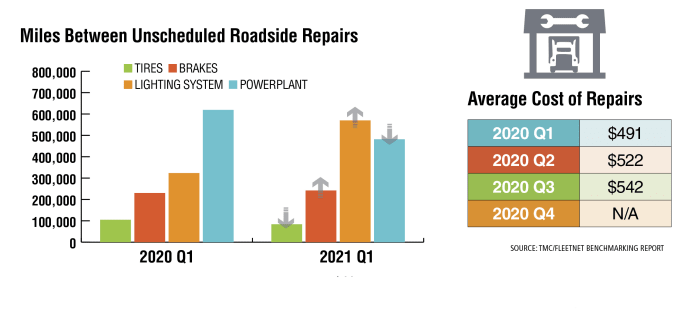
The top components/systems that lead to roadside breakdowns across all the fleets continued to be the lighting system, powerplant, brakes and tires, according to the Technology & Maintenance Council and FleetNet America’s Benchmarking report — the same components that top the list most years.

The average cost of roadside repairs gradually increased last year, a mirror of 2019 when the average cost of a roadside mechanical repair increased to $334 in the fourth quarter, up from $317 in the third quarter and $299 in the second quarter.
Source: TMC/FleetNet Benchmarking Report

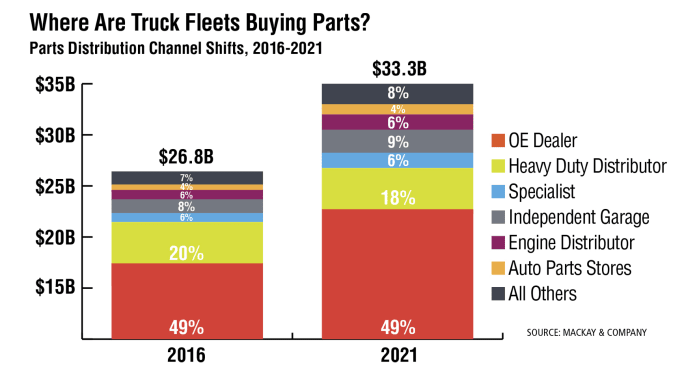
In the last five years, aftermarket parts demand for medium- and heavy-duty vehicles (Class 6-8), trailers and container chassis has grown 25%. The heavy-duty distributor lost 2 percentage points, 1 point each to the independent garage and other. The OE dealer share has held steady at nearly half of the market.
Source: MacKay & Company
More Maintenance

Fullbay Report: Heavy-Duty Shop Revenue Up, Rates Rising, but Shops Still Short on Techs
Strong growth across the heavy-duty repair sector is being tempered by workforce shortages and an aging technician pipeline.
Read More →
How Mack Sees the Next Era of Fleet Intelligence
Telematics has evolved from simple vehicle tracking into a connected service platform that can help fleets boost uptime, improve specifications, and move toward predictive maintenance. Mack executives say AI is now giving fleets a way to turn all that vehicle data into faster, smarter decisions.
Read More →
Clarios Expands Battery Monitoring Into Subscription Service with Battery Manager Pro
A new battery-monitoring-as-a-service program from Clarios Connected Services uses predictive analytics and automatic replacement to reduce downtime and smooth fleet maintenance costs.
Read More →
SAF-Holland’s BrakeSight Aims to Take the Guesswork Out of Air Disc Brake Maintenance
New Haldex sensor technology from SAF-Holland integrates with telematics systems to give fleets continuous insight into air disc brake condition.
Read More →
Vanair Introduces Solar, Battery Power Ecosystem for Class 8 Trucks
The company’s expanded EPEQ ecosystem includes flexible solar panels, lithium batteries, hydraulic power systems, and a portable fast charger for electric trucks.
Read More →
Mitchell 1 Targets Technician Search Challenges With New Fleet Feature
TruckSeries’ new Unit Number Search allows fleet technicians to access repair data using the identifier they know best — the truck’s unit number.
Read More →
Truck Maintenance Costs Ease Slightly, but Long-Term Trend Still Rising
Benchmark data from Decisiv and TMC shows repair expenses still climbing, but fleets are improving efficiency with digital tools.
Read More →
New PC-12 Diesel Engine Oil Category Nears Completion: What Fleets Should Know
The new heavy-duty engine oil category, PC-12, is nearing the finish line. Here’s what fleet maintenance managers should know before it arrives in 2027.
Read More →
Advanced Commercial Vehicle Diagnostic Strategies
Learn how to diagnose complex electrical and drivability issues with confidence using the Autel MS909CV, a digital storage oscilloscope, and real-world engine data in this hands-on virtual introduction to advanced commercial vehicle diagnostics.
Read More →
Smarter Maintenance Strategies to Keep Trucks Rolling
In today’s cost-conscious market, fleets are finding new ways to get more value from every truck on the road. See how smarter maintenance strategies can boost uptime, control costs and drive stronger long-term returns.
Read More →