





Related: Land O'Lakes Claims Coast-to-Coast Autonomous Truck Run
U.S. Commits to Lead in Autonomous Vehicle R&D
A new report issued by the U.S. National Science and Technology Council and the U.S. Department of Transportation laid out the Trump administration’s plans to stake out a leadership role for the country in the global race to develop autonomous vehicle technology.
January 13, 2020
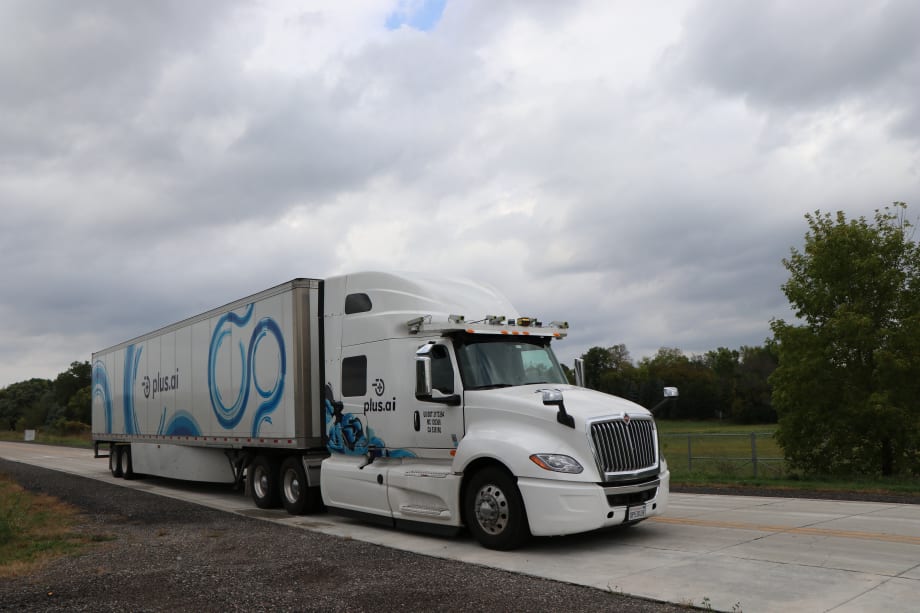
In a wide-ranging report released at CES on January 8, 2020, the Trump adminstration laid out its long-term goals to help promote autonomous vehicle development in the U.S.
Photo: Plus.ai
4 min to read
The U.S. government is committed to fostering surface transportation innovations to ensure the United States leads the world in automated vehicle technology development and integration while prioritizing safety, security, and privacy and safeguarding the freedoms enjoyed by Americans.
That’s the summary of Transportation Secretary Elaine Chao on a new report issued by the National Science and Technology Council and the Department of Transportation outlining the Trump administration’s goals and strategies to ensure that the U.S. government and companies attain and hold a leadership role in the global race to develop autonomous vehicles.
In an introductory letter in the report, which was released at the CES annual electronics show in Las Vegas on Jan. 8, Chao said the U.S. government, “recognizes the value of industry leadership in the research, development, and integration of AV innovations. Such innovation requires appropriate oversight by the government to ensure safety, open markets, allocation of scarce public resources, and protection of the public interest.”
Unsurprisingly, given the Trump administration’s anti-regulations stance, the report noted that for now, anyway, the federal government will reply on the automotive sector and autonomous technology developers to largely self-regulate themselves as they develop new vehicle systems and prepare them for deployment and testing on American roads.
Priority Goals for Safety and Efficiency
The report zeroed in on three broad policy goals, each with a list of desired end goals or actions to be taken to help achieve those objectives.
The first policy goal identified by the report is to “Protect Users and Communities” as new vehicle systems come on line. In order to do this, the report emphasized the following policies:
Prioritize safety
Emphasize security and cybersecurity
Ensure privacy and data security
Enhance mobility and accessibility
In order to boost competition in the race to develop autonomous vehicles, the report also said the U.S. would “Promote Efficient Markets” through the following:
Remain technology neutral
Protect American innovation and creativity
Modernize regulations
Facilitate coordinated efforts
Promote consistent standards and policies
Ensure a consistent federal approach
Improve transportation system-level effects
The report emphasized that autonomous vehicle development has many potential benefits for both the American economy and society at large, including improved safety and a reduction in roadway fatalities, as well as improved quality of life, access, and mobility. Other notable benefits include lower energy usage and improved supply chain management.
The potential economic and societal benefits of autonomous vehicles could also be substantial, the report noted, including increased economic productivity and efficiency, reduced commuting time, and even the potential reduction of the environmental impact of conventional surface vehicles while increasing overall system energy efficiency. In addition, the report said, adoption of autonomous vehicles may provide mobility to citizens who currently face transportation challenges, increasing their access to jobs and services and their ability to live independently.
Significant Commercial Impact
If there’s any area of society where autonomous vehicles could have the most dramatic impact, it is likely in the commercial sector, the report said. And nowhere is that potential more apparent than in the transportation of freight.
In the arena of commercial freight transport, the report found, autonomous vehicles have the potential to safely haul freight long distances, which could decrease long-haul transport times and improve supply chain management efficiencies. AV technology also has the potential to dramatically reduce congestion—one of the highest costs for freight movement—and to enable platooning technology that can reduce energy costs.
In order to facilitate those goals, the report said the Trump administration has directed the Federal Highway Administration to pursue several initiatives, including:
Investigating different roadway/automated driving scenarios with a focus on the data and systems that will be needed to enable ADS to exchange data to successfully navigate challenging roadway scenarios.
Developing new modeling and simulation capabilities to analyze the impact of connected and automated vehicles on the highway system, including developing new traffic simulation algorithms that incorporate these vehicles and conducting case studies to analyze impacts of these technologies on traffic flow and operations.
Pursuing an update of the Manual on Uniform Traffic Control Devices (MUTCD). The upcoming new edition will propose updated technical provisions to reflect advances in technologies and operational practices; incorporate recent trends and innovations; and set the stage for ADS as those continue to take shape.
Funding grants for through the annual $60 million Advanced Transportation and Congestion Management Technologies Deployment (ATCMTD) program. The Fixing America’s Surface transportation Act (FAST Act) established ATCMTD to make competitive grants for the development of model deployment sites for advanced transportation technologies to improve safety, efficiency, system performance, and infrastructure return on investment.
In all, the report said, the White House encourages a future in which the United States is a global leader in AV technology and will seek to offers autonomous innovators and entrepreneurs an ideal environment to develop and integrate AV technology. At the same time, the report said, these efforts must prioritize safety, security, and privacy for users and communities.
The report by the the U.S. National Science and Technology Council and the U.S. Department of Transportation can be accessed here.
More Fleet Management

Sponsored•September 16, 2026
Color Match Smarter: Tools That Restore & Perform
For fleet managers and collision repair professionals keeping heavy-duty trucks on the road, getting the color right the first time isn't just about appearance — it's about efficiency, turnaround time, and bottom-line results. Discover how today's digital color tools are transforming the repair process from guesswork to precision.
Read More →
FMCSA Pauses Biennial-Update Enforcement Amid Motus Transition
Carriers whose updates were due on or after June 1 have more time, while FMCSA works to stabilize its new registration system and warns of phishing sites impersonating its new carrier registration system, Motus.
Read More →
Sponsored•September 14, 2026
2026 Blueprint for Countering Smarter Supply Chain Theft
Cargo theft is no longer just the cost of doing business. It's a multi-billion-dollar criminal enterprise exploiting vulnerabilities across your fleet, drivers, and supply chain.
Read More →


Sponsored•September 1, 2026
How Telematics Improves Visibility, Control, and Performance in Refrigerated Fleets
Explore how telematics help refrigerated fleets improve visibility, uptime, efficiency, compliance, and cargo protection across connected cold chain operations.
Read More →
What the U.S.-Canada Trade War Means for Trucking
Escalating U.S.-Canada tariffs could disrupt cross-border freight, reduce truck volumes, raise costs, and create new uncertainty for carriers on both sides of the border.
Read More →
What Are Trucking’s Top Concerns for 2026?
The American Transportation Research Institute wants to know what's worrying trucking fleet managers, drivers, and other stakeholders in its annual Industry Issues survey.
Read More →
American Trucking Associations Looks for a New Leader
ATA President and CEO Chris Spear abruptly left his job at the association on August 21, at a pivotal time for the trucking industry.
Read More →
Public Wi-Fi Cybersecurity Risks: How Truck Drivers and Fleets Can Protect Their Data
Public Wi-Fi can expose truck drivers and fleets to credential theft, malware, and other cyber threats. Here’s how to reduce the risk on the road.
Read More →
For Nicky Cupp, Fleet Innovation Starts With Frustration
HDT Truck Fleet Innovator Nicky Cupp turns everyday pain points at Fraley & Schilling into opportunities for better technology and smarter processes.
Read More →
Adam Buttgenbach’s Approach to Electric Trucks: Start With Where They Fit
HDT Truck Fleet Innovator Adam Buttgenbach helped PepsiCo build one of North America’s largest EV fleets by focusing on where electric trucks make operational sense.
Read More →