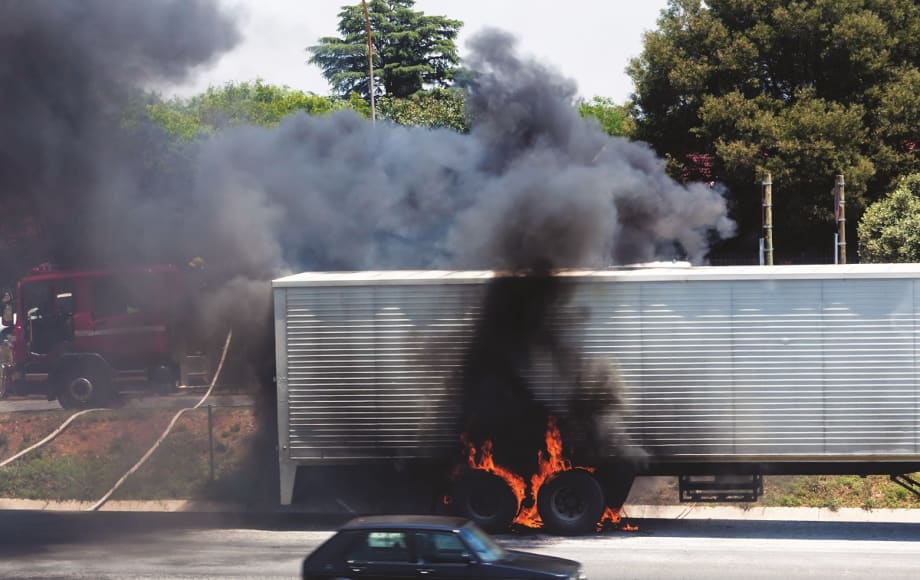
Wheel-end fires often make the news, with dramatic clouds of thick black smoke.
Credit:
Getty Images
7 min to read
Millions of dollars’ worth of equipment and cargo goes up in smoke every year because of wheel-end fires, euphemistically called thermal events. You’ll see it on the news or social media, with dramatic footage of thick black smoke and flames consuming an entire trailer — and the tractor, if the driver can’t get the two units unhooked fast enough.
Ad Loading...
But determining how and where the fires start continues to frustrate the maintenance community, because the damage is often so severe, there’s little left pointing to a cause.
Each fire could be a one-off incident — or it could be indicative of a pattern of events that happens to other fleets too, but fleets likely won’t be aware of what maintenance issues their competitors are experiencing.
Ad Loading...
What Causes Wheel-End Fires?
The American Trucking Associations’ Technology & Maintenance Council surveyed members to determine which, if any, contributing factors might show up as trends across a broad truck and trailer population. Nothing turned up that would give investigators something to focus on. Participation in the survey was light, we’re told, because fleets didn’t want to incriminate themselves by admitting to having had a fire, despite being promised anonymity.
What is known is that tires do not cause the fires.
Phil Arnold, a field engineer with Michelin North America, told attendees at TMC’s Fall Meeting that rubber compounds begin to break down when tire temperatures exceed 250 degrees. That’s when a blowout might occur resulting from the deterioration of the tire. It’s not until the rubber reaches temperatures of 500-550 that flammable vapors are emitted by the tire. If an ignition source is present, the rubber will start burning at 650-700 degrees. Spontaneous combustion won’t occur until 850-900 degrees. (The normal operating temperature range for tires is between 100 and 150 degrees).
“Tires contain a great deal of potential energy,” he said. “They are like high-grade coal when they start to burn, and they are very difficult to extinguish.”
When a tire comes apart while driving, it’s usually the result of underinflation.
Ad Loading...
Heat generated within the sidewalls as the tire flexes weakens the steel belts in the casing while softening the rubber to the point it eventually breaks down and the tire blows apart. With tire fires, the heat source is the wheel end. Heat travels through the metal of the hub and through the wheel, where it comes into contact with the tire bead. Since the bead is built differently from the upper sidewall, the rubber there just gets hotter and hotter, until at some point it begins burning, rather than exploding as the casing might due to underinflation.
The source of that heat is friction from either a deteriorating wheel bearing or a dragging brake. In the bearing’s case, failure usually stems from lack of lubrication. There are multiple causes for dragging brakes.
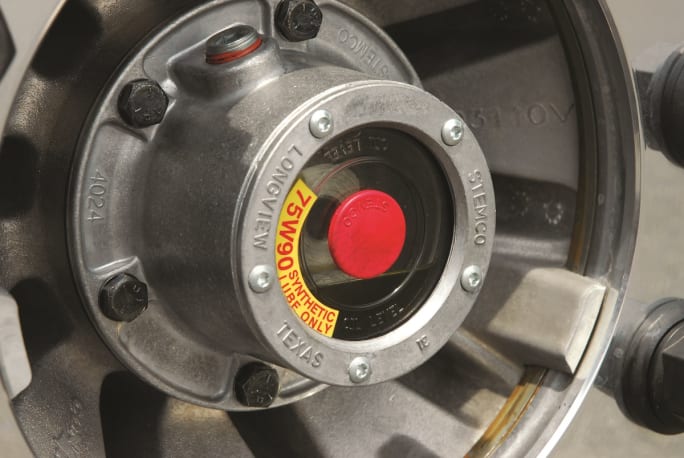
Drivers should be trained to inspect hub caps for proper condition. This one is over-filled with lubricant.
Photo: Jim Park
Wheel bearings
The axle/hub interface is a potential source of thermal saturation. High-quality wheel bearings, properly installed, properly lubricated, and operated according to the product specifications, seldom fail on their own. Unfortunately, much can go wrong due to neglect, oversight, or the best intentions gone wrong.
Wheel-bearing-related fires can almost always be traced back to lack of lubrication, whether it’s lube loss due to a seal failure or contamination related to water ingress, or debris in the bearing well damaging the seal and causing a leak.
Any situation that might increase friction between the axle spindle and the hub needs to be addressed in the installation and maintenance of the wheel-end assembly.
Ad Loading...
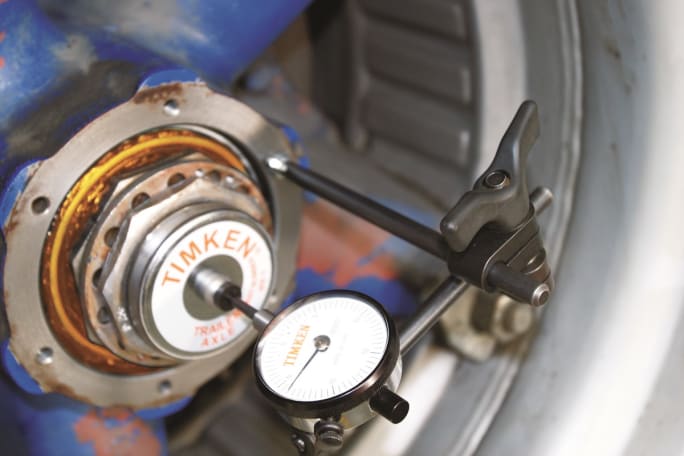
“Over-tightening (excessive preload) the bearing can limit the lube film, which will generate heat, though perhaps not to the level where there’s a risk of a fire,” says Ean Dickerhoof, an application engineer for mobile on-highway products at Timken. “Conversely, excessive endplay can affect seal alignment compromising seal life, which can allow debris to enter the system or the lubricant to leak out.”
Obviously, seal condition and lube levels and condition need to be inspected at regular intervals, Dickerhoof adds, being careful to maintain the proper lube level.
“Some people think packing the cavity full of grease is better than partially filling it,” says Michael Gromosiak, Timken chief application engineer for mobile products. “There’s a certain percentage fill that’s recommended. If you overfill the cavity you can overheat the bearing, because there’s no heat dissipation.”
Timken says bearings ought to run somewhere in the 160-175 degree range. Running at 250 and higher is getting into risky territory. In the case of complete lube depletion, temps will continue to rise until the wheel-end assembly either fails completely and separates from the truck or it heats the surrounding materials to a point where the tire catches fire.
Dragging brakes
“There are a lot of different reasons a brake can drag to a point of a thermal event occurring,” says Joseph Kay, Meritor director of brake engineering. “In general, it takes a rather large force applied to the brake shoes on a drum brake or brake pads in a disc brake to generate substantial rubbing forces that cause the brake system to get hotter and hotter as the vehicle is driven.”
Ad Loading...
Kay points to several potential sources, including driving with the parking brake applied, a failed parking chamber diaphragm not compressing the parking spring completely, brakes not releasing after a brake application, corrosion-related binding of the camshaft or disc brake caliper internal parts or sliding system, malfunctioning slack adjusters, or excessive brake lining swell.
“In most cases the driver will not be able to detect one or maybe two brakes that are dragging because of the engine power and weight of the vehicle,” Kay says. “This is where the driver needs to be aware of excessive smoking from the brakes or any handling differences, such as unusual pull or deceleration.”
Literally any moving brake part could be suspect, from valves that do not fully exhaust application pressure due to fouling or corrosion, to broken parking brake springs that inhibit full retraction of the push rod, or lack of S-cam or slack adjuster lubrication, says Keith McComsey, director of marketing and customer solutions – wheel-end at Bendix Spicer Foundation Brake.
“Proper preventive maintenance and inspection of all wheel-end components is critical, as is the proper specification and condition of brake linings per the OEM literature.”
As for TMC’s survey results, they revealed 88% of reported fires occurred on vehicles equipped with drum brakes and self-adjusting brake adjusters, while 25% of respondents reported fires on disc-brake-equipped vehicles.
Ad Loading...
Proper bearing installation using correct procedures will extend bearing life and limit the possibility of a wheel-end fire.
Photo: Jim Park
Preventive maintenance and the truck driver’s role
While procedures differ for various wheel-end assemblies and lubricants, at the bare minimum, technicians and drivers should watch for signs of lubricant leakage. Oil-lubricated hubs should be checked every time a trailer enters the shop. The lube should be checked for signs of water contamination (milky appearance), and the oil should be smelled to see if it has been subject to high temperatures (it will smell burnt). Also, the condition of the sight-glass should be checked.
With grease-filled hubs where the lubricant is not visible, the wheel should be jacked up, rotated and checked for signs of rough rotation, stiffness or looseness. If the hub cab is removed, verify the correct lube levels (not over-filled), and check for contamination and corrosion on the outer bearing.
Drivers are the last line of defense against wheel-end fires, but they can’t be expected to notice everything or even know what to look for without proper training in wheel-end inspection.
Jeremy Gough, director of national fleet maintenance at Canada’s Bison Transport, a 12-time grand prize winner of the Truckload Carriers Association Fleet Safety Award, says his company’s trip planners build extra time onto trips so drivers can comfortably complete those inspections properly, adding that the company also does extensive driver training on vehicle inspections.
“If you expect drivers to do what you ask of them, you have to give them the right tools to do the job,” he says. “That starts with training in the areas you want them to inspect, and you have to make it as easy as possible for them to do an effective inspection.”
Ad Loading...
Bison goes as far as installing lighting in the trailer bogey area so drivers can see the undercarriage even at night. It also installs brake-stroke indicators so drivers can see if the brakes are fully released and the application stroke is within tolerance.
“Drivers are taught what to look for while doing an undercarriage inspection, including how to identify problems with the hub caps, signs of oil leaks, loose wheel nuts, etc.,” says Gough. “We are all about safety here, and we encourage our drivers to be part of the solution.”
Drivers should be instructed to touch and smell the wheel-hub area for excessive temperatures and tell-tale odors of overheated brakes or wheel-ends. On top of that, Gough instructs drivers that if something doesn’t feel right, check it out. A dragging brake can be difficult to detect from the driver’s seat.
“The driver won’t always feel the brake dragging,” notes Trent Siemens, general manager of Oak Point Service in Winnipeg, Manitoba, whose company hauls diesel and gasoline to retain service stations. “I’ve known drivers to mistake a dragging brake for a heavier-than-usual load, a headwind, or even terrain that seems to make the engine work a little harder.”
Determining the cause of a wheel-end fire might not always be possible, but you can be certain it will be related to a lack of maintenance or inspections.
For fleet managers and collision repair professionals keeping heavy-duty trucks on the road, getting the color right the first time isn't just about appearance — it's about efficiency, turnaround time, and bottom-line results. Discover how today's digital color tools are transforming the repair process from guesswork to precision.
DTNA is recalling more than 2,400 trucks that received an incompatible software fix instead of the hardware repair required to address brake valve corrosion.
Fleets have more visibility into truck health, safety events, and driver activity than ever. The next challenge is turning all that information into useful guidance for the person who has to decide what to do next.
Making it through August isn’t the same as being ready for the next several months of operation. Find out what systems may have suffered from summer heat and need to be checked out before fall.
With freight improving but costs still climbing, fleet maintenance executives explain how they're balancing price, quality, and supplier relationships.
The new API PC-12 heavy-duty engine oil category reflects the changing demands of modern diesel engines. But fleets like Foodliner are looking to getting their own data before making decisions on adopting the new oils and questions such as extending oil drain intervals.
The joint venture will operate MCT's network of Carrier Transicold dealerships and mobile service locations, with the companies promising greater service capacity and uptime for refrigerated fleets.