




What to Consider When Choosing Lift Axles
There is no single lift-axle configuration that works everywhere, because of the wide variety of state and local regulations applicable to axle weights and spreads.There are many things to consider when adding liftable or steerable axles to a truck to increase payload capacity.

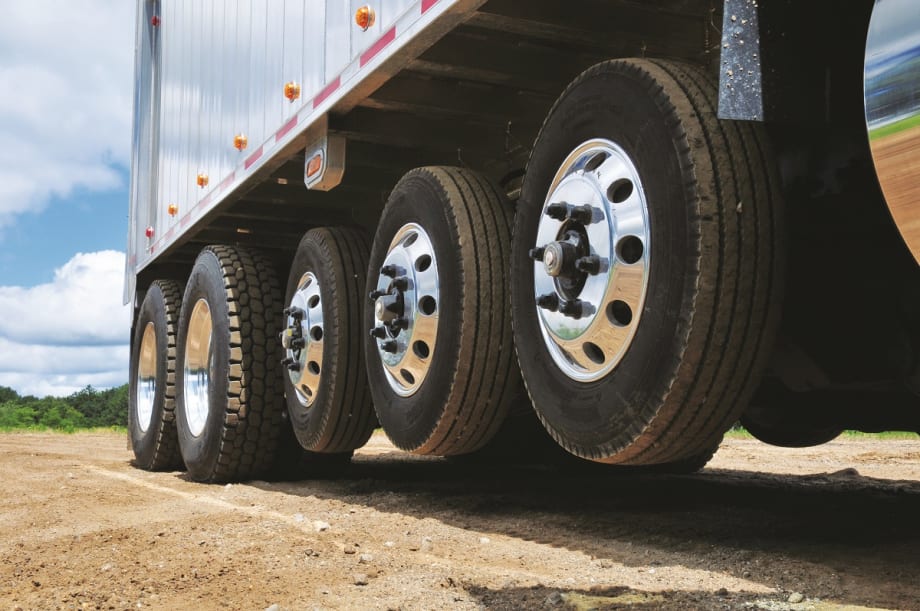
There are many things to consider when adding liftable or steerable axles to a truck to increase payload capacity.
Photos: Jim Park
Liftable and self-steering auxiliary axles can help add payload capacity, but they come with increased weight and additional complexity. An enormous amount of engineering is required to get the right number of axles in the right place on the frame for particular applications in particular jurisdictions. There’s much more to consider beyond how many axles you can squeeze into the available frame space.
There is no single lift-axle configuration that works everywhere, because of the wide variety of state and local regulations applicable to axle weights and spreads. Trucks spec’ed for use in Ohio, for example, may not be allowed in Indiana. Local dealers and upfitters will be aware of what configurations are allowable, but if you plan to cross state lines, you may have to settle for a lower common denominator.
“Fleets want to maximize their payloads, and it’s up to the manufacturer to figure out how to fit steerable/liftable axles under the truck or trailer,” says Neil Haslam, head of design engineering at Ingersoll Axles. “We work with the builders on how to install the axle. We also work with the end-users so they’ll know the best way to choose the axle.”
When spec’ing an axle and suspension system for a generic van trailer, there are fewer engineering factors to consider than when specifying a vehicle with a steerable or liftable axle. For example, Haslam says, customers need to weigh the pros and cons of single versus dual tires, the desired suspension style, and even the desired turning angle of the axle.

Liftable axles on trailers for extra capacity are permitted in many jurisdictions, but some require automatic lifting or steering capability.
A “super single” tire (as opposed to a fuel-efficient wide-base single tire) is several inches taller than a standard dual tire, so the suspension travel must be matched to the size of the tire. Were you to consider switching from the taller super singles to a standard tire at some point in the future, you’d risk damaging the suspension by over-extending the air springs.
“Conversely, a larger tire might not give the needed ground clearance with the axle lifted, say from 4 inches down to 1.5 inches,” says Paul Brown, auxiliary axle marketing manager at Hendrickson. “Tire choice is often determined by the frame-to-ground distance, because we have to match the ride height of the suspension to the tire of choice.”
Your tire choice can also impact the wheel cut on a steerable axle and the placement of components such as tie-rods and brake chambers, says Brown. “We can do a pre-set from 20-30 degrees of steer angle. The farther forward you mount the axle, the steeper wheel cut you need, but you still need the frame and component clearance.”
Air system capacity is another critical engineering consideration when spec’ing auxiliary axles, especially with multiple lift axles. Section 121 of the Federal Motor Vehicle Safety Standards requires a certain air reservoir capacity based on the size and quantity of brake chambers used. Those calculations are all done by the OEM when the truck is built, but in the case of an aftermarket installation, say with a dump body, the body builder would be responsible for ensuring the finished product meets all the requirements, and that could include upgrading the air compressor to meet the extra demand for air.
“When you’re talking about lift axles, there are other implications you have to consider, not just the structural loading,” says Dale Kwasniewski, director of rear drivetrain engineering at Meritor. “Adding one or more lift axles is an engineering-intensive process. You don’t just bolt them on and hope for the best. The OEMs are very diligent in that regard, but you should always seek professional advice if you’re adding an axle later in the truck’s life.”
And while it may seem like a no-brainer, ensuring the axle will physically fit into the allotted space can be challenging. You have to consider factors such as driveline clearance when the suspension is inflated and deflated, and ensure there’s adequate clearance for the tires while turning (with steerable axles).
“For retrofits, you will need to confirm there is adequate frame rail space for installation,” notes Sibin Luke, business development manager for vocational products at SAF-Holland. “It’s important to look for components like crossmembers and fasteners that could cause interference issues during installation and operation.”
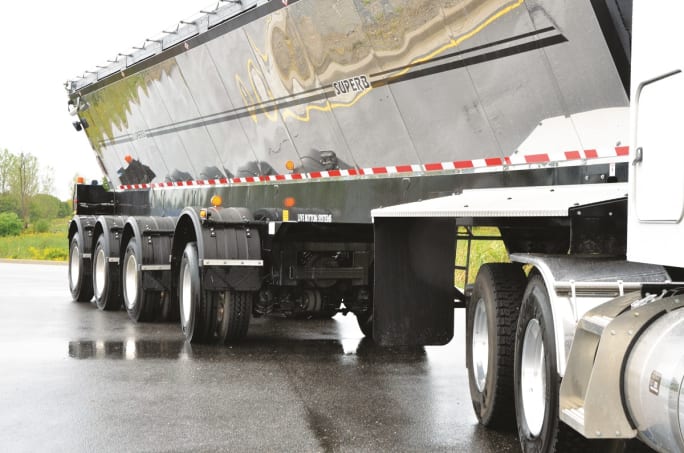
Steerable axles minimize pavement scrubbing, which states like, and help reduce scrubbing wear on tires, which fleets like.
Understanding ratings
You’ll usually hear two different ratings mentioned when spec’ing lift axles, the axle rating and the suspension rating. It’s not uncommon to find, for example, a 26,000-pound axle with a 30,000-pound suspension. The rating for the package — axle and suspension — will be that of the lowest-rated component, the axle in this case. Spec’ing a suspension with a heavier rating than the axle could be done for strength and robustness, not just load-bearing capacity.
Most of the discussion involving lift axles centers on carrying capacity, but you also have to consider the weight-bearing capacity of the truck when the lift axles are raised, such as when operating on a jobsite. With the axles raised, the drive axles and the steer axle are left to support the full weight of the load. The term most people in the industry use is “jobsite rating.”
“We apply structural ratings to all our vocational tandem and steer axles,” says Kwasniewski. “For example, a typical 40,000-pound tandem may have a jobsite rating of 55,000 pounds, but other criteria also apply, such as restricting speed to 5 mph or less, and the size and type of tires. That’s the reality of the vocational business, so we have to make sure our axle housings are structurally sound to manage that weight.”
The final consideration is where to put the lift-axle control: inside the cab or out on the chassis. Regulations vary around the country, with some insisting the controls be outside the cab beyond the driver’s reach, while others allow controls in the cab.
Automation has in some cases made the control a moot point, since deployment is based on weight as determined by the pressure within the air suspension. In the case of steerable axles, there’s often a lock-up or lift switch connected to the reverse light circuit of the transmission. Since steerable axles have 3- to 5-degree reverse caster, they will turn immediately upon reversing, so they must be lifted or locked in the straight position.
More Equipment

How Volvo Updated Its D13 for EPA 2027 [Watch]
Volvo’s updated D13 promises lower emissions without sacrificing performance or fuel economy. Take a closer look at what changed inside the engine in this HDT Spotlight video.
Read More →
Michelin Tire Improves Efficiency and Durability for Regional Fleets
The Michelin X Multi Energy D2 is a regional haul drive tire engineered to help fleets improve fuel efficiency, durability and traction in demanding stop-and-go operations.
Read More →
ZF Expands Commercial Vehicle Push in North America
ZF is expanding its North American commercial-vehicle presence with new transmission applications, electrification, trailer technology and autonomous-driving systems.
Read More →
Tesla Wants a Self-Driving Semi. Are Cameras Enough?
Could Tesla’s camera-only autonomous driving technology work on an 80,000-pound Semi? In this commentary, HDT's Deborah Lockridge takes a look at Tesla, Cybercab, and how autonomous trucks see the road.
Read More →
Kodiak: Driverless Long-Haul Truck Launch on Track for 2026
Kodiak AI says its driverless long-haul safety case is 93% complete and it remains on track to begin commercial operations by year-end 2026.
Read More →
What DOT’s Automated Vehicle Strategy Means for Trucking
The U.S. Department of Transportation issued a new automated-vehicle strategy that outlines plans for driverless-truck regulations, cross-state freight corridors, and federal safety standards.
Read More →
East Coast Port Launches $45M Electric Truck Push
The Port Authority of New York and New Jersey announced millions in incentives for zero-emission drayage trucks, yard tractors, and new charging hubs near the port.
Read More →
PlusAI Going Public to Fund Autonomous Truck Launch
A SPAC deal could provide PlusAI with up to $300 million as it works toward a 2027 commercial launch of factory-built autonomous trucks.
Read More →
NHTSA Moves to Rewrite Truck Fuel-Economy Rules
The National Highway Traffic Safety Administration says it lacks authority to regulate medium- and heavy-duty truck engines separately from complete vehicles, but the existing standards have not yet been eliminated.
Read More →
Detroit Opens Orders for EPA 2027 Engines
Detroit isn’t starting from scratch to meet EPA 2027 diesel emissions standards. Its Gen 6 DD13 and DD15 engines keep much of today’s platform while updating the fuel and aftertreatment systems.
Read More →