




Related: The Sustainable Future at Michelin's Movin'On Conference [Photos]
Michelin Executive Talks Airless Tire and Sustainability
Michelin's Executive Vice President Laurent Bourrut describe's how the company's UPTIS airless tire concept is the culmination of the company's vision for a sustainable future.
by John G. Smith
June 24, 2019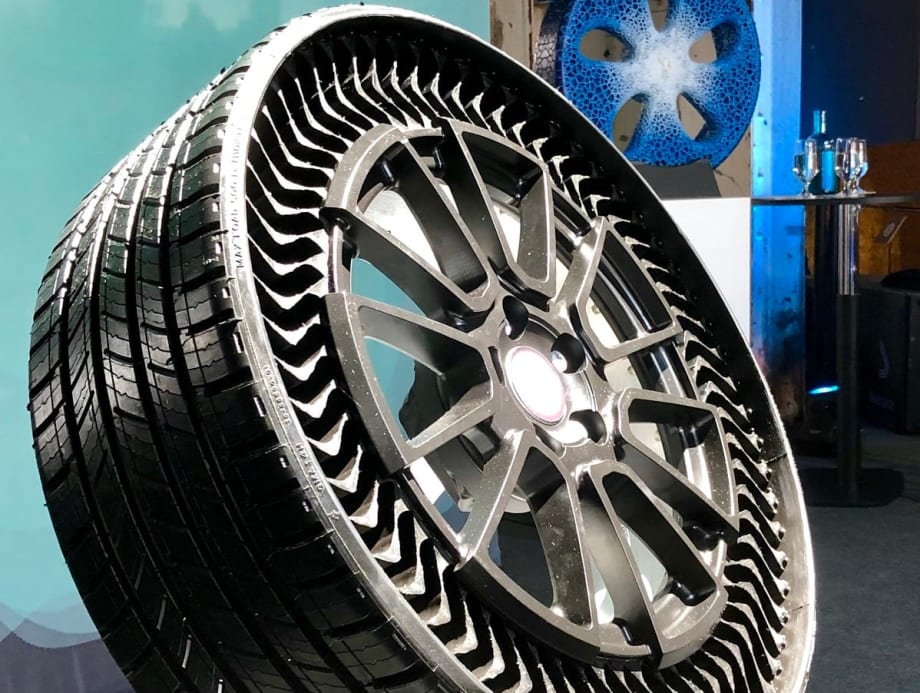
Michelin's Executive Vice President Laurent Bourrut describe's how the company's UPTIS airless tire concept is the culmination of the company's vision for a sustainable future.
Photo: David Cullen
3 min to read
Laurent Bourrut is clearly focused on the future of tires.
As the Michelin’s executive vice-president – long distance and urban transportation business lines, and a member of the tiremaker’s group executive committee, it’s his job. But the future of tires involves more than tracking sales trends. Michelin is exploring ideas that could radically transform the rolling rubber.
Picture tires made with sustainable materials, running without air, replenishing treads with 3D printers, and sharing information over the Internet of Things.
Those ideas all came together in 2017 in the form of the Vision concept tire, and some of the underlying concepts are already on a path to reality. During the recent Movin’On summit on sustainability, Michelin unveiled the UPTIS (Unique Puncture-Proof Tire System) that will enter production as early as 2024 through a partnership with General Motors.
Rather than filling a chamber with air, the UPTIS features a series of open ribs around the circumference of the wheel. The structure itself is made possible through new materials such as enhanced rubber compounds and a resin-embedded fiberglass.
“We are focused on passenger car, second stage maybe vans and light trucks,” Bourrat said of the initial UPTIS applications, in an exclusive interview with Today’s Trucking and Transport Routier. Similar models for heavy trucks aren’t on the horizon. Not yet.
It’s an approach that could theoretically deliver benefits in the form of uptime and reduced waste.
“This is good for the planet,” he said. “Twenty percent of the tires never meet their end of life [because of premature failures]. That means 200 million tires per year. This is about 2 million tonnes of raw material.”
The tires themselves aren’t the only thing to change. Michelin is also rethinking the way fleets might purchase tires – approaching them almost like a service rather than a product.
“We do not sell rubber, we sell kilometers,” Bourrat said. “This is well-installed in Europe, in major countries, and this is also progressing step by step in North America.”
The approach undeniably requires a close focus on tire management, maximizing the distance that can be traveled on every tire that’s installed.
“We have specific competencies, personnel to do so in each location of each fleet, so this is very sophisticated,” he said.
Dealing with the telematics data that can be generated by a tire is a perfect example.
“Telematics is a basic layer. You get the data, you cleanse the data, you go through algorithms, and at the end you get the predictive analytics – getting to the predictive maintenance, optimizing your tire, your maintenance costs, your maintenance structure,” he said. “This is really where we’ve already invested and are going to invest.”
“More than 80% of our tires are equipped with RFID already, so we are entering now in the Internet of Things.”
And with the right insights, fleets would be able to focus their attention elsewhere.
There are clearly obstacles to overcome, not the least of which is traditional business habits. “With such telematics, predictive analytics, predictive maintenance, you need different competencies at the fleet level,” he said. “We need to evolve in this field, bringing fresh competencies.”
These are clearly some blue-sky concepts, but that was the whole idea behind the annual Movin’On summit, which Michelin has supported as a leading sponsor.
“We are really focusing on sustainability,” Bourrat said, adding that isn’t only about building a sustainable business model. “We also need to be sustainable environment-wise because this is in our DNA.”
The company was experimenting with green tires as early as the 1990s, when it began replacing carbon black with silica, improving rolling resistance in the process. And they’re the type of things that continue to separate Michelin from the suppliers of value-priced brands, he said.
“We bring competence, we bring sustainability, and we are respectful of the planet and the people. This is why we are different.”
John G. Smith is the editor of the award-winning Canadian publication Today's Trucking. This article was used under a cooperative editorial sharing agreement between HDT and its Canadian counterpart.
Subscribe to Our Newsletter
More Fuel Smarts

How Volvo Updated Its D13 for EPA 2027 [Watch]
Volvo’s updated D13 promises lower emissions without sacrificing performance or fuel economy. Take a closer look at what changed inside the engine in this HDT Spotlight video.
Read More →
Diesel Price Spike Shortens Payback for Natural Gas Trucks, Report Says
Energy Vision estimates fleets could recover the higher purchase price of an RNG-fueled Class 8 tractor in 1.3 to 2.8 years under current fuel-price scenarios.
Read More →
Calstart Becomes Catalyst Mobility, Reflecting Broader Focus
Calstart is now Catalyst Mobility, reflecting the nonprofit’s growing national role in clean transportation, including zero-emission trucks, infrastructure and incentive programs.
Read More →

Record Diesel Prices Squeeze Trucking Fleets
Average U.S. diesel prices have climbed to nearly $6 a gallon, surpassing the 2022 record as tight refinery capacity and Middle East disruptions keep fuel costs elevated.
Read More →
Sponsored•September 9, 2026
How Fuel Delivery Shapes Engine Performance
Fuel delivery depends on more than what happens at the injector. For fleet, maintenance and technical professionals, looking at the full path from pump to injector can provide useful context for understanding engine performance.
Read More →
East Coast Port Launches $45M Electric Truck Push
The Port Authority of New York and New Jersey announced millions in incentives for zero-emission drayage trucks, yard tractors, and new charging hubs near the port.
Read More →
California Bill Could Shed Light on Electric Truck Prices
Why do battery-electric Class 8 trucks remain so expensive? A California bill headed to Gov. Gavin Newsom would give fleets and state agencies more visibility into what manufacturers charge.
Read More →
Detroit Opens Orders for EPA 2027 Engines
Detroit isn’t starting from scratch to meet EPA 2027 diesel emissions standards. Its Gen 6 DD13 and DD15 engines keep much of today’s platform while updating the fuel and aftertreatment systems.
Read More →
Zero-Emission Truck Corridor Planned for West Coast
California, Oregon, Washington, British Columbia and Baja California are coordinating plans for truck charging and hydrogen fueling from Canada to Mexico.
Read More →
A Closer Look at Kenworth’s Electric T880E Vocational Truck [Video]
Learn more about Kenworth's T880E battery-electric vocational truck at the Paccar Technical Center, including its range, applications, upfitting considerations, and PTO options, in this HDT Spotlight video.
Read More →