





Related: Amazon Competition May Affect 3PLs More Than Parcel Carriers
How is the Growth of E-Commerce Affecting Trucking?
Some of the issues of most concern to the industry, such as the driver shortage, hours of service, and truck parking, are affected by the growth of e-commerce and omni-channel marketing. A new study by the American Transportation Research Institute analyzes these impacts.
February 5, 2019
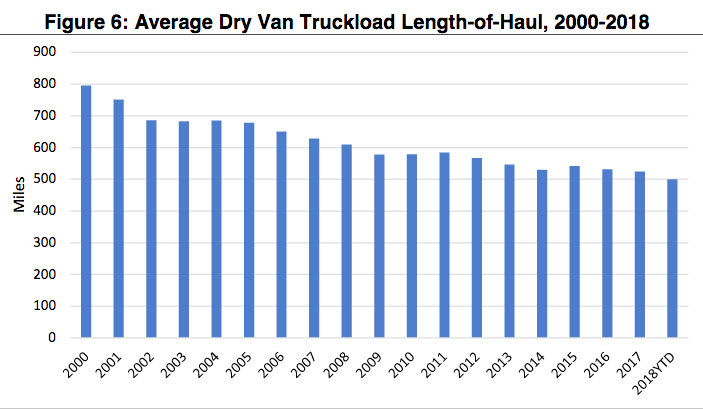
ATRI says e-commerce is one reason for the shortening of the average length of haul.
Graph: American Transportation Research Institute
5 min to read
Some of the issues of most concern to the industry, such as the driver shortage, hours of service, and truck parking, are affected by the growth of e-commerce and omni-channel marketing. The American Transportation Research Institute released an analysis of these impacts, including the challenges and opportunities posed by more regionalized retail supply chains and the proliferation of urban “last mile” deliveries have presented.
The growth of e-commerce
From 1999-2017, e-commerce sales increased from less than 1% of total U.S. retail sales to more than 9% – a 3,000% increase in e-commerce sales. Annual growth of e-commerce has ranged between 13 and 16% over the last five years, outpacing the 1% to 5% annual growth in traditional retail sales.
At the same time, we’ve seen the rise of the omni-channel model. Retailers are becoming more flexible in how they transact with consumers, decentralizing their distribution/fulfillment networks to bring inventory closer to consumers.
“Last Mile Fulfillment Centers” represented 73% of the industrial real estate market in 2017, a 15-percentage-point increase from the previous year.
What’s this doing to transportation and logistics? Some highlights from the study:
The number of intra-regional and last-mile truck trips has increased, while the average length of haul has declined. Average trip lengths have decreased 37% since 2000, while urban vehicle miles traveled have increased for much of this time period.
According to a study conducted by UPS, a majority (63%) of survey respondents indicated that delivery speed is important when searching for and selecting products. A push toward faster and more cost-effective shipping options has forced retailers and 3PLs to expand their distribution networks.
Several new regional distribution hubs are emerging, such as Cincinnati, Ohio, and Indianapolis, Indiana. These emerging geographical hubs are located within a few hours of major population centers, have access to significant transportation infrastructure like ports, airports, interstates, and rail, and have enough developable land to support large-scale distribution facilities.
Between 13% and 30% of all online orders result in the product being returned, compared to just 8% for in-store purchases. This means retailers are designing new approaches for efficiently handling the reverse logistics of returning items back through the distribution system.
Given the complexity of e-commerce, many firms are now altering their inventory management practices, with many adopting or testing just-in-time (JIT) inventory principles.
Delivery windows continue to compress as retailers build out their omni-channel retailing capabilities. Walmart, for instance, raised the minimum threshold of on-time deliveries imposed on its suppliers, and will fine suppliers who fail to consistently deliver orders within a specified one- or two-day window. Motor carriers must now operate with faster turnaround times, and contend with external factors such as weather, traffic congestion, and warehouse delays.
Outsourcing is one way retailers are expanding their e-commerce delivery networks, so third-party logistics companies are expanding their own operations and networks to meet growing e-commerce requirements. For example, in just five years, XPO Logistics has grown from a non-asset truck brokerage company grossing $175 million in revenues into the largest logistics provider in North America with annual revenues exceeding $15 billion.
As more motor carriers enter the “last mile,” many are expanding their operations into “white glove” deliveries of large and bulky items like furniture and home appliances. A number of large motor carriers, such as Schneider National and J.B. Hunt, as well as 3PL providers like XPO Logistics, are engaging with retailers to not only deliver these items to residences, but to also provide value-added services such as installation, product assembly, and repairs.
Effects on Trucking’s Top Issues
Since 2005, ATRI has conducted an annual survey to identify the critical issues affecting the trucking industry, so it looked at the effects of e-commerce on some of those top issues.
Driver shortage: Intrastate and local hauls for e-commerce could serve as a training opportunity for 18- to 20-year-old drivers, representing a huge new pool of potential interstate CDL drivers.
Hours of service and mandatory electronic logging devices: Under federal HOS regulations, drivers engaged in short haul operations are not required to log their hours if they fall under the 100 air-mile radius exemption. More drivers are shifting to these locally oriented positions, ATRI says, allowing them to operate under the more flexible HOS regulations stipulated by the federal exemption.
Driver retention: The e-commerce and omni-channel transportation preference for the shorter-haul LTL sector helps grows demand for the type of jobs that many truck drivers prefer, where they have more opportunities to spend time with family and friends. These lifestyle differences give LTL carriers an advantage in attracting new drivers to the industry and retaining their existing pool of drivers. One potential downside, however, is that this trend may lure drivers away from the truckload sector, making its longstanding retention issues worse.
Truck parking: The growing scarcity of private and public truck parking options is well documented. For local pick-up and delivery drivers, the truck parking issue is focused more on insufficient load/unload zones for drivers attempting to complete deliveries in urban areas. Cities were not designed with the growing volume of package deliveries in mind. One of ATRI’s top research priorities, in fact, is “Urban Planning and Smart City Design for Trucks.”
Changing Equipment
As the trucking industry evolves to accommodate omni-channel retailing, both in terms of shorter trip lengths and the types of products being shipped, we’re also seeing the type of trucks purchased changing, ATRI notes. This is particularly true in the “last mile.” Registrations for single-unit trucks increased by 7.8% between 2007 and 2016, compared to 4.4% growth in combination truck registrations.
Both motor carriers and equipment manufacturers are experimenting with a variety of new technologies to address the challenges created by urban package deliveries, including drones, delivery robots, and smart cargo compartments, and even autonomous delivery vans.
Nearer term, expanded use of electric vehicles seems to be a natural extension of alternative energy-based e-commerce deliveries, ATRI notes, as part of efforts to address issues such as air quality and noise pollution.
You can download a copy of this report at www.truckingresearch.org.
More Fleet Management

Nomination Deadline Extended for HDT Emerging Leaders
Just a few more days to nominate accomplished trucking fleet professionals under 40 who are making an impact and helping lead the industry forward for the HDT Emerging Leaders award. Deadline extended to October 20!
Read More →
What Will ATA’s New Leader Bring to Trucking's Table?
Incoming President and CEO Mark Colson’s record in Alabama offers clues about his priorities and approach following Chris Spear’s abrupt departure as the head of the American Trucking Associations.
Read More →
Volvo, Waabi Start Commercial Autonomous Operations in Texas
Volvo VNL Autonomous trucks, powered by the Waabi Driver, are hauling freight directly to third-party facilities for a customer in Texas.
Read More →
Samsara Launches Custom AI Agent Builder
Agent Studio lets fleets create AI tools for hours-of-service monitoring, reporting and driver support, including agents that communicate by phone.
Read More →
Einride Driverless Electric Trucks Begin Daily Freight Operations in Ohio
Two cabless electric trucks are hauling freight between EASE Logistics facilities in Marysville, Ohio, as part of a multi-state truck automation project.
Read More →
Geotab Links Fleet Card to Vehicle Data
The new card combines fuel discounts with telematics-based purchase controls. Geotab’s analysis also points to potential savings from choosing lower-priced fuel stops.
Read More →
How MFA Helps Protect Trucking Fleets
Multi-factor authentication adds protection when passwords are stolen. Here’s how it works and where fleets should start.
Read More →
How Better Freight Data Helps Trucking Teams Get Ahead of Disruption
Trucking and logistics teams have plenty of data. The problem is getting the right information in front of the right people soon enough to act. Better-connected data can help teams spot trouble earlier and make smarter decisions before small problems become big ones.
Read More →
Trimble: Taking Artificial Intelligence in Trucking Beyond Faster Tasks
At Insight 2026, Trimble executives argued that fleets may need to redesign workflows to get more from AI as it introduced new products and enhancements. AI’s value will depend on how fleets combine automation with their people's knowledge.
Read More →
Sponsored•September 28, 2026
Build a bulletproof fleet: Uniting ELDs and dash cams for total compliance
An ELD can prove compliance, but it cannot always prove what happened on the road. Discover how uniting accurate ELD data with AI-powered dash cam video can help your fleet strengthen compliance, defend against liability, protect drivers and reduce operational costs.
Read More →