





Related: Amazon Targets Parcel Fees with New Delivery Network
Amazon Competition May Affect 3PLs More Than Parcel Carriers
Amazon is the 800-pound gorilla in e-commerce retailing, but what is its impact on parcel carriers, less-than-truckload carriers, and the third-party logistics markets?
January 31, 2019
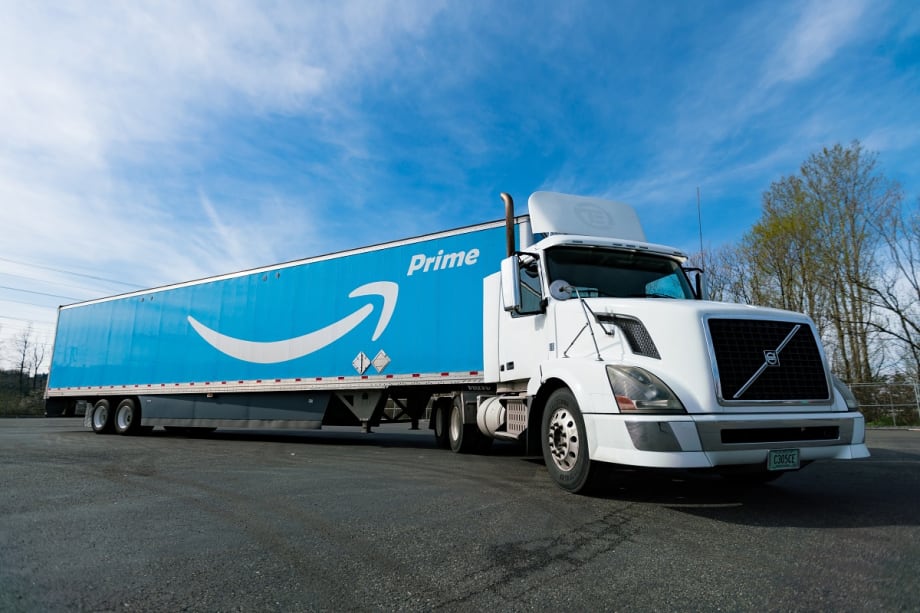
Amazon's online retail dominance is having a significant impact on parcel carriers, less-than-truckload carriers and the third-party logistics market.
Photo: Amazon
3 min to read
Amazon is the 800-pound gorilla in e-commerce retailing, but what is its impact on parcel carriers, less-than-truckload carriers, and the third-party logistics markets? Armstrong & Associates delves into that question in its latest report, Amazon Logistics Market Estimates, Benchmarking, and Predictions.
The first sector that may come to mind when talking about e-commerce is the parcel business, and indeed the report points out that e-commerce makes up about 30% of the North American parcel market. Armstrong estimates that Amazon (and Fulfillment by Amazon) accounts for 6.5% of total UPS revenue and 4.7% of FedEx revenue.
FedEx disputes the Armstrong estimate, telling HDT, "Amazon.com Inc. is not FedEx Corp.’s largest customer. The percentage of total FedEx revenue attributable to Amazon.com represented less than 1.3% of total FedEx revenue for the 12-month period ended Dec. 31, 2018."
E-commerce volumes have helped propel significant growth in revenue in the U.S. domestic package segment – profit growth, however, has been harder to come by. UPS and FedEx have been making significant investments in things such as network optimization and automation, adding new facilities and expanding existing ones.
Several reports have shown that Amazon is taking more control of its own last-mile delivery. It has a fleet of 4,000 trailers (some reports indicate up to 7,500 trailers) for transport between warehouses and fulfillment centers, the report notes. The company does not own tractors, instead handling transportation through truckload and LTL carrier partners, via 3PL partner capacity, parcel carriers, partnerships with last-mile delivery providers, or independent contractors using their own vehicles for last-mile delivery.
By the end of 2019, Armstrong reports, Amazon expects to have a fleet of 20,000 vans, owned by fleet-management companies, which then lease the vans to small delivery-service providers. The typical company under this scenario will employ 100 drivers and lease 20 to 40 branded vehicles.
Armstrong also points out that “taking control of the last mile also allows Amazon to expand delivery days and hours,” noting that FedEx just launched Saturday delivery, UPS is expanding its Saturday delivery to additional markets, and USPS already provides Sunday delivery for Amazon. “Amazon could push the envelope and put pressure on its competitors with its own delivery schedule.”
Amazon could go further, delivering not just to the door, but to inside the home, “crossing the threshold. “While indoor delivery historically was limited to white-glove-type deliveries, Amazon and others are pushing the envelope and seeking ways to add value to the customer (Walmart, for example, will put groceries in the refrigerator),” the report notes.
However, Armstrong believes the scenario of Amazon developing ground capabilities to rival UPS and FedEx “is very unlikely at this time.”
Amazon as 3PL
E-commerce makes up 7% of the U.S. third-party logistics market, and Armstrong points out that “Amazon is acting increasingly like a 3PL.” It estimates Amazon is acting like a 3PL for 12% of all business-to-consumer e-commerce shipments. Third-party sellers on Amazon’s marketplace represent more than half of all units sold through Amazon, and about half of those sellers use the company’s Fulfillment by Amazon program.
Armstrong expects this trend to continue, as third-party sales on Amazon’s marketplace continue to accelerate (including partnerships with big brands like Nike), and as it works on improving its third-party seller fulfillment and pass efficiencies along to those sellers – including continuing to raise the bar for fulfillment speed.
The company could be even more aggressive, Armstrong says, even extending its 3PL services beyond its own marketplace to multiple industries. This could involve acquisition of an existing 3PL.
The complete report and other A&A market research can be found at: https://www.3plogistics.com/product-category/guides-market-research-reports/.
Article updated 11:55 a.m. EST 2/1/2019 to add FedEx comment.
More Fleet Management

Sponsored•September 1, 2026
How Telematics Improves Visibility, Control, and Performance in Refrigerated Fleets
Explore how telematics help refrigerated fleets improve visibility, uptime, efficiency, compliance, and cargo protection across connected cold chain operations.
Read More →
What the U.S.-Canada Trade War Means for Trucking
Escalating U.S.-Canada tariffs could disrupt cross-border freight, reduce truck volumes, raise costs, and create new uncertainty for carriers on both sides of the border.
Read More →
What Are Trucking’s Top Concerns for 2026?
The American Transportation Research Institute wants to know what's worrying trucking fleet managers, drivers, and other stakeholders in its annual Industry Issues survey.
Read More →

American Trucking Associations Looks for a New Leader
ATA President and CEO Chris Spear abruptly left his job at the association on August 21, at a pivotal time for the trucking industry.
Read More →
Public Wi-Fi Cybersecurity Risks: How Truck Drivers and Fleets Can Protect Their Data
Public Wi-Fi can expose truck drivers and fleets to credential theft, malware, and other cyber threats. Here’s how to reduce the risk on the road.
Read More →
For Nicky Cupp, Fleet Innovation Starts With Frustration
HDT Truck Fleet Innovator Nicky Cupp turns everyday pain points at Fraley & Schilling into opportunities for better technology and smarter processes.
Read More →
Adam Buttgenbach’s Approach to Electric Trucks: Start With Where They Fit
HDT Truck Fleet Innovator Adam Buttgenbach helped PepsiCo build one of North America’s largest EV fleets by focusing on where electric trucks make operational sense.
Read More →
Deen Albert: Let Automation Do the Math, People Make the Decisions
HDT Truck Fleet Innovator Deen Albert makes sure people are still at the heart of operations at Grand Island Express, even while adopting artificial intelligence tools. AI-assisted dispatch helped boost revenue 25% with the same number of trucks.
Read More →
Trimble’s New AI Agent Takes Aim at Fleet Back-Office Busywork
Arc Agent works across Trimble TMS products to automate repetitive tasks such as freight orders, maintenance, invoices, fuel costs and more.
Read More →
How HDT’s 2026 Truck Fleet Innovators Are Rethinking Fleet Operations
Meet five trucking leaders who are challenging assumptions, solving operational problems, and putting innovative ideas to work.
Read More →