




Driving Mack’s Low-Ride Refuse Hauler
Mack’s LR model features high-powered, smart hydraulics and finely tuned details to help refuse fleets move trash fast.

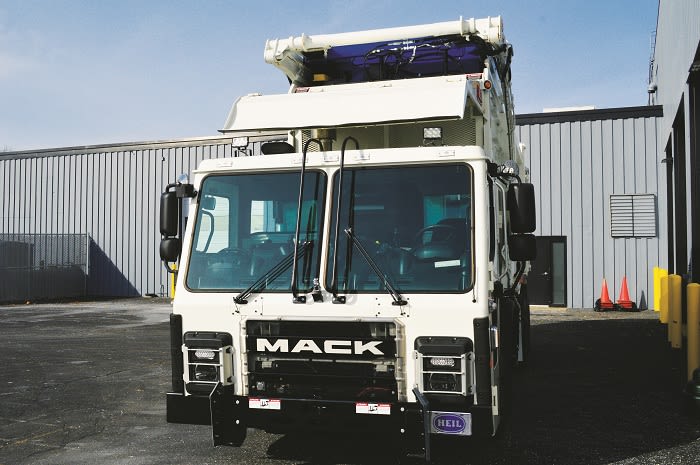
The LR cab features large front windscreen glass areas and channeling overhead to divert rain and wastewater away from windows and doors.
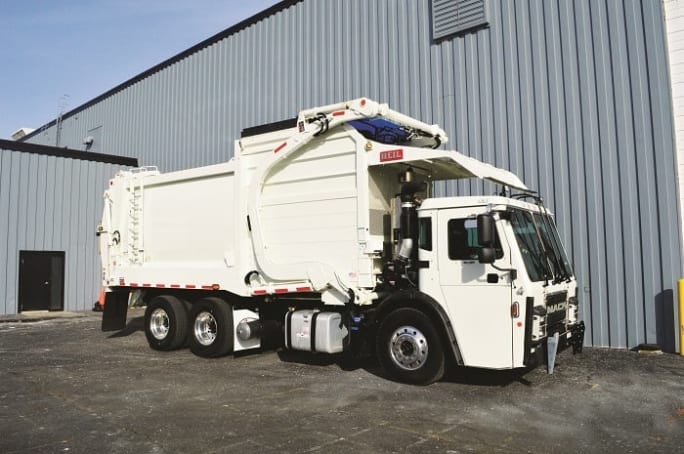
The new Mack LR features a performance-oriented design that is focused on refuse fleet details both big and small. Photos: Jack Roberts
Refuse is a grueling application for trucks, and the pressure is on to do more work with fewer workers and more powerful and capable equipment. These trends are behind many of the design points on Mack’s newest refuse truck, the Class 8 LR model.
The LR debuted at WasteExpo in 2015 and got some updates last fall. But for various reasons, no trucking journalist had been given the opportunity to examine the new truck up close and conduct a test drive — until Mack graciously offered HDT the opportunity to do just that.
The conditions on the ground weren’t perfect. A fast-moving snowstorm swamped Mack’s historical home in Pennsylvania’s Lehigh Valley, so I was dealing with snow, ice, and temperatures hovering in the low 20s. Vocational Brand Manager Curtis Dorwart noted that these were pretty typical conditions for refuse fleets in northern states and Canada, we still opted to do our walk-around and familiarization with the LR in a heated garage next to Mack’s impressive museum at its Customer Center in Macungie.
The Mack LR up close
Dorwart noted that the “LR” nomenclature simply stands for “Low Rider,” because keeping the vehicle low to the ground was a primary goal when Mack engineers went to work. Even with increasing numbers of partially automated, hydraulic side-boom trucks lifting and dumping trash bins, refuse drivers still climb in and out of their trucks multiple times a day. To that end, he said, the LR features an ultra-low ground clearance of just 15-1/2 inches, making it less arduous and safer for drivers to enter and exit the cab. This low vehicle height is combined with an array of different drive configurations, including a right-hand standup option, with the LR’s top speed limited to 20 mph when that station is in use.
The truck’s exterior design is remarkably clean, with no exposed wiring and protected hydraulic lines. Dorwart said simplifying wire and hydraulic line routing, with an emphasis on easier upfitting for the LR, is a big reason for the truck’s uncluttered look. Various nods to the tough life refuse trucks live were in evidence, as well, including wiper motors that can be serviced or swapped out from a standing position at the front of the truck by simply removing four screws, and a front grille and windshield that can be swapped out quickly. Up above the cab, the roofing sheet metal is designed to act much like a storm gutter on a house and route rain or refuse water away from the front and side windows and cab doors.
Both the left- and right-hand operating stations are compact, thanks to the massive doghouse that dominates the middle cab section, but still comfortable. Visibility to all quarters is outstanding thanks to large window sections to the sides and rear of the cab. Views forward are excellent as well, as Mack engineers enhanced the LR’s cab-forward (no hood) design by adding wrap-around front glass sections that extend in an unbroken line all the way back to the B pillars. Standard power, memory-programmable mirrors, and an array of cameras covering the sides and rear of the truck complete the LR’s visibility emphasis. An array of view screens is positioned in the middle of the cab, where operators on both sides of the truck can quickly check live video feeds from the safety cameras around the vehicle.
Dorwart also pointed out the LR’s automotive style controls, which include a surprisingly small steering wheel and an instrument cluster connected to the tilt steering column. The arrangement is compact, easy to see and ensures clear sightlines to the gauges regardless of where the driver positions the steering wheel. The doghouse covers both the LR engine and a powerful hydraulics system capable of handling the latest side-loading trash receptacle boom arms. Various boom and vehicle controls are located on the top of the doghouse and are within easy reach from both operator stations. Other new automotive-style features include a highly effective, in-dash HVAC system that easily kept the cab warm during the cold Pennsylvania test drive to come.
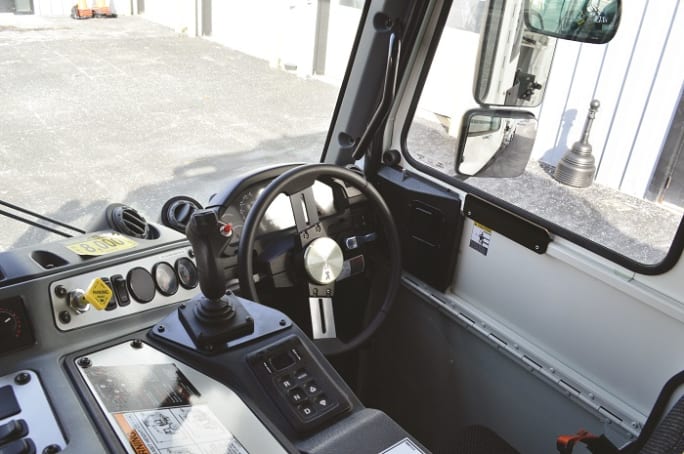
The LR can be driven from both the left and right cab positions. Vehicle speed is limited to 20 mph in the right-hand seat.
Taking the Mack LR on the road
Given the massive doghouse sitting immediately to my right, the LR was loud when I finally turned the key and fired up the Mack MP7 diesel lurking underneath. But this is to be expected in a cab-forward truck design like this one. And, it should be noted, Mack engineers did an excellent job at keeping powertrain, hydraulic system, and road noises at a minimum.
My test truck’s MP7 was rated at 355 hp and mated with an Allison 4500 automatic DRS 6-speed transmission. Underneath me were Mack axles and mRide suspension.
The truck is remarkably nimble and easy to drive at the slower speeds it will spend most of its working life running (although the MP7 engine responds beautifully and accelerates the truck nicely if you put your foot down).
Dorwart, who grew up in and around Allentown, suggested a nice cruise through a neighborhood and a typical subdivision, and the LR proved easy to handle in that environment. Given the expansive views from the cab, it was simple to spot and avoid common obstacles such as parked cars. And while it was too cold for pedestrians, the live video from the cameras around the truck gave me confidence I’d be able to pick them up and easily monitor them, as well.
A couple of runs into some tight cul-de-sacs showed off the LR’s tight turning radius, courtesy of the truck’s 45-degree wheel cut. The air disc brakes were a nice addition, as well, stopping the truck crisply and quickly with very light application of the brake pedal.
All in all, the LR is extremely well-mannered at residential speeds, which is a definite plus for any refuse truck.
Of course refuse trucks don’t live their entire lives at low speeds. So Dorwart and I took the LR out on I-78 over to Allentown and back. The truck was unloaded, so the ride was predictably bumpy. But the LR didn’t feel top-heavy at all, and didn’t wander around in the lane as some cab-forward designs are wont to do.
There weren’t many opportunities to get out of the right-hand lane and pass other vehicles. But the LR easily held its own at highway speeds, and the Mack MP7 had plenty of reserve power on hand when I did need to get around someone.
Mack has a pretty impressive share of the refuse market nationally, and Dorwart said response to the LR has been overwhelmingly positive since its debut. It’s not hard to see why. Mack engineers listened to refuse fleets, took note of emerging trends in that market segment, and delivered a thoroughly modern, detail-oriented design that will serve both the current and future needs of those customers well.
Mack LR Specs
Model: Mack LR Refuse Truck with left- and right-hand steer positions
Wheelbase: 186 inches
Engine: Mack MP-7 355A
Horsepower: 355 hp
Torque: 1,280 lb.-ft at 1,000 – 1,450 rpm
Transmission: Allison 4500-RDS-6 automatic (6 speed)
Engine brake: Mack PowerLeash
Front axles: Mack FXL20
Front axle rating: 20,000 lbs.
Rear suspension: Mack S246R
Rear suspension rating: 46,000 lbs.
Rear axle: Mack mRide
Rear axle ratio: 5:31
Brakes (front and rear): Meritor 17 inch. EX-Plus air disc
Related: Future Tech Gets Trashed
More Equipment

How Volvo Updated Its D13 for EPA 2027 [Watch]
Volvo’s updated D13 promises lower emissions without sacrificing performance or fuel economy. Take a closer look at what changed inside the engine in this HDT Spotlight video.
Read More →
Michelin Tire Improves Efficiency and Durability for Regional Fleets
The Michelin X Multi Energy D2 is a regional haul drive tire engineered to help fleets improve fuel efficiency, durability and traction in demanding stop-and-go operations.
Read More →
ZF Expands Commercial Vehicle Push in North America
ZF is expanding its North American commercial-vehicle presence with new transmission applications, electrification, trailer technology and autonomous-driving systems.
Read More →
Tesla Wants a Self-Driving Semi. Are Cameras Enough?
Could Tesla’s camera-only autonomous driving technology work on an 80,000-pound Semi? In this commentary, HDT's Deborah Lockridge takes a look at Tesla, Cybercab, and how autonomous trucks see the road.
Read More →
Kodiak: Driverless Long-Haul Truck Launch on Track for 2026
Kodiak AI says its driverless long-haul safety case is 93% complete and it remains on track to begin commercial operations by year-end 2026.
Read More →
What DOT’s Automated Vehicle Strategy Means for Trucking
The U.S. Department of Transportation issued a new automated-vehicle strategy that outlines plans for driverless-truck regulations, cross-state freight corridors, and federal safety standards.
Read More →
East Coast Port Launches $45M Electric Truck Push
The Port Authority of New York and New Jersey announced millions in incentives for zero-emission drayage trucks, yard tractors, and new charging hubs near the port.
Read More →
PlusAI Going Public to Fund Autonomous Truck Launch
A SPAC deal could provide PlusAI with up to $300 million as it works toward a 2027 commercial launch of factory-built autonomous trucks.
Read More →
NHTSA Moves to Rewrite Truck Fuel-Economy Rules
The National Highway Traffic Safety Administration says it lacks authority to regulate medium- and heavy-duty truck engines separately from complete vehicles, but the existing standards have not yet been eliminated.
Read More →
Detroit Opens Orders for EPA 2027 Engines
Detroit isn’t starting from scratch to meet EPA 2027 diesel emissions standards. Its Gen 6 DD13 and DD15 engines keep much of today’s platform while updating the fuel and aftertreatment systems.
Read More →