




4 Keys to Spec'ing the Right Liftgate for your Truck or Trailer
While the right liftgate can reduce operator fatigue and injuries, shorten delivery times and improve productivity, the wrong liftgate can open the door to a host of new problems.
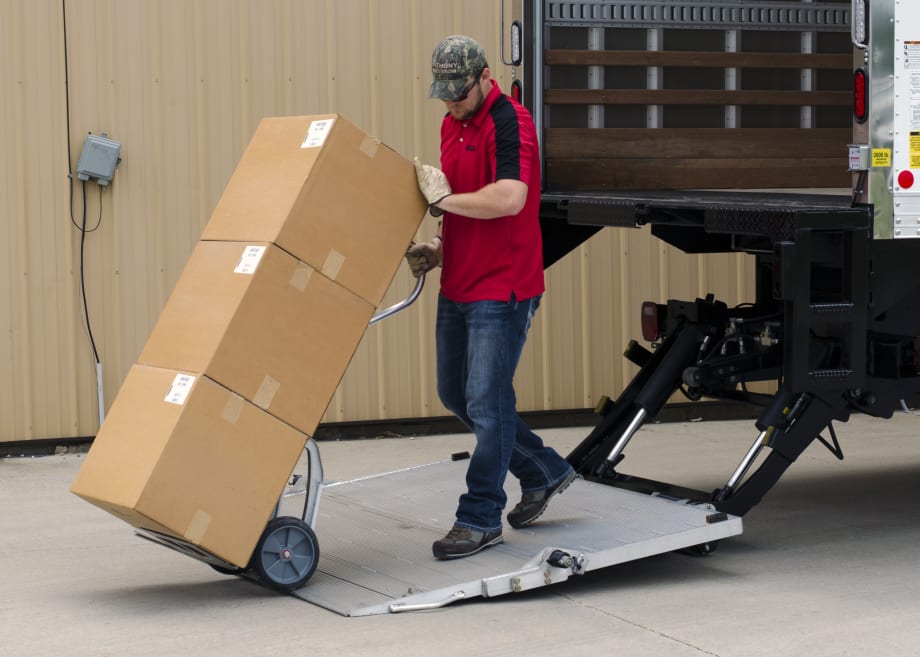
You need to understand your application and how it affects liftgate specs for your truck or trailer. Photo: Anthony Liftgates
You need to understand your application and how it affects liftgate specs for your truck or trailer.Photo: Anthony Liftgates
As liftgates become a more commonplace feature in today’s final mile delivery market, it’s essential that fleets spec the right liftgate from the get-go. For while the right liftgate can reduce operator fatigue and injuries, shorten delivery times and improve productivity, the wrong liftgate can open the door to a host of new problems.
With that in mind, what are the top considerations for fleet managers as they spec liftgates for the trucks in their fleet?
1. Start and end with the liftgate application
What is it that you want a liftgate to achieve? What cargo will you be handling? What are the dimensions of the cargo (length, width and height)? How heavy is it? The type of liftgate will vary greatly by what you’re delivering – there is a vast difference in size between a pallet of groceries and a refrigerator.
“If you deliver 2,000 pounds, and occasionally 3,500 pounds plus the weight of the driver, you don’t need a liftgate with a 6,000-pound capacity,” explains Kurt Walker, director of sales and marketing at Anthony Liftgates. But, he adds, do not forget to factor in the weight of the equipment used to move the product. A pallet jack, dolly or cart might increase capacity weights by anywhere from 100 to 1,000 pounds.
Anton Griessner, vice president of marketing and business development at Maxon Lift, provides a sample estimation to help fleet managers calculating weight:
Driver Weight: 250 pounds
+
Pallet Weight: 50 pounds
+
Pallet Jack Weight: 200 pounds
= 500 pounds (before product weight is added in)
It is also necessary to consider how the cargo will be secured. “Does it need to be secured with cart stops as you drive it out? Does the platform need to be horizontal all the time, all the way from the floor to the top because it’s high-top stuff, which would tip over when the platform would ramp to the ground?” asks Griessner.
The answers to these questions will impact platform choice. A level-ride platform, which stays level as it moves, is appropriate for top-heavy loads, as opposed to standard ride platforms, which tend to tip slightly as they approach the ground.
2. Go big
Get the largest liftgate the delivery vehicle can handle. The type of vehicle in use, be it a pickup truck, straight truck, van or tractor-trailer, drives the type and size of the liftgate. The vehicle width impacts the overall width of the liftgate as well as the platform sizes. Walker recommends buying the largest size the vehicle can handle because it provides greater delivery flexibility. “If you can buy a 50-inch platform, but there is a 60-inch available, it’s probably a good idea to get the larger one,” Walker says.
Griessner adds that the type of liftgate spec’d will vary by trailer and by truck. “There are specific models for specific types of vehicles,” he says, noting that smaller and medium-duty liftgates are not designed for the pounding a trailer can give them.
In addition, whether the vehicle body has a roll-up or swing door can also impact the type of liftgate. An application with a swing door might not be able to use a rail gate, for example. In addition, a straight truck with a swing door can be spec’d with different liftgates than a trailer with a swing door.
3. How low can you go?
Bed height is also a consideration, and Griessner says it must be considered from a laden (loaded) and unladen (unloaded) standpoint because a bed might drop up to 3 inches when it's loaded. “You need to ask what is the minimum and the maximum bed height that the liftgate needs to bridge,” he says.
4. Equipment lifecycle matters
Walker recommends fleet operators ask themselves how long they plan to run the equipment. If a fleet turns over its equipment quickly, keeping the lifecycle short, they may be able to get away with a less-expensive liftgate constructed of painted steel instead of galvanized metal. They also may be able to use a lighter-weight product.
“But if they are going to keep it awhile, they may want to consider options like galvanized finishes, dedicated ground aluminum platforms, cart stops, etc.,” Walker says.
The considerations listed above are far from comprehensive. Fleet managers should work with their liftgate operator to spec the right product for their unique situation. But the tips above will drive them closer to selecting the right liftgate for the job.
Ronnie Garrett is a freelance writer based in Fort Atkinson, Wisconsin, who writes about a variety of topics, including supply chain and logistics.
Related: HDT's 2017 Trailer Update
More Equipment

How Volvo Updated Its D13 for EPA 2027 [Watch]
Volvo’s updated D13 promises lower emissions without sacrificing performance or fuel economy. Take a closer look at what changed inside the engine in this HDT Spotlight video.
Read More →
Michelin Tire Improves Efficiency and Durability for Regional Fleets
The Michelin X Multi Energy D2 is a regional haul drive tire engineered to help fleets improve fuel efficiency, durability and traction in demanding stop-and-go operations.
Read More →
ZF Expands Commercial Vehicle Push in North America
ZF is expanding its North American commercial-vehicle presence with new transmission applications, electrification, trailer technology and autonomous-driving systems.
Read More →
Tesla Wants a Self-Driving Semi. Are Cameras Enough?
Could Tesla’s camera-only autonomous driving technology work on an 80,000-pound Semi? In this commentary, HDT's Deborah Lockridge takes a look at Tesla, Cybercab, and how autonomous trucks see the road.
Read More →
Kodiak: Driverless Long-Haul Truck Launch on Track for 2026
Kodiak AI says its driverless long-haul safety case is 93% complete and it remains on track to begin commercial operations by year-end 2026.
Read More →
What DOT’s Automated Vehicle Strategy Means for Trucking
The U.S. Department of Transportation issued a new automated-vehicle strategy that outlines plans for driverless-truck regulations, cross-state freight corridors, and federal safety standards.
Read More →
East Coast Port Launches $45M Electric Truck Push
The Port Authority of New York and New Jersey announced millions in incentives for zero-emission drayage trucks, yard tractors, and new charging hubs near the port.
Read More →
PlusAI Going Public to Fund Autonomous Truck Launch
A SPAC deal could provide PlusAI with up to $300 million as it works toward a 2027 commercial launch of factory-built autonomous trucks.
Read More →
NHTSA Moves to Rewrite Truck Fuel-Economy Rules
The National Highway Traffic Safety Administration says it lacks authority to regulate medium- and heavy-duty truck engines separately from complete vehicles, but the existing standards have not yet been eliminated.
Read More →
Detroit Opens Orders for EPA 2027 Engines
Detroit isn’t starting from scratch to meet EPA 2027 diesel emissions standards. Its Gen 6 DD13 and DD15 engines keep much of today’s platform while updating the fuel and aftertreatment systems.
Read More →