With the industry’s appetite for smaller-displacement engines on the rise, International’s new A26 is nicely sized, and well positioned to pick up a good chunk of the company’s truckload carrier business.
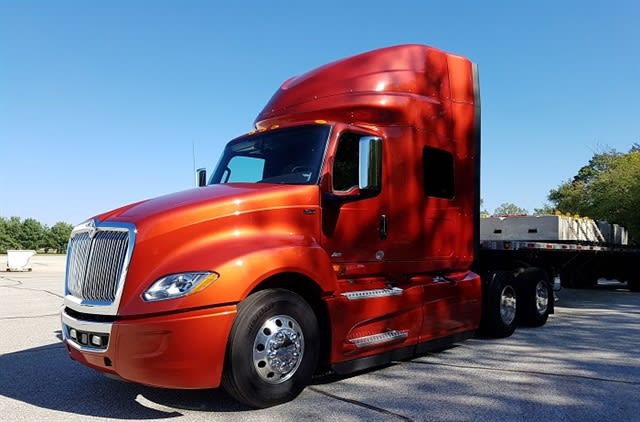
We drove the A26 engine in a 2018 International LT chassis.Photos: Jim Park
7 min to read
We drove the A26 engine in a 2018 International LT chassis.Photos: Jim Park
With the industry’s appetite for smaller-displacement engines on the rise, International’s new A26 is nicely sized, and well positioned to pick up a good chunk of the company’s truckload carrier business. At 12.4 liters, it’s a little under the 13L wire, but the A26’s torque and horsepower ratings put it squarely in the same medium-bore class. It’s a big performer in a lighter package, and that will earn it points in the bulk sector. The truckload folks will like its impressive fuel economy potential and extended maintenance intervals.
Ad Loading...
With most medium-bore engines coming in at around 12.8L, the A26 won’t have any competition in the lighter side of that segment until 2018 when Cummins debuts its 11.8L X12. That one will be targeted at regional haulers, while the A26 can easily step over the regional line into the long haul segment too. Some may think it a little light for long haul, but with a B10 design life of 1.2 million miles, the highway is obviously where it belongs.
The engine was unveiled in February, and I finally got a chance to drive one in October. My initial impressions are good ones. It’s a strong puller at low rpm, it’s quiet and smooth, and it seems relatively easy to maintain.
Ad Loading...
About the engine
International Product Development Manager Jim Nachtman says the A26 designation comes from an engineering project known internally as Project Alpha — “for a new start.” The number 26 is shorthand for the 126-mm diameter of the piston on the European MAN D26 engine, which is the base for this engine. The two share a block, crankcase and most rotating components.
Nachtman says special emphasis was placed on fuel efficiency and uptime right from the start of the A26 project.
“It’s up to 5% more fuel efficient than the N13,” he says, “and that’s before you add some of the customer options like predictive cruise control.”
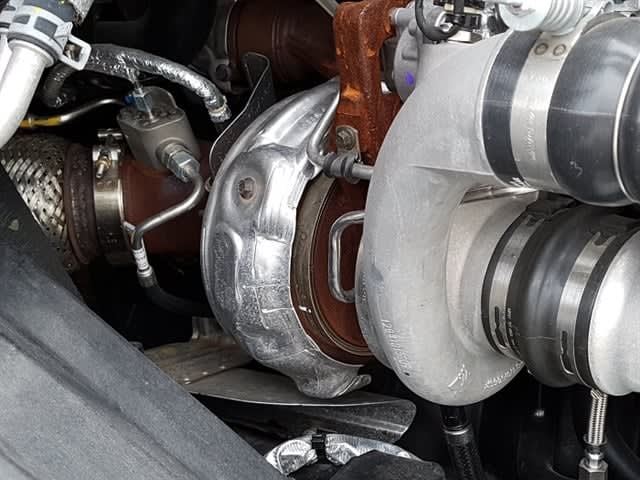
Those gains come from, among other things, improvements to the air handling system, which include switching from series turbochargers on the N13 to a single Borg Warner variable geometry turbocharger. The engine also uses a common rail fuel injection system with new injectors, new nozzles, and a new fuel pump that develops more than 36,000 psi. Ditching the series turbochargers allowed engineers to dispense with an associated low-temperature radiator. That reduced weight and complexity while providing better air flow through the main cooling module.
The new variable geometry turbocharger eliminates a cooler from the radiator cooling package, boosts transient responsiveness, and greatly improves engine brake output.
Much was done to ease parasitic loss and friction within the engine, such as using a cylinder head and cooling module with up to 50% less restriction for easier movement of fluids through the engine. That reduces the workload on various pumps, which in turn saves fuel and contributes to durability. The A26 in an over-the-road International LT chassis uses the same cooling module as the Cummins X15, providing more than enough heat rejection capability to greatly reduce fan-on time. That allowed engineers to use a six-blade fan rather than the common 11-blade model. That saves about 30 hp when running at 1700 rpm — and cuts out a whole lot of noise.
Ad Loading...
International also uses a low-friction coating on the piston skirts and low-friction piston rings. The standard factory fill is 10W-30 CK-4 oil, but the company offers an optional FA-4 factory fill for 0.7% better fuel economy, according to International’s tests. The A26 also has a thermostat bypass on the oil cooler, which helps warm the oil faster and get it flowing freely at low ambient temperatures.
Uptime — another word for reliability — was a big consideration during the design process. The A26 got several upgrades over the N13, including a stainless steel, laser-welded, single-stage exhaust gas recirculation cooler and beefier piston pins, connecting rods, and bushings. The VGT has a titanium compressor wheel for superior fatigue life, International says, and the Bosch fuel pump that drives the common rail fuel system has been tested for six years and has been in service since 2015 on the European 15L MAN D38 engine.
The A26 block is made of compacted graphite iron, like the N13. Several composite components adorn the engine, like the valve covers and the oil pan. To reduce weight, the flywheel housing is made of shot-peened aluminum.
On the maintenance side, Nachtman says, International will offer oil drain intervals of up to 70,000 miles with a sampling program. Diesel particulate filters won’t need to be cleaned until 600,000 miles or 11,000 hours for fleets achieving more than 6.5 mpg. That means most first owners of the engines will never have to touch their DPF.
The engine comes with a standard two-year warranty with unlimited miles, and an additional warranty is available up to four years.
Ad Loading...
Fuel economy estimates are always difficult to come by, save for a percentage claim, but Nachtman is throwing out a number based on pre-production testing of the A26 in an LT chassis.
“During evaluation on our 900-mile ‘Illinois/Kentucky hilly route,’ which is a 98% match with our typical on-highway customer route profile, with a 6x4 drivetrain at 60,000 GVW, we exceeded 8 mpg without the benefit of predictive cruise control,” he says.
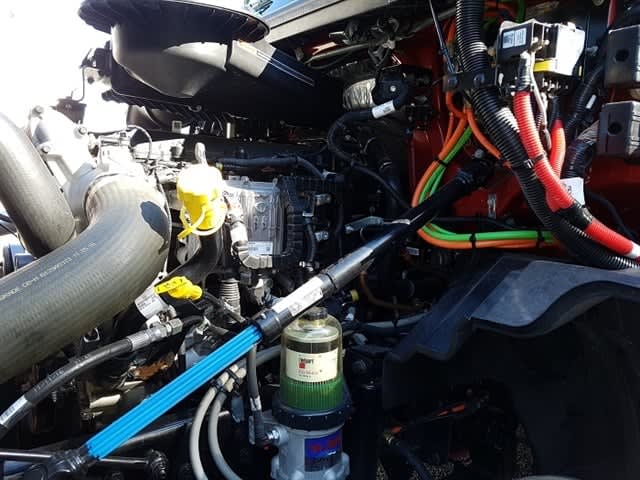
The left side of the engine places all the driver inspection points in just the right places.
On the road
The good A26 vibe started with the under-hood pre-trip inspection. While the engine is wedged in there pretty good, the driver inspection items were all easy to get to without climbing. The oil dipstick and filler pipe are front and center, and there’s little chance of pouring oil all over the engine while topping up the crankcase.
Once the engine was running, I have to say, it has a very solid sound to it. Deep and throaty, without the whiny gear train noise you hear on some engines. It’s quiet, too.
The A26 was mated to an Eaton Fuller Advantage 10-speed automated manual transmission, which does a pretty good job of keeping the engine revs down while traveling at low speed. I saw nice smooth shifts and a couple of skip-shifts too, which speaks to the integration between the engine and transmission and the calibrations decided upon by International and Eaton.
Ad Loading...
We left International’s proving grounds in New Carlisle, Indiana, and headed east on Hwy 20 toward South Bend. The speed limit was 50 mph, which might have been a problem for some powertrains, depending on the gear ratios, etc. Running at 55 mph I was in 10th gear at 1,025 rpm. That’s just 75 rpm above peak torque, yet the engine didn’t feel or sound bad at all like some do at really low rpm.
I dropped down to 50 mph and we downshifted to 9th gear (direct) and the revs bumped up to 1,250. That’s about center of the peak torque plateau and a very drivable engine speed. At 1,025, it feels solid but the responsiveness is a bit lacking. At 1,250 it’s sparklingly responsive, still plenty torquey, but you’ll be burning a little more juice. I could easily leave it in 10th gear on a flat road at 55, but at 50 mph, 9th was the better choice.
While driving through South Bend at 30 mph, I was in 8th gear and cruising at just 940 rpm. It was really quiet, and that will win you points with the locals, for sure. There’s no need to be running 1,500 or 1,700 rpm at that speed, like some transmission/engine combinations would.
Up at highway speed, 65 mph, the engine was running 1,175 rpm, which left 200 rpm to dig down into before the torque dropped off, and it’s still a very nice-feeling and fuel-efficient engine speed.
The new VGT turbocharger improves the engine’s retarding capability considerably compared to the N13 – by about 67% to be precise, at least according to my tour guide, Bill Distel, Navistar’s director of on-highway product marketing. The nozzle opens up and draws tons of air into the engine, largely overcoming the engine’s relatively small displacement. I was surprised by the engine brake’s performance from a 12.4L block.
Ad Loading...
Our 90-minute ride took us on some two-lane and some four-lane roads at speed ranging from 50 to 65 mph, and even a few 30-mph stretches. I found the level of cooperation between the engine and the transmission to be very high, and the driving experience (noise, harshness, awkward shifts, etc.) to be very pleasant. Engine noise was minimal in the LT cab.
The A26 seems to be following the trend in ratings, with relatively high torque compared to the horsepower rating. You didn’t see many 1,700 lb-ft engines rated at just 450 hp 10 years ago. But today, with the advanced aerodynamics and all the parasitic loss reduction, you really don’t need a lot of horsepower to maintain highway speed anymore. What you want is torque to make a downsped driveline work. The A26 is very nicely positioned to serve the regional and truckload sectors with their traditionally lighter loads of 50,000-70,000 lbs. GVW.
If I was running the mountains and pulling heavy (75,000-80,000 pounds) consistently, I think I would want something a little bigger. But fleets that know their operation is mostly on the lighter side will be well served by the A26.
Specifications
Technical Specifications: International A26
Type: Inline 6-cylinder, 4-cycle diesel, 4-valve, single overhead camshaft
Displacement: 12.4 L (758 cu. in.)
Bore & stroke: 4.96 in. & 6.54 in. (126 mm & 166 mm)
Compression ratio: 18.5:1
Aspiration: Variable geometry turbocharger w. charge air cooler
Combustion system: high-pressure common rail 2500 bar (36,260 psi)
Can trucking’s standard seven-way connector handle more cameras and trailer data? Grote’s Adam Slade shows HDT how the company is using new technology with its 4See trailer system, not only to add a new backup camera but also to expand other capabilities — without adding another connection.
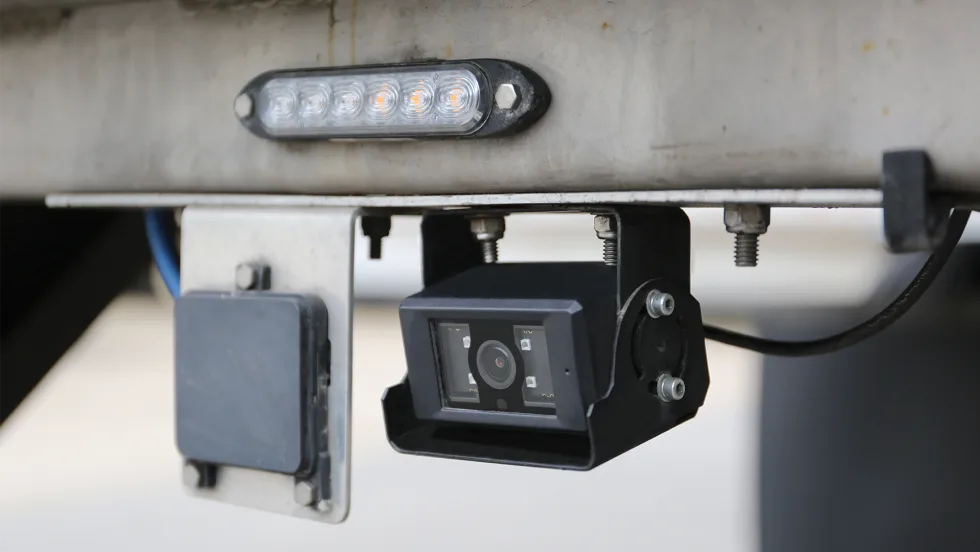
The next-generation 4See rear-view backup camera from Grote uses the standard seven-way connector and supports additional cameras and other trailer data.
From rigs decked out in patriotic America's 250 paint schemes to autonomous trucks and more, check out these photos from ATA's 2026 Management Conference & Exhibition.
Volvo Trucks has launched the VNX, a new vocational truck also available as a tractor in day cab and two sleeper configurations, with one heavy-haul model. The Volvo VNX is powered by Volvo's D13 platform, which delivers up to 540 horsepower and 1,950 pound-feet of torque and is EPA 2027-compliant.
What’s another tenth of a mile per gallon worth? GP Transco shares how equipment upgrades and driver coaching turn small gains into meaningful fuel savings.
Operating-cost savings have overtaken sustainability goals as the leading reason surveyed fleets are adopting battery-electric terminal tractors, according to new NACFE research.
Continental says its new Generation 5 steer and drive tires for regional operations offer longer tread life, with estimated mileage gains of 22% and 19%, respectively.