




Alignment and Balancing: Hassle, or Worth the Hustle?
There are three strong arguments in favor of a good tire alignment and balancing program, experts say: Fuel, tread life, and drivers.

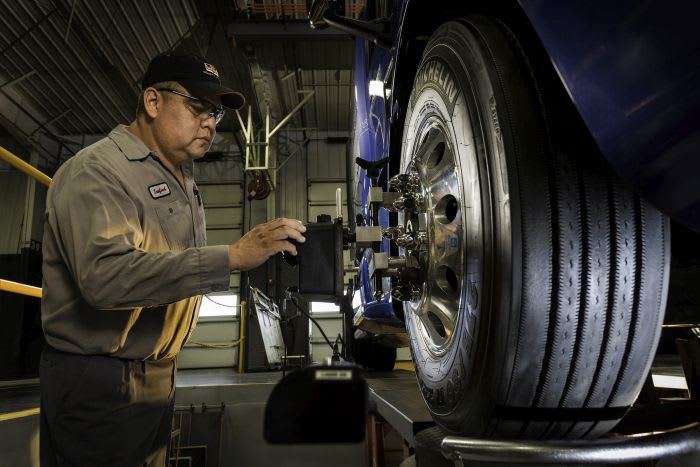
Many fleets dread the downtime. But according to Rush Truck Centers, front-end alignments can be done in as little as 90 minutes. Photo: Rush Truck Centers
Many fleets dread the downtime. But according to Rush Truck Centers, front-end alignments can be done in as little as 90 minutes. Photo: Rush Truck Centers
There are always trade-offs when it comes to maintenance practices, and tires are no different. In a perfect world, every fleet would take the time and spend the money to make sure its trucks’ tires were properly aligned and balanced. But trucks are heavy – and the kinetic forces that surge through a suspension after hitting one good pothole are many times stronger than anything a passenger car ever has to deal with. That one pothole can undo an alignment job in a split second. So why bother?
The same philosophy holds true for balancing tires: Every truck shakes and shimmies its way down the road to one degree or another. So unless that shimmy is really, really bad, why bother?
The counter-argument here is a pretty simple one: The biggest fleet expenses typically are drivers, tires, and fuel. If you’re having issues getting one or more of those costs under control, an alignment and/or tire balancing program might yield dividends.
Your fleet may want to invest in alignment equipment from companies such as Hunter or Bee Line to do your own alignments.
Victor Cummings, vice president, service operations, for mega-dealer group Rush Enterprises, says that often fleets don’t perform front-end alignments themselves. Instead, they take the truck to a service shop. This means it can be seen as an inconvenience to take the vehicle out of service. But, he says, fleets that do so enjoy some significant benefits.
“The biggest advantages to front-end alignments for heavy-duty vehicles include improved fuel economy and reduced tread wear, thus extending the life of your tires,” Cummings says. “Depending on the severity, a misalignment could also present a safety issue, so it is an important factor to consider.”
Tires and powertrains both like to run in nice, straight lines. A misalignment can adversely impact fuel economy by creating increased rolling resistance. Better fuel economy is achieved by reducing this resistance, Cummings notes, as well as longer tire life.
“A proper alignment job ensures the vehicle axles are set to factory specifications,” he explains. “Correct caster/camber and toe-in setting help extend tire life while reducing misalignment [that] can cause stress and increased wear on suspension components, which in turn can lead to poor ride quality. A vehicle that is misaligned can also be more difficult to operate, which can be stressful and fatiguing for the driver.”
Paul Crehan, director of product marketing for Michelin Americas Truck Tires, says alignment is an important part of keeping commercial vehicles properly maintained. “Alignment refers not only to the various angles of the steer axle geometry, but also to the tracking of all axles on a vehicle, including the trailer,” he says. “The dual purpose of proper alignment is to minimize tire wear and to maximize predictable vehicle handling and driver control.” Toe misalignment is the number one cause of steer tire irregular wear, he says, followed by rear axle skew (parallelism or thrust).
Application plays a big part in truck alignment, too, Cummings adds. The severity of the environment and the intensity of your operations have the largest impact on your trucks’ alignment. For example, refuse trucks driving on a wide variety of roads while constantly maneuvering in tight spaces may go out of alignment more frequently than a truck operating in a normal, on-highway environment. But even on-highway trucks are subjected to varying conditions that can lead to alignment issues. “Periodic checks and scheduled alignments should be viewed as a common preventive maintenance item for these reasons,” he notes.
Don’t overlook the trailer
Jon Jefferies, director of trailer OEM sales for Hendrickson, notes that even fleets that are proactive in aligning tractor tires often elect to overlook their trailers. “It is always recommended to do a full alignment on a trailer once a year,” he says. “One of the quickest checks which should be done on every trailer during each maintenance is an axle-to-axle alignment. This check requires very little tooling. Scrub from an axle to axle that is not parallel can quickly cause major tread wear and increase your maintenance costs.”
Jefferies says to use a trammel bar (straight and in good condition) to check the center of the hub on one side of the vehicle in relation to the hub on the opposite side of the vehicle, with a tolerance of no more than 1/16 of an inch, to ensure proper alignment.
Proper trailer axle/wheel alignment is critical to maximizing tire life, agrees Ted Armstrong, OEM technical support manager for trailer products at SAF-Holland. This is especially true with wide-base single tires. “The tread face of the radial tire reacts differently on wide-based tires so it is more susceptible to wear when not aligned properly,” Armstrong explains. “Achieving alignment with today’s sophisticated laser alignment equipment provides for a more accurate process than past methods for achieving alignment.”
In addition, he says, proper maintenance of suspension components is critical to maintaining proper alignment. “The importance of inspecting suspension components, bushings and fasteners during routine maintenance checks can’t be overlooked. Worn bushings on air ride suspensions are a leading cause of loss of initial manufacturer’s alignment. Ensuring proper torque on U-bolts and track bar/rods on mechanical suspensions during routine maintenance intervals is crucial as well.”
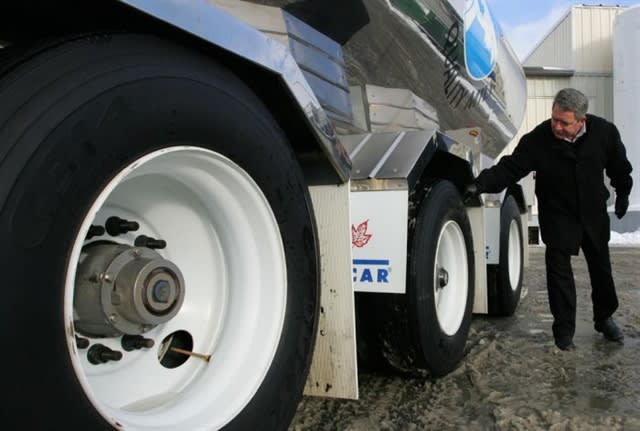
Your tires will tell the tale if they’re improperly balanced. Signs include chunking and scalloping created as the tire vibrates or hops while rolling down the road. Photo: Rush Truck Centers
Three balancing acts to consider
In addition to following recommended guidelines when mounting tires on wheels and installing tire and wheel assemblies on vehicles, fleets also can optimize tire life and enhance the driver experience by helping ensure their tires – particularly in the steer position — are balanced.
Evan Perrow, senior product marketing manager, Goodyear, also points out that balancing can help ensure long, even, tire wear, and can help minimize potential vibrations felt in the steering wheel, seat or cab.
“When discussing balancing, it’s also important to understand the concept of radial run-out, as well as the tire/wheel assembly balancing methods that are available,” Perrow adds. Radial run-out is the up-and-down movement of a tire or wheel assembly as it rotates. Minimizing radial run-out is vital to controlling vibration. Lateral run-out is side-to-side movement – but steer axles are typically more susceptible to run-out than the drive axle.
There are three balancing methods that should be understood as well, Perrow says: static, dynamic and on-vehicle. Static balancing is considered a “single plane target.” A technician will take a measurement of the heaviest point on the tire and then add a steel weight (if the tire is mounted on a steel wheel) or a stick-on weight (if the tire is mounted on an aluminum wheel). This is done to mitigate “hop,” which is the tire/wheel assembly’s up-and-down movement.
Static balancing requires fewer weights and is quicker to implement than the next method, dynamic balancing. In this method, a technician measures two planes – inside the wheel flange and outside the wheel flange – and then adds weights to both flanges. Dynamic balancing can help mitigate “hop,” in addition to “wobble” (movement from side to side).
“The third method,” Perrow says, “is on-vehicle balancing, which balances the tire/wheel assembly while it’s literally on the vehicle. This method is generally less prevalent than static and dynamic balancing.” Some providers of on-vehicle or continuous balancing include IMI’s Equal and Equal Flexx, Counteract Balancing Beads, and Centramatic’s wheel balancers.
When it comes to improving tire wear and preventing ride vibration, tire/wheel assembly balancing is a worthwhile corrective measure that can have real impact on tire longevity and driver comfort.
More Equipment

How Volvo Updated Its D13 for EPA 2027 [Watch]
Volvo’s updated D13 promises lower emissions without sacrificing performance or fuel economy. Take a closer look at what changed inside the engine in this HDT Spotlight video.
Read More →
Michelin Tire Improves Efficiency and Durability for Regional Fleets
The Michelin X Multi Energy D2 is a regional haul drive tire engineered to help fleets improve fuel efficiency, durability and traction in demanding stop-and-go operations.
Read More →
ZF Expands Commercial Vehicle Push in North America
ZF is expanding its North American commercial-vehicle presence with new transmission applications, electrification, trailer technology and autonomous-driving systems.
Read More →
Tesla Wants a Self-Driving Semi. Are Cameras Enough?
Could Tesla’s camera-only autonomous driving technology work on an 80,000-pound Semi? In this commentary, HDT's Deborah Lockridge takes a look at Tesla, Cybercab, and how autonomous trucks see the road.
Read More →
Kodiak: Driverless Long-Haul Truck Launch on Track for 2026
Kodiak AI says its driverless long-haul safety case is 93% complete and it remains on track to begin commercial operations by year-end 2026.
Read More →
What DOT’s Automated Vehicle Strategy Means for Trucking
The U.S. Department of Transportation issued a new automated-vehicle strategy that outlines plans for driverless-truck regulations, cross-state freight corridors, and federal safety standards.
Read More →
East Coast Port Launches $45M Electric Truck Push
The Port Authority of New York and New Jersey announced millions in incentives for zero-emission drayage trucks, yard tractors, and new charging hubs near the port.
Read More →
PlusAI Going Public to Fund Autonomous Truck Launch
A SPAC deal could provide PlusAI with up to $300 million as it works toward a 2027 commercial launch of factory-built autonomous trucks.
Read More →
NHTSA Moves to Rewrite Truck Fuel-Economy Rules
The National Highway Traffic Safety Administration says it lacks authority to regulate medium- and heavy-duty truck engines separately from complete vehicles, but the existing standards have not yet been eliminated.
Read More →
Detroit Opens Orders for EPA 2027 Engines
Detroit isn’t starting from scratch to meet EPA 2027 diesel emissions standards. Its Gen 6 DD13 and DD15 engines keep much of today’s platform while updating the fuel and aftertreatment systems.
Read More →