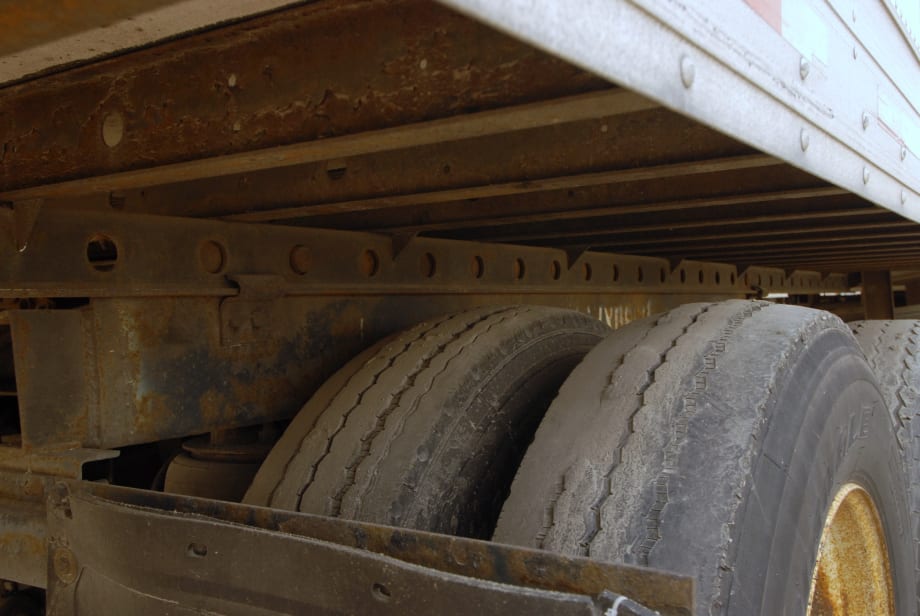
Tread wear is the most obvious defect-- and one that immediately catches an inspector's eye. Photo: Jim Park
6 min to read
Tread wear is the most obvious defect-- and one that immediately catches an inspector's eye. Photo: Jim Park
RoadCheck 2016 begins at 12:01 am Eastern time on Tuesday, June 7. The Commercial Vehicle Safety Alliance announced in April that inspectors will be paying close attention to tires. They will be measuring tire tread depth, checking tire pressure, checking to make sure that no items are lodged between dual tires, and examining the overall condition of the tire to make sure that no deep cuts or bulges exist in the sidewalls of the tire.
Ad Loading...
The good news is potential tire-condition violations are pretty easy to spot if you know what you're looking for.
The bad news is potential tire-condition violations are pretty easy to spot if you know what you're looking for — and your friendly neighborhood CVSA inspectors know what they are looking for. If you don't catch the problem first, you can be assured somebody wearing a badge riding on a creeper and toting a clipboard will.
Ad Loading...
There are more than a dozen tire-related violations noted in CVSA's Out-of-Service criteria handbook (available to order here), and a half-dozen or so that inspectors write citations for pretty regularly. Mostly these are tread-related, such as separations of tread from the casing, tread worn to the point the cord or belts are visible, and tread depth across two or more major grooves that doesn't meet minimum standards.
Air leaks are also a target, and they are pretty easy to detect. Improper repairs can be cited, along with tires that show visible signs of internal damage, such as bulges or deformities in the sidewalls, including cuts.
Tire inflation pressure with respect to an "underinflated" condition is no longer an out-of service issue. That was resolved following the submission of a petition by the American Trucking Associations requesting that the Federal Motor Carrier Safety Administration remove language relating to underinflation from the rule book.
CVSA, the ATA's Technology & Maintenance Council and an untold number of tire experts studied underinflation for more than a year, trying to come up with a definition of "underinflated" that would work across the board. As it turned out, the issue proved impossible to resolve and the wording was removed from the book.
However, a "flat" tire could still run you into problems. Any tire whose bead has separated from the wheel, or if the tire itself is in shredded ruins on the wheel, wil obviously be flat. Tires that appear "soft" or could be underinflated can still be measured, using a formula that calls for at least 50% of the maximum inflation pressure stamped on the tire's sidewall. Tires vary, but it's commonly 120 psi, so any tire with 60 psi or less would be deemed flat, cited, and placed out of service.
Ad Loading...
A new defect was added for 2016: Items lodged between tires of a dual set, which can include rocks, road debris etc., that are in direct contact with the tires' sidewalls.
It's worth noting that some tire violations will result in citations only while others could put the truck out of service until the defect is remedied.
Either way, you'll be out of pocket at least, or you could be down for a while waiting for the tire service truck and end up garnering a few CSA points. Clearly it's better to be proactive in this instance, but judging from the published results of previous inspections, many drivers and fleets apparently don't pay enough attention to their tires.
Here's a list of the top tire violations from previous inspection blitzes. Check your tires carefully to insure they don't meet any of these criteria:
Steer Tires
393.75(b) -- Less than 2/32 of tread depth when measured in any two adjacent major tread grooves (typically any groove containing a treadwear indicator) at any location on the tire. (Be careful not to measure the tread depth over top of a treadwear indicator or stone ejector as you will not get an accurate indication.)
Ad Loading...
393.75(a)(1) -- When any part of the belt material, breaker strip or casing play is showing through the tread.
393.75(a)(1) -- When the sidewall is cut, worn or damaged to the extent that steel or fabric ply cord is exposed.
393.75(a)(2) -- Visually observable lump, bulge or knot apparently related to tread or sidewall separation. EXCEPTION: a bulge (due to a repair) of up to 3/8 of an inch in height is allowed. This bulge may sometimes be identified by a blue colored triangular label in the immediate vicinity.
396.3(a)(1) -- Presence of rubber coated cord or cured rubber plug in the sidewall.
393.75(a)(3) -- A leak that can be heard of felt, or a tire which has 50% or less of the maximum inflation pressure marked on the tire sidewall. NOTE: Pressure will be measured only if there is evidence the tire is under inflated.
Ad Loading...
396.3(a)(1) -- Tires that come into contact with some other component on the truck at the time of inspection. NOTE: An out-of-service condition exists only if the tire can be made to contact the component at the time of inspection.
All Tires Other Than Steer Tires
393.75(a)(3) -- A leak that can be heard of felt, or has 50% or less of the maximum inflation pressure marked on the tire sidewall. NOTE: pressure will be measured only if there is evidence the tire is under-inflated.
393.75(a)(2) -- Visually observable lump, bulge or knot apparently related to tread or sidewall separation.
396.3(a)(1) -- Tires that come into contact with some other component on the truck at the time of inspection. This includes any tire contacting its mate in a dual set.
393.75(a)(2) -- Seventy-five percent (75%) or more of the tread width loose or missing in excess of 12 inches in circumference.
Ad Loading...
393.75(a)(1) -- Bias-ply tire: When more than one ply is exposed in the sidewall and the area exceeds 2 sq.in.
393.75(a)(1) -- Radial-ply tire: When more than one ply is exposed in the sidewall and the area exceeds 2 sq.in.
396.7(a) -- Any solid item lodged between a set of dual tires that is in direct contact with the sidewalls of the tires (excluding mud and snow).
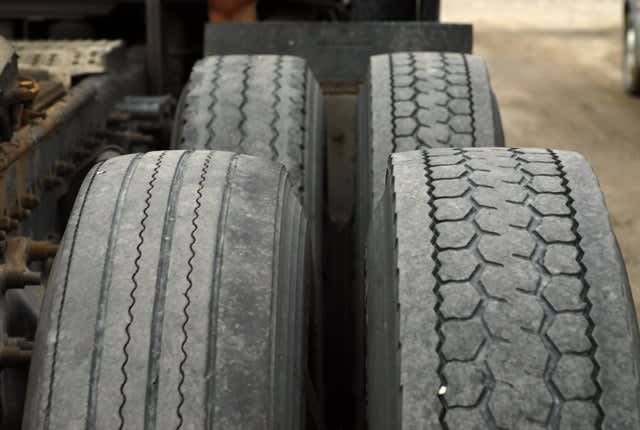
Mismatched tires are not an offence, but they will catch an inspector's eye and prompt a closer look. Photo: Jim Park
Tips For Avoiding Tire Violations
The Commercial Vehicle Safety Alliance has assembled a one-page tip sheet on how to avoid trouble at the scales with your tires. It's a basic, common-sense list that will serve you well year-round and help you keep your tires in good shape. It's available here.
Brian Buckham, general manager, product marketing, Goodyear, suggests fleets and drivers conduct regular visual/tactile inspections to check for cuts, cracks, blisters, bulges, and other issues.
Ad Loading...
"They should also be also looking for unusual wear patterns like cupping and feathering," he says. "If detected early enough, these patterns can be corrected to help extend tire life."
Over time, a regular alignment schedule can help prevent irregular tire wear, Buckham points out. "For 18-wheelers, a traditional front-end alignment isn’t always enough. Drive axles should be brought into alignment, too. A correctly aligned truck also can have a favorable impact on fuel consumption."
Mismatched tires can lead to many problems. For example, diameter differences larger than ¼-inch can create scrubbing patterns for the smaller of the two tires.
The single most effective practice that a fleet or driver can employ to impact tire wear, casing life, and overall performance is to maintain correct inflation pressure.
"Both over-inflation and under-inflation change a tire’s footprint, making it susceptible to irregular wear, possible loss of traction, and specifically in the case of under-inflation, excessive heat build-up," says Buckham. "Check inflation pressure levels at least once a week."
Fleets have more visibility into truck health, safety events, and driver activity than ever. The next challenge is turning all that information into useful guidance for the person who has to decide what to do next.
Federal regulators also are targeting more than 160 additional training providers and launching a nationwide audit of third-party CDL skills testers as part of a broader crackdown on trucking fraud.
Two pilot programs could eventually reshape hours-of-service rules, giving truck drivers options to pause their 14-hour clock or use longer split sleeper rest periods.
Medical-card violations jumped to the top of the driver out-of-service list during CVSA’s 2026 International Roadcheck, while English-language proficiency violations appeared among the leading violations for the first time.
New Teletrac Navman research suggests that onboarding, transparency about driver data, and positive feedback can play a significant role in how commercial drivers respond to safety and coaching technology.
By changing regulations on English-language proficiency requirements for commercial drivers, rather than relying on a guidance memo, the FMCSA said future administrations won't be able to walk back the Trump administration's stricter enforcement with just a memo.
The Freedom Haulers program pulls together existing and expanded programs at several federal agencies to recruit veterans to drive commercial heavy-duty trucks and cut the red tape for them to get a CDL, training, and employment.