




Hybrid Electric-Drive Trailer Tandem Promises Quick Payback
A hybrid electric-drive trailer tandem being developed by a group of engineers at Hyliion Inc. in Pittsburgh, Pa. The device, which for now has no official name, is undergoing road testing and should be ready for the market in mid-2017,


Hyliion founder Tom Healy poses with the first prototype of the hybrid system. The company is currently driving and testing a newer and more improved, third prototype. Photos: Hyliion

Hyliion founder Tom Healy poses with the first prototype of the hybrid system. The company is currently driving and testing a newer and more improved, third prototype.Photos: Hyliion
Hybrid trucks? Sure, though they’re somewhat complex and expensive, and interest has waned in the face of cheap fuel. Hybrid trailers? Comin’ up, and they’ll be comparatively simple and quicker to pay back their extra investment.
That’s the plan for a hybrid electric-drive trailer tandem being developed by a group of engineers at Hyliion Inc. in Pittsburgh, Pa. The device, which for now has no official name, is undergoing road testing and should be ready for the market in mid-2017, they say.
The system captures energy as a tractor-trailer runs downhill, and reapplies energy through a drive axle to help the truck run uphill. Operation is completely autonomous and, except for an on-off switch, the driver has nothing to do, explains Thomas Healy, the company’s founder and CEO. Electronic controls read road, terrain and speed conditions and try to keep a vehicle at a desired speed.
Healy has observed big rigs and wondered why their mass couldn’t be captured for reuse, like the hybrid electric car he now drives. Hyliion, the company’s name, means hybrid lithium ion, which is the type of battery that’s part of the system, says Robert Culbertson, the company’s marketing director. The firm started about a year ago to perfect the idea and market a product.
“We’ve been trying it out with different battery combinations and different motor combinations,” Culbertson says. “A lot of our supplies are going down in price, so it’s becoming cost-effective as well as environmentally beneficial.” The fuel savings is estimated at 21% for the electric-drive tandem alone. Trailer aerodynamics would save more.
The system would more than meet trailer targets in the proposed Phase 2 greenhouse-gas and fuel economy regulations, Healy says.
When its design is finalized, the product will be a complete tandem with axles and a suspension that would replace a trailer’s existing tandem. Three people at Hyliion have changed out a tandem in less than 30 minutes. He envisions trailer builders eventually offering the electric-drive tandem on new trailers.
The suspension can be mechanical or air-spring, and a sliding tandem is the first type planned. A suspension supplier is being discussed.
Included will be a fairing mounted ahead of the tandem to smooth air flow and protect electronic, electrical and mechanical components.
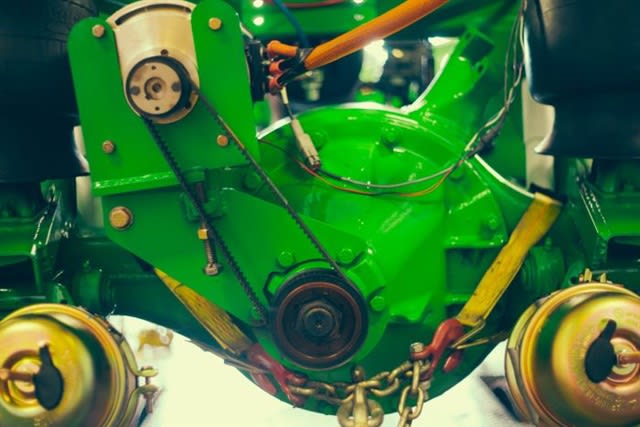
Prototype uses belt and pulleys to transfer power between axle differential and motor-generator mounted above. Production version will put the motor inside the diff where it will be gear-driven.
How it works
A truck drive axle with a differential, now sourced from Dana, substitutes for one of the standard trailer axles. A 300-hp Remy motor-generator transmits energy to a battery pack that nestles between the rails of the slider box. When power is needed, electricity is sent to the motor, and it propels the trailer through the axle diff and shafts to the wheels.
The prototype uses a belt and pulleys to transfer power between the differential and the motor-generator that’s mounted above. Production models will mount the motor within the differential so the motor is gear-driven.
“We’ve been working with Dana on determining differential gear ratios,” says Healy, a mechanical engineer. “We think there’d be one set for an operator who does pickup and delivery and another for highway use.”
Electronic controls use an algorithm to process data from wheel sensors and GPS monitoring, then determine what road speed should be maintained. Controls know when there’s wheel slip and alter the energy capture and power that’s applied. It works with the tandem’s anti-lock braking system to become electronic stability control, enhancing safety. Hyliion is working with Bendix on the ABS-related apparatus.
The hybrid-electric tandem weighs 400 to 500 pounds more than a standard tandem, but some of that would be offset by changing from dual wheels to wide-base singles, suggested a test driver whose testimonial is featured on the company’s website.

The craftsmen at Hyliion prepare a sliding suspension system for installation, a process which takes less than an hour.
An APU, too
In addition, energy captured in the battery pack can be tapped to run air conditioning and heating in a sleeper cab, Healy says. A reefer unit might also be powered from the batteries. For sleeper-cab HVAC, voltage would be stepped down from 400 to 110 by an inverter that’s part of the electronic controls. Depending on ambient temperatures, there would be 20 to 30 hours’ worth of power available.
Because the system doubles as an auxiliary power unit, federal law exempts 400 pounds from the 80,000-pound gross weight limit, so “the truck wouldn’t lose any payload,” Healy says. The APU function would take total fuel savings to about 31%.
Projected price for a complete tandem is $29,500, but the projected fuel and dollar savings would supply a payback in as little as six months, according to the company. A lease-purchase plan would cost $500 per month for five years, and monthly fuel savings would more than cover that.
“We’ve got this 80,000-pound vehicle moving around, so why can’t we get some energy out of it?” Culbertson says in recalling the idea that set development in motion. “The parts are pretty well tested, the motors, and it all works.”
More Fuel Smarts

How Volvo Updated Its D13 for EPA 2027 [Watch]
Volvo’s updated D13 promises lower emissions without sacrificing performance or fuel economy. Take a closer look at what changed inside the engine in this HDT Spotlight video.
Read More →
Diesel Price Spike Shortens Payback for Natural Gas Trucks, Report Says
Energy Vision estimates fleets could recover the higher purchase price of an RNG-fueled Class 8 tractor in 1.3 to 2.8 years under current fuel-price scenarios.
Read More →
Calstart Becomes Catalyst Mobility, Reflecting Broader Focus
Calstart is now Catalyst Mobility, reflecting the nonprofit’s growing national role in clean transportation, including zero-emission trucks, infrastructure and incentive programs.
Read More →

Record Diesel Prices Squeeze Trucking Fleets
Average U.S. diesel prices have climbed to nearly $6 a gallon, surpassing the 2022 record as tight refinery capacity and Middle East disruptions keep fuel costs elevated.
Read More →
How Fuel Delivery Shapes Engine Performance
Fuel delivery depends on more than what happens at the injector. For fleet, maintenance and technical professionals, looking at the full path from pump to injector can provide useful context for understanding engine performance.
Read More →
East Coast Port Launches $45M Electric Truck Push
The Port Authority of New York and New Jersey announced millions in incentives for zero-emission drayage trucks, yard tractors, and new charging hubs near the port.
Read More →
California Bill Could Shed Light on Electric Truck Prices
Why do battery-electric Class 8 trucks remain so expensive? A California bill headed to Gov. Gavin Newsom would give fleets and state agencies more visibility into what manufacturers charge.
Read More →
Detroit Opens Orders for EPA 2027 Engines
Detroit isn’t starting from scratch to meet EPA 2027 diesel emissions standards. Its Gen 6 DD13 and DD15 engines keep much of today’s platform while updating the fuel and aftertreatment systems.
Read More →
Zero-Emission Truck Corridor Planned for West Coast
California, Oregon, Washington, British Columbia and Baja California are coordinating plans for truck charging and hydrogen fueling from Canada to Mexico.
Read More →
A Closer Look at Kenworth’s Electric T880E Vocational Truck [Video]
Learn more about Kenworth's T880E battery-electric vocational truck at the Paccar Technical Center, including its range, applications, upfitting considerations, and PTO options, in this HDT Spotlight video.
Read More →