There's a new head of the committee developing the new heavy-duty engine oil classification, known as PC-11. HDT talked to Shawn Whitacre to find out what fleets need to know about the new oils.
Shawn Whitacre, senior staff engineer at Chevron. Photo courtesy Chevron.
7 min to read
Shawn Whitacre, senior staff engineer at Chevron. Photo courtesy Chevron.
There's a new head of the committee developing the new heavy-duty engine oil classification, known currently as PC-11 for proposed category 11. HDT talked to Shawn Whitacre to find out what fleets need to know about the new oils.
Whitacre, senior staff engineer at Chevron, succeeds colleague Jim McGeehan, Chevron consulting scientist, as the head of the Heavy-Duty Engine Oil Classification Panel for testing and standards organization ASTM. McGeehan had led the panel since 1987 but announced his retirement earlier this year. Whitacre has been active on the panel since 1996 and has represented not only Chevron but also Cummins. Plus he spent five years doing lubricant, fuel and emissions research for the Department of Energy's National Renewable Energy Lab.
Ad Loading...
HDT: Explain to our readers what this committee does.
Whitacre: Really there are two primary committees. One is the PC-11 new category development team. That is a group I'm also a participant in and it's generally responsible for all the technical and commercial elements for the new specification. My committee works closely with that one, but my committee is focused specifically on establishing the technical specification itself – the physical and chemical properties, the engine tests, the bench tests, and the limits associated with those tests. That's negotiated in an extensive process in the committee, which encompasses over 20 members, including oil makers, the additive companies that supply technology that helps us meet those specs, and the engine manufacturers themselves that requested the new category.
HDT: What's the status of the new category?
Whitacre: We're in a critical time right now because we're rapidly approaching final adoption of PC-11, which we hope to get finished in December of this year because that gives the industry one year to get ready. We will first license it starting in early December 2016. The milestone we are working toward in December is full approval of the specifications within the committee. Once it's approved for adoption as an ASTM spec, then that sets in motion a one-year waiting period that will allow API member organizations to get products ready for market and do the final technical development to make sure the products meet the specs.
HDT: That's a little behind the original schedule, isn't it?
Ad Loading...
Whitacre: I think when we first started discussing the category… initial discussions were focused on a first license date in the early part of 2016. But as various pieces started to mature it was obvious that meeting that deadline was no longer going to be practical. About a year ago we realized the more likely scenario would be March of 2017, but that was not going to meet the OEM requirements. They're trying to get these in the market before the 2017 GHG standards. We had a lot of discussions and converged on this December 2016 date as the right compromise between those of us who have to get these products ready and the needs of the OEMs and ultimately the end user.
Whitacre: That certainly is the one nuance to this category introduction that's different from those we've worked through previously. There will be a CK-4 backwards-compatible grade, which will keep the same viscosity limits that CJ-4 introduced. The transition to those products will be very transparent to the user. They will be marketed in all the same viscosity grades customers are used to seeing. It really just brings a performance improvement in oxidation stability, or the ability of the oil to stand up to higher temperature exposure.
But the new thing, the more complicated scenario, is this low viscosity fuel economy grade. Instead of calling it another "C," we're going to call it FA-4. Those products will not be backward compatible, because they are of lower viscosity than was previously allowed. But some engine makers will recommend those and first fill engines with them. The complicating factor will be to what extent those low viscosity oils can be used in older equipment.
HDT: So what happens if I'm a fleet running both older and newer equipment?
Ad Loading...
Whitacre: Understanding that mix and various OEM requirements will be key to figuring out what works best for their business and operations. Those who choose to do so can stick with the more conventional grades and upgrade pretty seamlessly. I don't think there will be a scenario that will require multiple products. If a fleet is looking to go to a common denominator, a suitable option would be to stick with a CK-4 conventional viscosity product that would be allowed in the entire fleet. I don't see a requirement from OEMs that they can only use the lower viscosity grade. This is something that's been playing out in the passenger car market for many years as well. You've got 0W-20 oils that some passenger car manufacturers recommend, but that's not necessarily the product customers choose to use. We know that fleets don't practically have the ability to carry multiple products.
HDT: What do you think trucking fleets need to know about PC-11? Are there common myths or misconceptions you run into?
Whitacre: I think the biggest misconception is that PC-11 only means low viscosity. There will be a backward-compatible grade within PC-11 that I think will continue to make up a sizable portion of the market for some time to come. They will be able to use CK-4, whether it be a 5W40 or 10W30, in all the same products and applications they do today. With fairly transparent results. Except there will be a performance boost in those products that will be driven to meet the needs of the most modern hardware. That's one big piece of the misconception, that people will think they need to avoid these products as a way to maintain older hardware.
The other thing that's still being discussed and isn't totally finalized is the two ways we're trying to differentiate the high and low viscosity subcategories. This has been a very important topic for the OEMs. There are certain OEMs, especially those who mainly market to off highway fleets, that will not be in a position to embrace FA-4, the low vis category. So they want to make sure the difference in the product is easily distinguishable.
The one thing we're certain of is there will be two distinct designations, C and F. The other thing that will likely happen is that products that meet the lower viscosity sub category will have an L behind the viscosity grade – 10W-30L for low viscosity, where the backward compatible grade will not include that L.
Ad Loading...
HDT: Where did the FA designation come from?
Whitacre: There were a lot of discussions. We didn't want to go just to the next letter D because it sounded too much like B. there's also some alignment with the approach being taken in the European oil classification system. They're doing something similar and using F as well. There's also some belief that it links up with "fuel economy."
HDT: What about this whole High-Temp/High-Shear test we've heard about that's a new spec?
Whitacre: In order for an oil to qualify for a given viscosity grade, there are four measurements that get made. Two at low temp, two at high. Only one is familiar to your readers, and that's kinematic viscosity. That's the one most often reported on oil analysis reports. But the other high-temp measurement is HTHS, and the reason we focused on that one is that there's been a tremendous amount of research done that shows that is the one measurement that is most highly correlated to fuel economy performance. And historically there has been a limit in our standard saying HTHS viscosity can be no lower than 3.5 centipoise. And that's sort of the paradigm we're breaking with this new category. In order to offer fuel economy improvements, research says you have to go lower in HTHS. That will be the essence of this new low viscosity category. The low-viscosity limit is between 2.9 and 3.2, and the conventional product will continue to be 3.5 or higher.
But at the end of the day those numbers aren't the ones the end user has to focus on. It will continue to be the viscosity grade designation they will need to focus on and understand whether they're using API CK-4 or FA-4 and whether there's an L associated with the viscosity grade or not.
Ad Loading...
HDT: Looking at the EPA/NHTSA regulations trying to reduce greenhouse gases by improving fuel economy in trucks, do you think you'll be doing this all over again in just a few years?
Whitacre: One of the things about these categories is the tests that make up the specifications don't live forever and don't always remain relevant. The prior category has been in place 10 years. The types of engines involved in those tests in some cases aren't even commercially marketed anymore. So as requirements change, as the availability of the hardware evolves, those are all the things that prompt a need for new categories. There's nothing official called PC-12, but there are a lot of reasons to believe that's on our horizon, either to meet new requirements or to update the category with new, more relevant hardware.
Fleetio’s analysis of 1.2 million commercial vehicles finds older assets driving outsized service spend, while most fleets remain cautious on AI adoption.
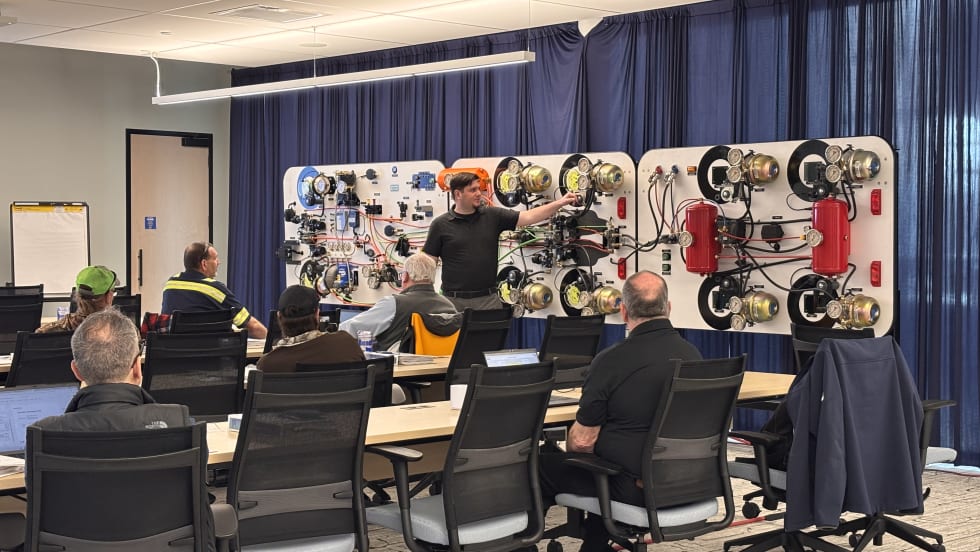
Bendix Commercial Vehicle Systems will roll out its 2026 technical training calendar with expanded access to its Advanced Technology Training program, alongside its long-running Air Brake Training course.
After reports of corrosion and thermal events on trucks already repaired under a prior campaign, DTNA is recalling nearly 27,000 Western Star 47X and 49X models to address a battery junction stud defect.
This white paper examines how advanced commercial vehicle diagnostics can significantly reduce fleet downtime as heavy duty vehicles become more complex. It shows how Autel’s CV diagnostic tools enable in-house troubleshooting, preventive maintenance, and faster repairs, helping fleets cut emissions-related downtime, reduce dealer dependence, and improve overall vehicle uptime and operating costs.
Brakes are the final frontier for telematics on Class 8 trucks. But Hendrickson is close to a breakthrough that could change the game in getting real-time brake system information back to fleets.
Phillips Industries’ new Cincinnati-area distribution center is now shipping aftermarket trucking parts nationwide, aiming to speed up delivery times for customers.
Cummins used Heavy Duty Aftermarket Week (HDAW) to introduce a new brake pad platform aimed squarely at one of the aftermarket’s biggest pain points: Complexity.