




Oil Viscosity: How Low Can You Go?
To meet expected greenhouse gas/fuel efficiency standards, oil companies and engine makers have been busy developing a new standard for engine oils that will provide a new type of lower-viscosity oil to improve engine efficiency.

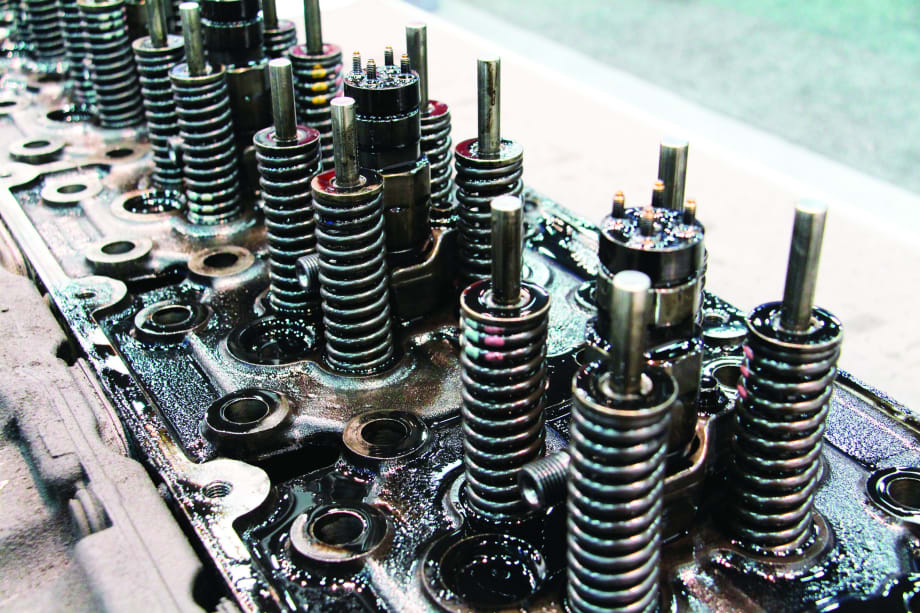
Chevron conducted a live teardown of a Detroit DD15 engine, with more than 400,000 miles of service using Delo 400 XLE 10W-30, during the Mid-America Trucking Show. Photo: Evan Lockridge
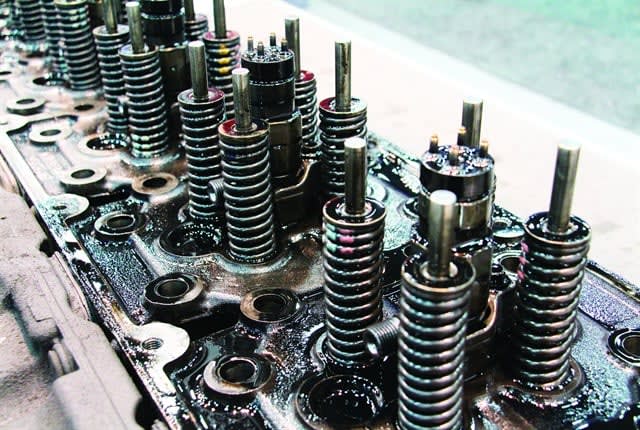
Chevron conducted a live teardown of a Detroit DD15 engine, with more than 400,000 miles of service using Delo 400 XLE 10W-30, during the Mid-America Trucking Show. Photo: Evan Lockridge
To meet the expected greenhouse gas/fuel efficiency standards the federal government is in the process of developing, oil companies and engine makers have been busy developing a new standard for engine oils that will provide a new type of lower-viscosity oil to improve engine efficiency.
The new API (American Petroleum Institute) category, being called PC-11 during the development process, will be the standard for a new generation of low-viscosity engine oils, which on-highway engine manufacturers will use as part of their EPA 2017 GHG reduction strategies.
Oils have changed a lot over the past 25 years to keep up with emissions technology, but it’s been a decade since the last time we had a new oil classification.
“The current CJ-4 standard has lasted well beyond the life of the typical engine category,” says Dan Arcy, global OEM technical manager for Shell Lubricants, who is heading up one of the API committees working on the new oil category. “Some of the engine tests are no longer available or no longer relevant. The types of hardware being used in engines has changed. We’ve gone to common rail injection systems; metallurgy has changed.”
While the new oil category will offer improvements in areas such as oxidation stability, aeration performance, scuffing/adhesive wear, and shear stability, one of the biggest changes is the viscosity change.
One of the unique things about this category is there will actually be two different sub-categories. In addition to the new low-viscosity oil for GHG/fuel economy, there will also be a higher-viscosity sub-category that’s backwards-compatible with older engines.
About Viscosity
John Loop, technology manager, engine oils, for Lubrizol, explains that viscosity is a measure of how things flow — “the degree to which a fluid resists flow under an applied force,” or “the power of resisting a change in the arrangement of the molecules.” A solid would have infinite viscosity, he says — a gas, very little.
For the new oil category, it’s not just a matter of using a lower-viscosity oil, but also one that will maintain its viscosity under high-temperature/high-shear, or HTHS, conditions.
HTHS is a different way of measuring viscosity than what you’re probably used to. Kinematic viscosity is what you might envision when thinking of viscosity — gravitational flow. Think of a row of beakers with different viscosity oils, tipped so they flow into a container. Lower-viscosity oils would flow faster than higher-viscosity oils. Obviously, you don’t want one that runs like water, but neither do you want one that falls out in a big gelatinous glob. This is what is being measured in the SAE viscosity grades you’re used to seeing, such as SAE 30 or SAE 40.
HTHS viscosity, on the other hand, is a measurement of a type of dynamic viscosity, which measures a fluid’s resistance to flow in the narrow confines between fast-moving parts, explains Shell technical expert Seung Min Yeo. This simulates an environment more like actual engine parts operation, where the oil is being flung around at high temperatures and the molecules in the oil are stressed — deformed, stretched, and even sheared.
Kinematic viscosity, which is measured by unit of centistoke, is measured at 100 degrees Celsius, or 212 degrees Fahrenheit. HTHS viscosity, which is calculated by a different unit of measure, centipoise (cP), is measured at a higher temperature — 150 degrees C (302 F) — and a pre-set shear rate.
For both types of measurements, lower numbers mean lower viscosity. The new category is expected to limit the HTHS viscosity range from 2.9 to 3.2 cP for the GHG version, while the non-GHG version will be at 3.5. Current CJ-4 oils run at a minimum of 3.5 cP, Arcy says, which is in the higher-viscosity end of the acceptable viscosity range to meet SAE 30. The new low-HTHS-viscosity oils will be more on the lower end of the viscosity range found in SAE 30 oils.
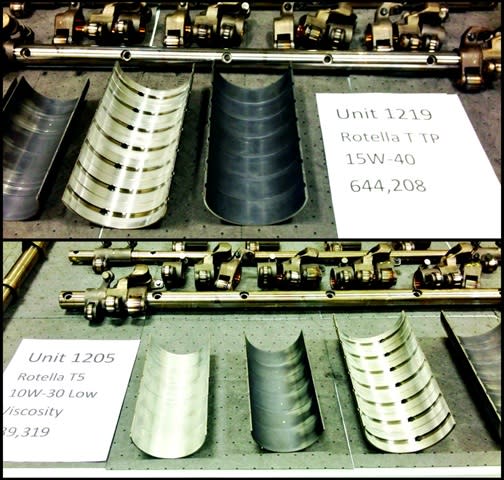
Shell field-tested an experimental low-HTHS-viscosity oil against a traditional 15w-40. Teardown results showed virtually no difference between the wear in these two engines. Photo: Deborah Lockridge
The New Oil Category
In order to be ready to meet the 2017 model year requirements, the new API category originally was scheduled to be in place by January 2016, but it is now looking like it won’t be ready until late 2016 or even January 2017, according to Arcy.
Jeremy Dean, supervisor, chemical technology and cleanliness laboratories for Daimler, says some of the possible concerns about lower-viscosity oils that need to be addressed in the new category, in addition to making sure overall wear rates are equivalent, include:
Scuff and seizure resistance of reciprocating and rotating components such as the cylinder kit, crankshaft, valve train, gear train, oil pump and air compressor.
Equivalent performance of engine seals (internal and external oil leaks).
The category will require oils to pass some 20 engine and bench tests to make sure they can protect engines. Some tests are carryover tests from the previous category. Others carry over but with stricter limits, and two are brand-new.
One of those is the Mack T-13 oxidation test. Oxidation is the chemical reaction that takes place when something is exposed to oxygen. It is accelerated by high temperatures, and the new engines are going to run about 10 degrees hotter. In fact, Arcy says, for every 10 degrees increase in temperature, you double the oxidation. Oxidation can lead to an increase in the oil’s viscosity, the formation of acidic compounds that could lead to corrosion, and deposits of varnish and sludge.
“Today’s oils, we believe, are borderline at best for the new engines in this area,” says Greg Shank, executive staff engineer, coordinator fluids technology, for Volvo Powertrain.
“The oxidation test is really going to be the defining test for the category,” says Shell’s Arcy. The new Mack T-13 test operates at 130 degrees C and at max power and torque. “This test is designed to destroy oils,” he says.
Another test that will probably be included is a Caterpillar test for aeration. The churning and splashing of oil in the engine can cause air to become entrained in the oil. Air is not a good lubricant, so the new test will measure the oil’s ability to release that air.
One test that was considered but was deemed not ready for the new category was a scuffing test, which measures for adhesive wear — the kind that happens when two metal surfaces actually make contact. Currently, oils are only subject to abrasive wear tests, the type you would get from particles in the oil. While the new category won’t have a test to measure for this, it’s possible some equipment manufacturers will include such a test for their specific engines.
The new category does not actually have any test to measure improved fuel economy.
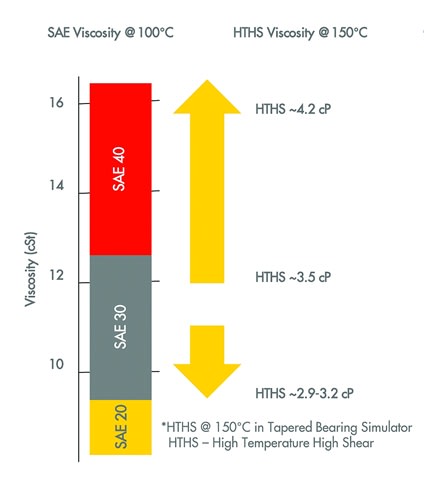
The future PC-11 fuel-efficient subcategory will come in at the lower end of the SAE 30 viscosity range, at 2.9-3.2 cP. The other subcategory, which will be backwards-compatible, will include oils on the higher-viscosity end of oils rated at SAE 30, up to the even thicker viscosities of SAE 40-weight oils. Graphic courtesy of Shell
Protecting the Engine
All this testing is designed to make sure the engine oils can protect the engine as they are supposed to, even with lower viscosity measurements.
“When a low-viscosity oil can demonstrate proven engine durability, the benefits of significant fuel savings while sustaining optimum engine life is achievable,” notes Mark Betner, heavy-duty lubricants manager at Citgo Lubricants. “However, emphasis needs to be placed on how the oil is formulated and tested. Just lowering the viscosity grade without providing a performance-enhancing additive technology could lead to higher engine wear and shortened engine life.”
“There’s a lot of talk about fuel economy, and rightfully so — but we’re also very cognizant that the engine is king,” says Barnaby Ngai of Petro-Canada, which makes Duron brand lubricants. “At the end of the day, you’re not going to save much money if the engine isn’t moving.”
Although we don’t know the exact specifications of the new oil category yet, both Chevron and Shell this year highlighted the protection possibilities of a lower-viscosity oil through engine teardown events.
Chevron conducted a live teardown of a Detroit DD15 engine, with more than 400,000 miles of service using Delo 400 XLE 10w-30, during the Mid-America Trucking Show in Louisville, Ky., in March.
“There’s a misconception that lighter viscosity oils don’t offer the same level of protection as heavier oils,” said Jim Gambill, Chevron’s North America commercial and industrial brands manager, at the show. “We’re here to dispel that myth.
“What we’re looking for is wear that can be seen in touch areas like the cam, cam lobes, and some of the bearing materials,” he explained, showing off the parts that were coming off the engine. “The wear was really good. We’re also looking for deposit control around the ring and piston; the rings were really clear. The crosshatching inside was fully intact — no sign of early wear there.”
In May, Shell shared with journalists its teardown resulting from a fleet field test comparing Shell Rotella 15w-40, 10w-30, and an experimental 10w-30 with viscosity properties similar to what is expected in the new category. The engines torn down for this inspection were 2011 model-year Detroit DD15 engines with about 550,000 miles on them.
Shell laid out the parts for inspection in the Clarke Power shop in Greensboro, N.C., and dared trucking journalists to tell the difference. They couldn’t.
Howard Hill, engineer, lubricant technology, who’s in charge of Shell’s field test program, noted that the highest iron wear rates they saw were about 100 ppm, and Detroit Diesel’s condemnation level is 250 ppm, so it was well under that condemnation level.
Both Chevron and Shell took particular note of the lack of any sludge buildup anywhere in the engines.
“We like how the oils are performing,” said Shell’s Hill. “We’re very, very pleased with the new technology, and it’s proven itself out with the engine inspections.”
More Fuel Smarts

How Volvo Updated Its D13 for EPA 2027 [Watch]
Volvo’s updated D13 promises lower emissions without sacrificing performance or fuel economy. Take a closer look at what changed inside the engine in this HDT Spotlight video.
Read More →
Diesel Price Spike Shortens Payback for Natural Gas Trucks, Report Says
Energy Vision estimates fleets could recover the higher purchase price of an RNG-fueled Class 8 tractor in 1.3 to 2.8 years under current fuel-price scenarios.
Read More →
Calstart Becomes Catalyst Mobility, Reflecting Broader Focus
Calstart is now Catalyst Mobility, reflecting the nonprofit’s growing national role in clean transportation, including zero-emission trucks, infrastructure and incentive programs.
Read More →

Record Diesel Prices Squeeze Trucking Fleets
Average U.S. diesel prices have climbed to nearly $6 a gallon, surpassing the 2022 record as tight refinery capacity and Middle East disruptions keep fuel costs elevated.
Read More →
How Fuel Delivery Shapes Engine Performance
Fuel delivery depends on more than what happens at the injector. For fleet, maintenance and technical professionals, looking at the full path from pump to injector can provide useful context for understanding engine performance.
Read More →
East Coast Port Launches $45M Electric Truck Push
The Port Authority of New York and New Jersey announced millions in incentives for zero-emission drayage trucks, yard tractors, and new charging hubs near the port.
Read More →
California Bill Could Shed Light on Electric Truck Prices
Why do battery-electric Class 8 trucks remain so expensive? A California bill headed to Gov. Gavin Newsom would give fleets and state agencies more visibility into what manufacturers charge.
Read More →
Detroit Opens Orders for EPA 2027 Engines
Detroit isn’t starting from scratch to meet EPA 2027 diesel emissions standards. Its Gen 6 DD13 and DD15 engines keep much of today’s platform while updating the fuel and aftertreatment systems.
Read More →
Zero-Emission Truck Corridor Planned for West Coast
California, Oregon, Washington, British Columbia and Baja California are coordinating plans for truck charging and hydrogen fueling from Canada to Mexico.
Read More →
A Closer Look at Kenworth’s Electric T880E Vocational Truck [Video]
Learn more about Kenworth's T880E battery-electric vocational truck at the Paccar Technical Center, including its range, applications, upfitting considerations, and PTO options, in this HDT Spotlight video.
Read More →